
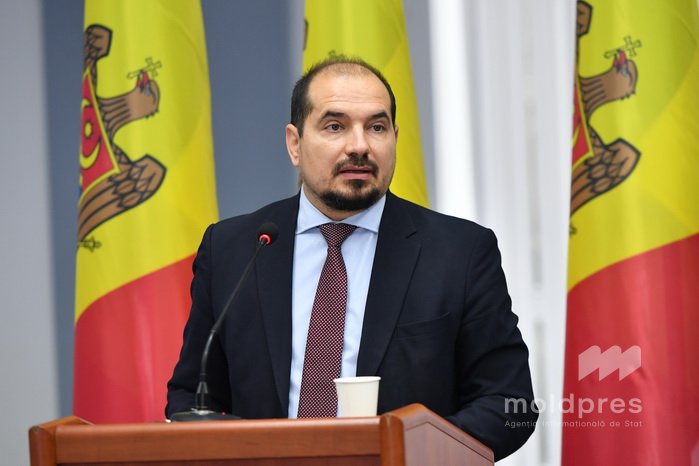
Concept of local public administration reform to be presented in late February–early March
The concept of local public administration reform will be presented in late February–early March. Subsequently, all the technical aspects of the reform will be finalized, and the draft legislation to be presented to Parliament this autumn session. Secretary General of the Government Alexei Buzu made the statements, noting that the purpose of this reform is to accelerate the development of localities.

“We are currently in the period in which we are conducting preliminary consultations. We want to have this exchange of views on a fundamental and significant change. In late February, early March, we will publish the reform concept with more details, after which, in June–July, we will finalize all technical aspects, so that we can come to Parliament in the autumn session with the entire legislative package, which also covers issues related to territorial‑administrative re‑dimensioning, financing of local public administration, and amending the Electoral Code,” said Buzu.

The Secretary General of the Government stressed that the reform initiated is a complicated one, but very necessary.

“The reform of local public administration is not only about drawing a new administrative map, it is also about the competences and structure of mayor’s offices—what they are supposed to do, including districts. So it is a much more complex reform and effort than just administrative‑territorial re‑dimensioning,” he explained.

According to the official, the central objective of the reform is to accelerate the development of localities and to bring services closer to citizens.

“What we want to do is precisely to accelerate the pace of development, and we must understand that the investments we have already made need to be maintained. Our citizens have higher expectations, they expect faster and deeper changes, and that is why we will try to do this. It is a complicated reform; it is no coincidence that until now no one has taken responsibility for this reform. But I believe there is consensus that the situation requires it and that the reform is necessary,” the official stated.

Alexei Buzu noted that there are currently over 300 mayor’s offices involved, at various stages, in the process of voluntary amalgamation. In this regard, the official said that the authorities will initiate a draft law aimed at simplifying the amalgamation process and providing new incentives for localities that choose to undergo this procedure.

In addition to the voluntary amalgamation process, there will also be normative amalgamation, which will be mandatory for those mayor’s offices that serve a certain population size. The exact threshold to be used will be determined through the ongoing consultations.

Alexei Buzu underlined that normative amalgamation is necessary, given that statistical data confirm that 60% of mayor’s offices in the Republic of Moldova manage local affairs for a population of fewer than 1,500 citizens. “We do not believe that, in the long term, such mayor’s offices will be able to manage services, projects and programs at the level of expectations of the citizens in those communities,” he specified.

“The way a mayor’s office is organized today, in 2026, when a new version of an artificial intelligence model appears once every three months, was created more than 25 years ago—a model based on the provision of administrative services and not on a local development model,” he said.

The Secretary General of the Government explained that after the reform is carried out, there will be a service delivery center and a representative of the mayor in every locality.

“In all mayor’s offices that will be amalgamated, the names of the villages will not change; traditions and identity will not change. The changes will concern only the administrative domain. We will expand the network of unified service delivery centers, where all public services will be provided. Thus, there will be no risk of citizens becoming more distant from public services; they will come to the town hall building and will be able to benefit both from town hall services and from the services of the National Social Insurance House (CNAS), the cadastral service, civil status services, and any other services,” he stated.

Alexei Buzu also referred to the fate of the districts. “In my view, in a post‑2027 reality, we will certainly have fewer districts, but they will have a much clearer mandate,” he said.

Alexei Buzu rejected claims that the main goal of this reform is to save money.

“The goal of this reform is to accelerate the development of our communities and regions. We need strong mayor’s offices for developed localities and better services for people. That is the goal. We have always put citizens’ interests first, and that is what we are doing with this reform as well,” Buzu concluded.

In late January, the Government officially announced the launch of the process of preparing the local public administration reform, as part of efforts to modernize the administration and improve the quality of public services provided to the population.
 Facebook
 Instagram
 X/Twitter
 Telegram
Moldovan expert says Moldova becomes strategic constant in Romania
Romania supports Moldova's economic integration; Romanian president says Romania to continue to support Moldova's integration into European Union, integration of two economies
Prime Minister at The Economist conference on accelerating EU accession process: Moldova moves forward despite challenges
PAS to have new MP in Parliament
Ben Gurion Airport in Tel Aviv remains closed until 16 April
National airspace overflown by Shahed drone
Perspectives on Moldova's European integration: experts says joint declaration announced today by officials from seven states good political signal
European Union member states' MPs call for speeding up EU accession talks with Moldova; declaration to this effect signed in Chisinau
Moldovan president to meet Moldovans living in Ireland
PHOTO // Republic of Moldova opened Honorary Consulate in Almaty, Kazakhstan
President on 108 years since Union of Bessarabia with Romania
Prime Minister conveys message on anniversary of Bessarabia's Union with Romania
Speaker - 108 years after Union of Bessarabia with Romania
PHOTO // Moldovan foreign affairs minister meets Romanian senators
New oil slicks on Dniester River; Moldovan authorities order reinforcement, expansion of anti-pollution barriers
New wave of oil products' slicks detected on Dniester River; authorities convene for emergency meeting
Moldovan PM participates in awards ceremony recognizing rescuers' achievements
Large wind farms with energy storage systems to be built in Moldova: 16 bids submitted in tender
Environmental protection experts from two banks of Dniester hold new working meeting
Moldovan Central Electoral Commission accredits 14 national observers to monitor new local elections, local referendums
New milestone for green energy: Moldova surpassed 1 Gigawatt of installed renewable energy capacity
 National Bank of Moldova
Moldovan authorities step up prevention, response measures on Dniester, amid anticipated new pollution wave
Moldovan PM participates in awards ceremony recognizing rescuers' achievements
Environmental protection experts from two banks of Dniester hold new working meeting
Moldovan deputy PM has meeting with Ambassador of Germany
President met with U.S. Senator

President met with U.S. Senator
PAS faction to have new MP
VIDEO // Single institution to manage Moldova’s forests
CNMC: Eenergy sector remains fragile, ending state of emergency requires caution
Foreign Ministry: We condemn violation of airspace. Such actions endanger citizens’ security
Support for export promotion: 16 business associations to receive 14.6 million lei through Bridge Export Program
Over 20 media projects to get funding from media subsidy fund
Shahed drone illegally flew over airspace of Moldova
Over 25,000 residents from left bank of Dniester commute daily to right bank, Deputy Prime Minister for Reintegration says
BTA: Bulgarian Literature Has Become Increasingly Visible on International Stage - Deputy Culture Minister Stoyanov
Simple motion on public policies implemented by Ministry of Labour and Social Protection failed
Proposals for improving efficiency of ministries discussed at roundtable
PHOTO GALLERY // Premiere at Mihai Eminescu National Theater: “Intrigue and Love,” directed by Alexandru Cozub
Moldova to sign social security agreements with Quebec (Canada), Albania, Croatia and Ireland
Around 622,000 vulnerable families receive energy compensation
Prime Minister visited agricultural business in Unguri village, Ocnița district
Receive the latest news directly to your email

Receive the latest news directly to your email