
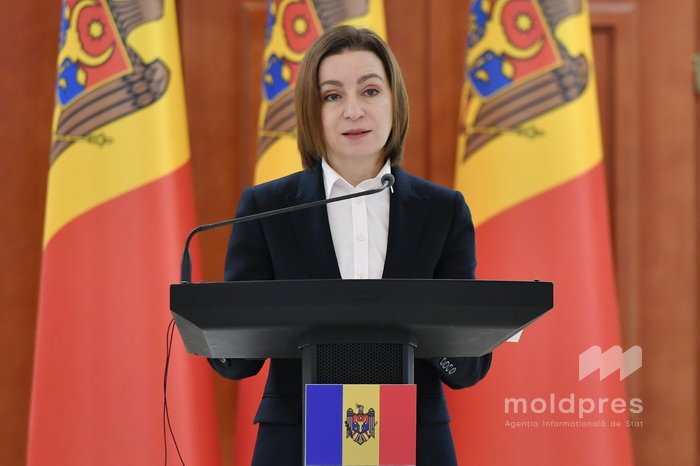
Head of State: We cannot stop justice reform just because we don’t have 61 votes
Justice reform cannot be halted because Parliament has not found 61 votes to appoint a new member to the Prosecutors’ Evaluation Commission. This view was expressed by head of state Maia Sandu, who argued for the need to reduce the required number of votes in order to unblock the situation.

“In this Parliament there are not 61 MPs who support the justice reform. (...) In the previous legislature there were, because the parliamentary majority ensured 61 votes and then it was not a problem. Now they do not exist. So what do we do? Because there are not 61 votes, do we block ourselves and stop the justice reform? No. The same mechanism applies to the appointment of the members of the Superior Council of Magistracy (CSM). This mechanism was coordinated with the Venice Commission. So first you try with 3/5, with 61 votes. If there are no 61 votes, you don’t stay without members, you move to a simple majority,” Maia Sandu said.

The President explained that applying this mechanism is necessary to unblock the situation and to continue the justice reform.

“If 61 votes were not found, it is natural, just as with the appointment to the CSM, to have an unblocking solution so that members can be appointed to this commission. Today there are no 61 votes and therefore we cannot stop the justice reform because there are not 61 votes. Fifty-one votes, a simple majority, is sufficient,” the head of state added.

Last week, Parliament examined the draft decision on appointing a new member to the Prosecutors’ Evaluation Commission. The draft did not garner the necessary number of votes, being supported by only 53 MPs, while at least 61 votes were required.

At the same time, on Thursday the legislature passed a bill introducing a subsidiary measure for appointing members to the external evaluation commissions of judges and prosecutors. According to the author of the amendment, the proposal will eliminate a legislative vacuum and is necessary to avoid harming the external evaluation process, especially in the context of time constraints.
 Facebook
 Instagram
 X/Twitter
 Telegram
VIDEO // Republic of Moldova marks four years since submitting application for European Union membership
Moldovan-Romanian bilateral cooperation strengthened through new diplomatic mandate: Ambassador of Moldova presented copies of accreditation letters in Bucharest
Parliament speaker says, after 34 years, Moldovans have duty to build bridges, where there were walls
PHOTO // Decade of Memory and Gratitude launched in Chisinau; Moldovan president says state without memory vulnerable state
EU Entry/Exit System extended to more border crossing points of Moldova as of March 2
Moldovan PM conveys message on 34 years since outbreak of Transnistria War
Perspectives concerning Moldova's territorial reintegration; expert says reunification can happen through society’s collective refusal to play Russia’s game
Moldovan foreign affairs minister to pay official visits to Germany, Azerbaijan
Moldova marks 34th anniversary of joining United Nations
Local referendum to recall mayor of Sadîc scheduled for May
British MPs in Chișinău: security and cooperation on discussion agenda
Moldova's Ambassador to Israel says Moldovans in Israel urged to stay in shelters, avoid travel
Foreign Affairs Ministry says no casualties reported among Moldovan citizens in Israel, Qatar, United Arab Emirates, Turkey
Moldovan Foreign Affairs Ministry's Crisis Cell activated amid escalating tensions in Middle East; urgent recommendations for citizens, embassies' contact details
Moldovan government proposes simplification of voluntary amalgamation procedure
PHOTO // Moldovan president visits south of country: modernization of two ports in Giurgiulesti, construction of Cahul regional hospital, talks with young people
PHOTO // Moldovan foreign affairs minister has talks with Azerbaijani parliament speaker; boosting dialogue between two legislatures on agenda
Reform of local public administration: consultations held with over 3,700 local elected officials, citizens in 29 districts of Moldova
New rules against digital piracy: Moldovan parliament approves administrative sanctions
Moldovan parliament appoints two international experts to prosecutors' evaluation commission
Moldova strengthens role in regional logistics: strategic quadrilateral meeting in Brussels
 National Bank of Moldova
Sănătatea, în centrul vizitei efectuate de președinta Republicii Moldova, Maia Sandu, în sudul țării
Moldovan government proposes simplification of voluntary amalgamation procedure
Reform of local public administration: consultations held with over 3,700 local elected officials, citizens in 29 districts of Moldova
Dialogue on parliamentary platform regarding country’s reintegration policies
Moldovan government encourages individual taxpayers to direct 2 per cent of income tax paid on last year’s earnings to non-commercial, non-profit organizations

Parliament changes rules for Giurgiulești Port: It will also get strategic status
Dialogue on parliamentary platform regarding country’s reintegration policies
Deputy Prime Minister meets with President of Azerbaijan
UPDATE // Heavy cross-border traffic at Sculeni crossing point eased
Over 90% of food products tested in 2025 compliant. ANSA publishes pesticide residue report
Moldova marks one year since joining SEPA: lower fees and millions of euros saved
Head of State: We cannot stop justice reform just because we don’t have 61 votes
First monument dedicated to Moldovan heroes fallen in all wars inaugurated in Hungary
Ministry of Agriculture warns oil companies against diesel price gouging ahead of spring fieldwork: We demand responsibility and fairness towards farmers
Law strengthening security of judges and prosecutors published in Official Journal
ARBOM supported reception dedicated to Bulgaria’s National Day in Chisinau
Moldovan deputy PM visits Brussels: railway modernization, EU transport cooperation discussed with European officials
MOLDAGROTECH SPRING 2026 exhibition to be staged at Moldexpo exhibition centre: state-of-the-art agricultural machinery, smart solutions for farming
BTA: MP Stresses Importance of Preserving Moldova's Taraclia District as Centre of Ethnic Bulgarians
Moldovan government encourages individual taxpayers to direct 2 per cent of income tax paid on last year’s earnings to non-commercial, non-profit organizations
Foreign affairs minister says authorities make efforts to maintain stability in Moldova, including in energy sector
Receive the latest news directly to your email

Receive the latest news directly to your email