
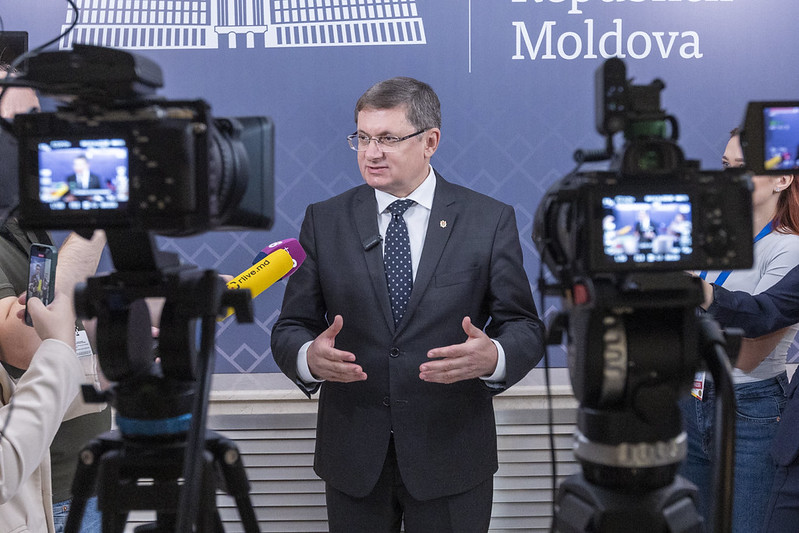
Speaker: Administrative-territorial reform must ensure predictable transfer of powers and resources
Administrative-territorial reform should be discussed less in terms of the names of future administrative units and more in relation to property, taxation, powers and budgetary resources. Speaker Igor Grosu made the statement following discussions with district presidents and city mayors, in the context of the Government’s presentation of the concept for reorganizing second-level local public administration.


“The impressions I had yesterday from the meeting with district presidents and city mayors were very good. I followed what appeared in the public space, and it somehow aligns with the public’s expectations. I would urge that discussions focus less on the name—what the administrative seat or administrative center will be called—and more on issues related to property, taxation, powers and the budgetary component. In other words, we must ensure that this entire transfer will be predictable,” Igor Grosu explained.


According to the concept, the 32 districts are to be reorganized into three regions—North, Centre and South—while the municipalities of Chișinău and Bălți will retain their current status, the Autonomous Territorial Unit of Gagauzia will continue to have special status, and Taraclia is proposed to become a second-level municipality.

Igor Grosu stressed that the specialists currently working in district councils will also be needed in the new administrative structure. They may work in larger mayoralties, deconcentrated services or the administrative offices of future regional administrations.


“We need their capabilities and expertise. I invite them to find positions either in the newly created large mayoralties, because we will have mayoralties reaching 42,000 people—for example, Ungheni—or more than 20,000, if I am not mistaken, in Călărași; Cantemir will grow from 2,400 to 17,000, Cimișlia and so on. So they will find places in the future structure of larger mayoralties, in the future staff or administration—the administrative office of the regions. We need these people and their experience,” Grosu added.


At the same time, Grosu said that services intended for citizens would remain at the local level, while property and public services would not be “taken away” from localities. According to him, judicial and police jurisdictions, as well as the structures of the Ministry of Internal Affairs, CTAS and CNAS, will not be changed by this reform.

Regarding representation at the regional level, Grosu said that the current mechanism is proposed to be retained: regional councillors would be elected directly by citizens, while the president and vice-president of the region would be elected indirectly by the regional council.


“District councillors are elected directly, while the presidents and vice-presidents are elected indirectly, exactly as is currently the case: district councillors elect the district president and vice-president,” the official explained.


Referring to criticism from PSRM leader Igor Dodon concerning the need to amend the Constitution, Igor Grosu said that the reform does not involve eliminating any of the levels of public administration.


“There are three levels of representation: the central level, the second level and the first level. We are not changing anything; we are keeping the same three levels. There is the central level, the second level, which will be represented by seven administrative-territorial units: three regions, the municipalities of Chișinău and Bălți, the Autonomous Territorial Unit of Gagauzia and Taraclia, and the first level. The second level remains,” he explained.


Grosu urged people to consult the constitutional provisions and said that, if there are legal objections, they can be challenged before the Constitutional Court.

He also said that the authorities intend to adopt the legislative package on the new administrative-territorial structure in October-November, so that the new framework will be known approximately one year before the next general local elections. He noted that this timetable had been discussed with the State Chancellery and the Government. The concept presented by the Government is currently at the consultation stage, while the legislative package is due to be submitted to Parliament in the autumn of 2026.

The concept for reorganizing second-level local public administration, presented by the Government on October 1, was discussed with district presidents and city mayors from across the country. Prime Minister Vasile Tofan, Speaker Igor Grosu and Government Secretary General Alexei Buzu participated in the discussions.
 Facebook
 Instagram
 X/Twitter
 Telegram
Moldova supports international efforts to return Ukrainian children
Moldova, Canada to strengthen cooperation in security and trade
Moldovan president condemns Russia’s latest attacks on Ukraine: “Russia must answer for its crimes”
New U.S. Ambassador to Moldova Joseph Mark Burkhalter presents copies of credentials
European Commissioner at Moldova Business Week 2026: Whoever invests in Moldova today is investing in European success story
VIDEO // Speaker - one year after parliamentary elections: We have made faster progress than ever on path to joining European Union
Foreign Minister: 868 Moldovan citizens in Canada benefited from consular services through the “Embassy Comes Closer to You” Program
Deputy Prime Minister to visit Canada: talks on strengthening bilateral relations and developing economic partnerships
Prime Minister’s speech at UN: We have realistic path to build country our children will not have to leave in search of new opportunities
Prime Minister: Our ambition is clear: to firmly anchor Moldova in European family
PM: We want peaceful reintegration of country
VIDEO // Republic of Moldova presents candidacy for presidency of 82nd session of UN General Assembly
VIDEO // Message in Romanian delivered by Prime Minister from UN rostrum
PHOTO // U.S. Ambassador-designate to Moldova arrives in Chisinau
PHOTO // Energy Minister presents investors with objectives of Energy Strategy 2050: Energy directly influences companies’ competitiveness
MOLDPRES INTERVIEW // Moldexpo Exhibition Centre on threshold of major transformation; director Zinaida Popa: “Business must meet and create connections”
Speaker: Administrative-territorial reform must ensure predictable transfer of powers and resources
Environment Ministry announces stabilization of Dniester water level near Cosăuți station
Foreign Minister receives new U.S. Ambassador: We want to further strengthen and develop partnership
Foreign Minister at opening of Honorary Consuls’ Meeting: Moldova made clear and irreversible choice to join European Union
Teachers from Moldova applauded in Parliament
 National Bank of Moldova
Moldova transposes European rules, conditions governing activities in postal communications sector into national legislation
Single legal framework for investigating accidents, incidents in air, rail, maritime transport of Moldova
Moldova's Civil Code amended to strengthen legal framework applicable to commercial agency relationships
Five vehicles donated in Ungheni and Căușeni for cultural, sports and charitable activities, exempt from import duties
National legislation on direct taxation and excise duty calculation to be aligned with European Union rules

National legislation on direct taxation and excise duty calculation to be aligned with European Union rules
Foreign Minister at opening of Honorary Consuls’ Meeting: Moldova made clear and irreversible choice to join European Union
Teachers from Moldova applauded in Parliament
Over 100 producers expected at 25th edition of National Wine Day
Moldova seeks to attract more freight to TRACECA corridor and proposes facilities for carriers
VIDEO // Moldovan president to attend Security Forum
Three water pumps from state reserves made available to Apă-Canal Chișinău
Government delivers three more pumps to Apă-Canal Chișinău for water intake from Dniester
Energy Minister: Gas prices in Moldova not highest in Europe
PHOTO // About 145 people enrolled in just three weeks at University of Third Age
Energocom company of Moldova estimates gas price for October at 76.35 euros/MWh
PM says European integration Moldova's national project
VIDEO // Moldovan parliament speaker says local administration reform must lead to stronger local administrations, better services
Moldovan government, European Commission, partners from international financial institution discuss investment priorities under Moldova Growth Plan
Moldovan PM participates in third edition of Pro-Industry Dialogue
Moldovan PM, EU commissioner make joint statements on Growth Plan, Moldova’s European path
Receive the latest news directly to your email

Receive the latest news directly to your email