
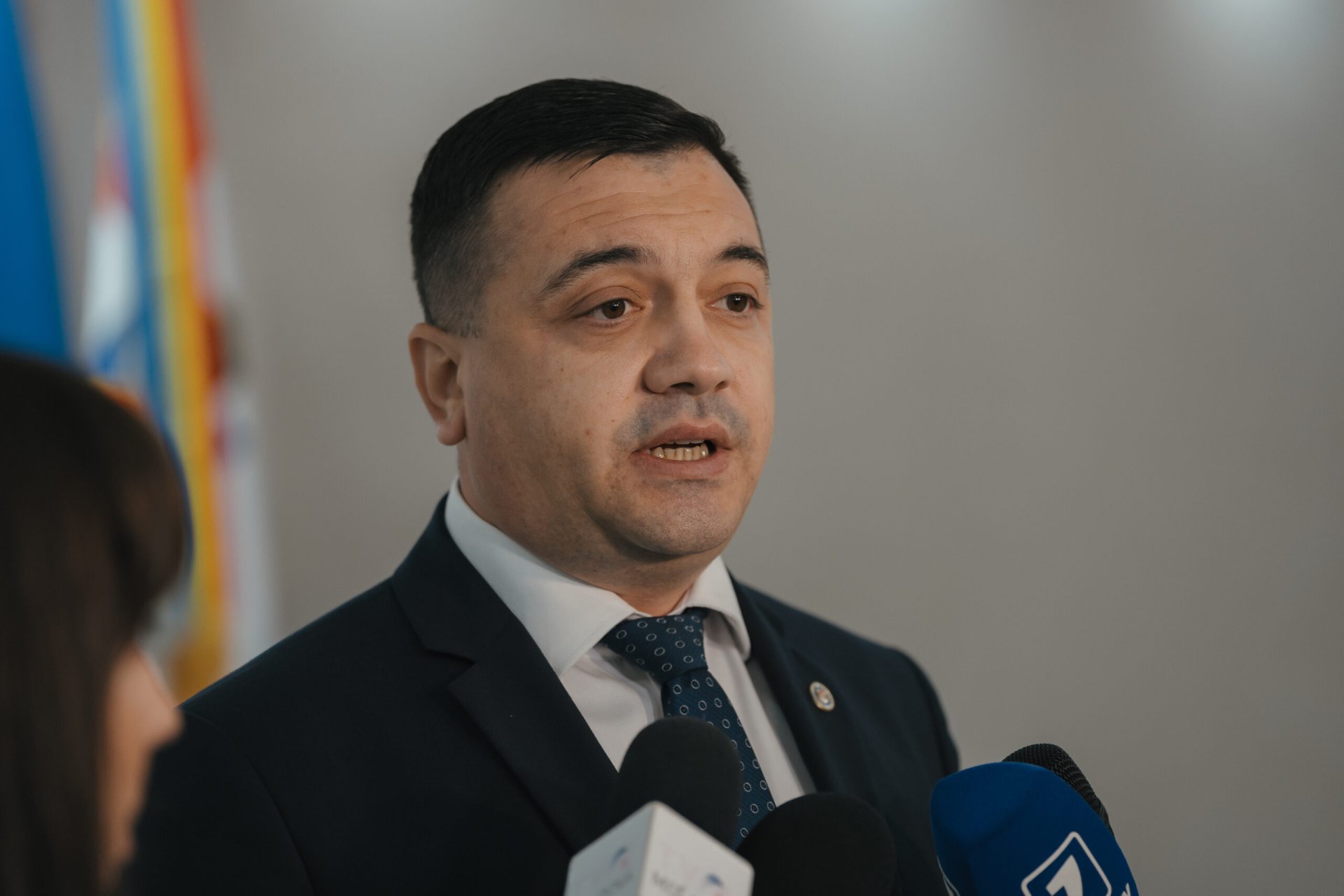
Former Moldova's interior minister says spontaneous, uncontrolled explosion at Cobasna ammunition depot technically excluded
A spontaneous and uncontrolled explosion at the Cobasna ammunition depot is technically excluded. The ammunition is stored according to compatibility categories and is separated from initiation means, which makes explosive objects more resistant to various external impacts. The conclusions have been presented by engineer Adrian Efros, former interior minister, for the Moldova 1 TV channel, in the context of the report titled, Cobasna: Separating a Myth from Reality, presented by the Intelligence and Security Service (SIS) and the Military Intelligence Agency (AIM) today.

The former interior minister welcomed the evaluation carried out by the competent authorities, which relied on precise data regarding the situation at the ammunition depot.

“In the case of previous governments, this message of fear, meant to mislead people and artificially create a psychosis around Cobasna, was actually maintained by the authorities themselves. Now, our objectives and our pro-European orientation have changed and therefore I thank my colleagues from SIS and AIM for having the courage to investigate and conduct an analysis based on data, not intuition,” Adrian Efros emphasized.

He explained that the ammunition is kept by compatibility categories, separated from initiation means, and arranged in a checkerboard pattern, in order to prevent a chain reaction.

“Why do I agree with my colleagues’ conclusion that a mass explosion or a simultaneous explosion of all depots cannot take place? Because the ammunition is stored by compatibility category and is separated from initiation means, which makes explosive objects more resistant to different external impacts. From my point of view, having more than 25 years of experience in engineering service and having handled thousands of explosive objects, I believe that the possibility of an explosion initiating by itself or due to natural factors is excluded,” he noted.

Adrian Efros also referred to the necessary steps for evacuating the depot in the event of an agreement.

“First of all, we need a visual inspection and the identification of the types of ammunition stored in these depots. Afterwards, based on this data, decisions can be taken regarding the most efficient ways of neutralizing or using this ammunition. Thus, part of it could be neutralized on site, while the explosive substance resulting from processing could be reused in demining missions,” the former minister said.

Adrian Efros suggested that eliminating the narrative about the depot’s danger could transform Cobasna from a Russian pressure tool into a useful element in the process of settling the Transnistrian issue.

“Once these myths have been dispelled, I believe it will act as a catalyst and will be useful during negotiations and during these settlement processes,” he specified.

Asked whether Russia will continue to invoke the situation in Cobasna to justify its military presence, the former minister said that Moscow would not easily give up such pretexts, but stressed that the new report brings clarity and provides the public with truthful information.

“The narratives or pretexts used by the Russian Federation to justify the troops that are stationed illegally on the territory of Moldova will, I believe, continue. But what was intended with this report was to bring safety to the citizen and to instill the feeling that the government takes care of its citizens. We have always made efforts to ensure that citizens are safe and are not manipulated by various forces with political or geopolitical interests,” Adrian Efros concluded.

The Intelligence and Security Service and the Military Intelligence Agency today presented the report, Cobasna: Separating a Myth from Reality, according to which the Cobasna ammunition depot holds a quantity of approximately 14,000 gross tons of armaments (including packaging and crates), while the net quantity of explosive substance is only 2,800 tons, a volume much smaller than previously circulated. The report highlights that the Cobasna depot represents a risk, but a limited and controlled one and does not represent “an existential threat to the region, as it has been repeatedly presented for geopolitical purposes.”
 Facebook
 Instagram
 X/Twitter
 Telegram
Republic of Moldova received humanitarian aid from 35 countries in first half of year
Prime Minister and Education Minister joined teachers demanding pay raises
Government initiates negotiations with NATO on regulating exchange and protection of classified information
Government accepts resignation of Director of State Agency on Intellectual Property
PHOTO // Teachers protest at Government, demanding salary increases from September 1
Moldovan citizens residing in Latvia to be able to exchange driving licences without additional exams
PHOTO GALLERY // Preparations for Military Parade on 27 August: Veterans and soldiers hold last rehearsals to mark 35 years since proclamation of Independence of the Republic of Moldova
Republic of Moldova digitalized 70 percent of public services: savings estimated at over 850 million lei in 2025
Energy compensation to be available again this year
Government Spokesperson about request for pay raise for teachers: Government to present identified solutions as soon as possible
Braniște commune, Râșcani district invests in clean water and waste management with residents' involvement
VIDEO // Defence Minister about crash of aircraft in Talmaza: Russia's hostile activities against Ukraine also endanger Moldova
Chronicle of INDEPENDENCE // We stood in front of Soviet tanks – memories of day that proved generation’s courage
PHOTO // Initial police findings: aircraft crashed in Talmaza shows characteristics similar to drone-missile
VIDEO // General rehearsals for Military Parade due in Moldova on August 27; Law-enforcement personnel train on Great National Assembly Square
Moldova's government to recommend introducing licensing regime for imports of cereals; PM says cabinet tries to protect Moldovan producers, exporters
Moldovan PM has talks with Ambassador of Kazakhstan
Moldovan PM, Japanese Ambassador discuss Moldova-Japan partnership
Moldovan energy minister inspects works at Chisinau Electrical Substation: faults detected in auxiliary equipment may cause delays
About 470 young teachers assigned to work at educational institutions of Moldova
Moldovan PM has talks with BPO company representatives: predictability, better conditions for business development
 National Bank of Moldova
Moldovan PM has talks with Ambassador of Kazakhstan
Moldovan PM, Japanese Ambassador discuss Moldova-Japan partnership
Moldovan PM has talks with BPO company representatives: predictability, better conditions for business development
Prime Minister and UNDP Representative approach cooperation priorities
Over 120 officials, staff trained on integrity standards and access to public interest information

Moldovan PM has talks with BPO company representatives: predictability, better conditions for business development
Meteorologists issue yellow heatwave, fire danger warning in Moldova; air temperatures to reach up to 36°C
Modern school minibuses for more educational institutions of Moldova: 38 new vehicles to carry pupils to school
DOC // SIS and AIM report debunks myths about real amount of ammunition in Cobasna
LIVE // 14,000 tons of ammunition stored at Cobasna, gross quantity
UPDATE Increased traffic at Leușeni and Sculeni border crossings eased
ANRE approves new natural gas rates for end consumers
DOC // NBM to put into circulation two coins on 35th anniversary of proclamation of Independence of the Republic of Moldova
Number of people accommodated in tourist facilities in country increased by around 16 percent in first half of year
Border crossing between Ukraine and Moldova attacked by drones
Prime Minister and UNDP Representative approach cooperation priorities
CFM: Moldovan farmers have priority for grain transport by rail
Five former officers convicted for illegal interception of communications of activists, journalists, politicians
Over 120 officials, staff trained on integrity standards and access to public interest information
ARMENPRESS: Armenia to provide medical treatment for Gaza children
MAI: Drone debris of Geran type discovered near Giurgiulești
Receive the latest news directly to your email

Receive the latest news directly to your email