
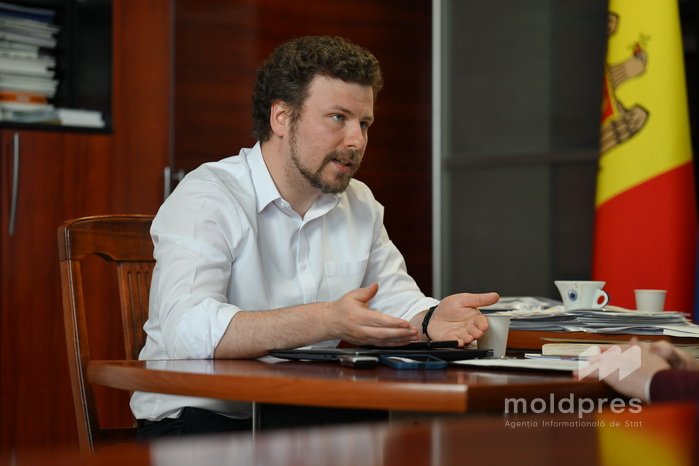
Moldovan education minister says reform of education departments to ensure higher salaries, objective-based management
The reform of education departments targets three major objectives: better alignment between the policies set by the Education and Research Ministry (MEC) and their implementation in schools, strengthening the institutional capacity of the departments, and depoliticizing local-level decisions that affect the education system. Minister of Education and Research Dan Perciun has presented the goals in an interview given exclusively with MOLDPRES.

According to the minister, one of the main goals of the reform is to ensure a uniform implementation of education policies.

“We essentially want three major outcomes from this reform. The first is better alignment between what the ministry establishes as public policy and what actually happens in schools. We want to ensure a sound and coherent implementation of education policies. We want to make sure the ministry’s vision on combating bullying, integrating children with Special Educational Needs (SEN), digitalization and meritocracy is fully achieved in the system. Today, we have a fragmented system, where on one hand, the ministry sets certain policies and objectives, but their implementation lies exclusively with the education departments. As a result, not every district in our country is aligned with these objectives. In some places, there is more tolerance of certain phenomena, in others there is less involvement in certain subjects. We see this in the area of bullying prevention and response, and we see it in relation to SEN as well,” said Dan Perciun.

The second objective is to strengthen the capacity of education departments, by increasing salaries and streamlining processes.

“The second fundamental goal is to increase the capacity of the education departments. Today, some of them face staff shortages of up to 75 per cent. I believe the average occupancy rate of positions is about 70 per cent. Positions in the departments are not attractive. A sort of negative selection has taken place there. Bringing the education departments under the ministry’s authority will allow us to increase their capacity, offer higher salaries, have objective- and data-based management, improve processes and ensure that departments are proportional to the territories they manage. Because today we have situations where an official in a department in one district is responsible for one school, while in another district they are responsible for five schools. In one district, one official corresponds to 64 students, in another – to 400 students, and we do not have a single, standardized approach to how education departments work and operate,” the education minister noted.

The official stressed that the MEC aimed to transform the education departments into support tools for schools.

At the same time, the third objective concerns the depoliticization of local-level decisions regarding school activities.

“We also want to depoliticize certain decisions that today are at the discretion of the departments and district councils, and primarily not even the departments, but the district councils. Here we refer to the school network, to school principal competitions, and to the allocation of resources. All these decisions currently lie with the district councils, which are essentially political entities and where the best interests of the child do not always come first; sometimes local political interests prevail. With this change, the system will come to be managed by people from the education field, with education-related degrees and experience, and decisions will no longer be made simply by local-level politicians,” the minister said.

Dan Perciun added that, for schools and for school principals, the reform would mean greater school autonomy.

“It will mean more clarity in the relationship with the authorities. Today, some of them feel they somehow have two or even three bosses. On the one hand, the district department, on another hand the district council, and on yet another hand the ministry, and people are caught between a hammer and an anvil. Departments continue to represent a political cudgel, and for school principals, I can fully assure you this will mean more autonomy, more decision-making freedom, and more independence from political influence,” Dan Perciun concluded.

The Restart programme, which aims at the reform and reorganization of district and municipal education departments, will be presented by Minister Dan Perciun  at a press conference on May 26.

More details about the field of Education can be found in the interview given exclusively with the MOLDPRES Agency by Minister Dan Perciun. The interview will be published on May 26.
 Facebook
 Instagram
 X/Twitter
 Telegram
Minister explains upcoming education reform: It will bring very clear salary increases
Old-style Orthodox Christians honor Saint Nicholas of Summer on May 22
VIDEO // National Food Safety Agency of Moldova destroys dozens of tons of non-compliant imported food products
Meteorologists issue Yellow Code warning for atmospheric instability in Moldova
New rules for corruption and organized crime investigations
DOC // Activity of zoos to be regulated by new law
DOC // Particip.gov.md platform to be modernized to ensure easier access to information on draft decisions proposed by authorities
Adopted in final reading: From 1 June, day laborers to be registered electronically
VIDEO // CSP approved three interim appointments to leadership positions within Prosecutor’s Office
Prime Minister on World Day for Cultural Diversity: Only through unity, dialogue and mutual understanding can we build European, modern and united Moldova
DOC // Condominiums to face new administration and voting rules
Orthodox Christians celebrate Ascension of the Lord
Two bomb alerts in single night at Chișinău Airport
Tourism integrated into state’s economic policies in Moldova; sector moves to Economic Development and Digitalization Ministry
Moldovan Technical University launches Innovation Center for Viticulture and Winemaking for connecting research with wine industry
VIDEO // Moldovan president urges mayors, citizens to take part in decisions on local public administration reform
Governor of National Bank of Moldova says country's economy to continue to grow in 2026, inflation stays major challenge
DOC // Moldovan president revokes citizenship of five officers from so-called state security ministry of Transnistrian region
 National Bank of Moldova
Moldovan president summons meeting of National Security Council
Moldova's president signs decree withdrawing citizenship from five individuals
PM attends Study in Moldova event
Moldovan PM attends inauguration of National Tennis Center
Moldovan PM visits settlements hit by heavy rains, flash floods from central district

DOC // Moldovan president revokes citizenship of five officers from so-called state security ministry of Transnistrian region
PHOTO // European Museum Night 2026: cultural institutions of Moldova filled to capacity, thousands of visitors discovered art, history, traditions
Tour of Romania reaches Bessarabian soil: first stage to take place fully in Moldova
Ombudsman of Moldova launches new edition of Human Rights Caravan
Moldova's General Police Inspectorate warns about new fraud schemes: scammers send fake SMS messages about alleged fines for traffic infringements
Historic first for Tour of Romania: cycling race unites both banks of Prut, with trophy inspired by Brâncuși’s work
PHOTO GALLERY // Spectacular edition of Tour of Romania: Over 800 km cycling race connects Chișinău and Bucharest
PHOTO // Moldova to participate in China International Import Expo
Delegation of Austrian MPs on visit to Chișinău
Customs Service collected over 871 million lei last week
BTA: Bulgaria Celebrates Day of Holy Brothers Cyril and Methodius, of Bulgarian Alphabet
Moldovan authorities, environmental experts strengthen skills in assessing biodiversity
PM attends Study in Moldova event
Education Week culminates with national university fair: Moldovan PM says lyceum graduates should be proud of country
Moldovan president conveys congratulatory message to renowned Romanian filmmaker
Moldova showcases investment advantages in Shanghai: 30 major Chinese companies interested in country’s market
Receive the latest news directly to your email

Receive the latest news directly to your email