
Moldovan cabinet approves draft of budgetary, fiscal policy for 2024
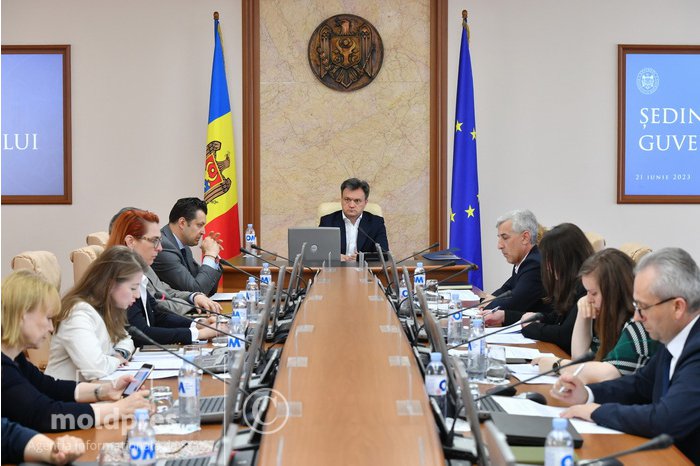
Chisinau, 21 June /MOLDPRES/ - The draft on the budgetary and fiscal policy for 2024 was approved at a today’s cabinet meeting. The draft includes conceptual and systemic changes of optimization of the fiscal administration and is aimed at solving the economic constraints found out by tax payers, identifying instruments of residents’ support, as well as continuing the process of Moldovan legislation’s approximation to the European Union’s practices.
Prime Minister Dorin Recean said the government got into normality; the budgetary and fiscal policy is approved in the middle of the year and thus, the business environment and the citizens get that very predictability and have half a year to prepare for the next financial and fiscal cycle.
„The most important changes this year regard the focusing on people. We have a deficit of qualified labour force. The government works to invest in the labour force to enhance it productivity, so as we increase the salaries and revenues to the budget and respectively, we can increase the salaries and pensions for the other social categories from the budget revenues. The budgetary and fiscal policy for the next year implies more personal deductions, more deductible expenses in the favour of the employee for real estate projects. This will represent an efficient and additional alternative to projects dealing with financing prior to the purchasing of real estate for families. Other expenses stipulated are the ones dealing with staff, social and health insurances,’’ Dorin Recean added.
According to Finance Minister Veronica Sirețeanu, the main goals proposed in the document target the implementation of instruments of attracting qualified labour force, as well as the revision of mechanisms of calculation and payment of taxes, in order to simplify them.
Thus, to maintain the qualified labour force, attract new specialists and diversify the ‘’social package’’ provided to employees, the government extends the spectrum of fiscal stimuli through revising the categories of expenses borne by the employer in favour of employees, allowed for deduction on fiscal purposes, such as: compensation of expenses for alternative child-care services, providing of support subscriptions, expenditures for employees’ qualification, expenses related to the contracting of medical services, limited to a quantum which will now allow, according to the ministry, to use these facilities in order to replace the basic payments. At the same time, the draft sees the increase of the deductible ceiling for the optional health insurances premiums, as well as the introduction of regulations for the expenses for food and transport borne for probationers and/or apprentices.
Additionally, the drafts proposes the extension of the categories of deductions for the private people at the establishment of the obligations related to the income tax with expenses related to the optional health insurance premiums, expenses related to the premium based on the contract on life insurance, the sums paid by the private person for the interests related to mortgage loans when buying the first dwelling, other than the ones contracted through the First Home state programme.
The document also sees the standardization of the quotas of the income taxes for private people, retained for the investment and financial incomes, through establishing them at 6 per cent. The measure’s goal is to stimulate the investment of the savings gained by private people, through the enforcement of a single regime on all aforementioned incomes.
The practice of establishing the rates of excise duties for a period of 3 years (2024-2026) will be continued, in order to ensure the fulfillment of the principle of predictability for the business environment, as well as for having a clear-cut forecast of the budget revenues. Thus, the tax on the excisable products, including tobacco, cider, some oil products, will by 7 per cent annually in the next three years, except for some categories of products, such as the liquefied gas, crude oil, beer or alcohol.
To observe the commitments of adjusting the fiscal and customs legislation, the fiscal regime applied to touring cars is changed, through taxing these vehicles with value added tax according to general principles starting from 1 January 2025, with the gradual decreasing of the excise duty’s quota.
This year, the Finance Ministry worked out and presented the fiscal policy, by observing the budgetary calendar.
 Facebook
 Instagram
 X/Twitter
 Telegram
Moldovan National Road Transport Agency launches nationwide inspections of heavy trucks
First contract for Union Highway A8 signed; project to connect Moldova by road with European network
Incentives for investments in green energy in Moldova: customs duties eliminated for storage batteries, wind turbines
Moldovan parliament speaker tells farmers state came up with response it can afford at present
New step toward strengthening energy security: Moldova to establish emergency reserves of petroleum products
Fuel prices are going down in Moldova; petrol price drops below threshold of 31 lei
State to be able to respond more quickly in event of energy emergency
Moldovan carriers to receive additional 300 permits for routes to Azerbaijan
Import duties on energy storage batteries and wind turbines to be abolished
Moldovan energy minister calls for compliance with deadlines for completing works needed to start energizing Vulcanesti–Chisinau power line
Moldova to receive 150 million euros to modernize strategic roads
Moldovan energy minister says every leu invested in energy efficiency generates significant economic impact
Energy compensations to be maintained in next cold season
Agriculture Minister after farmers’ protest: I will continue to focus on dialogue to identify solutions to all demands
Over 1,000 Diaspora Moldovans register for Online Career Fair
PHOTO // European Commissioner for Enlargement urges young people to defend democracy, combat disinformation
Moldova Presents exhibition inaugurated in Vaslui: Moldovan products promoted in Romania by 60 local companies
Moldovan president conveys message on World Environment Day
Moldovan president attends ceremony on 24th anniversary of foundation of National Anticorruption Centre
Environment Minister announces when fish safety to be checked
Moldova prepares new edition of Red Book
 National Bank of Moldova
Moldovan president attends ceremony on 24th anniversary of foundation of National Anticorruption Centre
Prime Minister at Moldova Digital Summit 2026: Our ambition is not only to join EU, but to help build Europe’s digital future
Over 1 billion euros in new investment partnerships, financing announced for Moldova
Topical issues addressed at meeting of Joint Control Commission
Moldovan president, European Commissioner for Enlargement discuss reforms, next steps in accession process

Republic of Moldova to receive 250 million dollars from World Bank to advance reforms
Moldova Digital Summit 2026 starts in Chișinău
Moldova prepares case against Russia over Dniester pollution
Chișinău and Bratislava discuss next steps in EU accession negotiations
International post-disaster needs assessment mechanism launched in Chișinău following Dniester river pollution crisis
EU Commissioner in talks with Prime Minister and Deputy Prime Ministers
Right to fair trial – most frequently reported problem by Moldovan citizens in 2025: Ombudsman’s report presented in parliament
Moldovan parliament sets up inquiry committee on phone, online scams: damages exceeding 270 million lei
Moldovan parliament speaker describes Russia’s intention to move Russian Center of Culture to Tiraspol as political provocation
PHOTO GALLERY // Major event in Chisinau: EU announces 1 billion euros in investments in Moldova
Stricter rules for taxi platforms: payments to be required to obligatorily go through banks of Moldova
Moldovan parliament speaker says each day of delay of elections in Gagauzia works against autonomy
Digital solutions for schools of Moldova: 140 institutions equipped with 700 interactive boards, computers
Moldova hosts 4th international conference on noncommunicable diseases
Voted in parliament: Moldovan citizens who worked legally in Canada to be able to receive social benefits
Moldovans working in Ukraine to be able to receive pensions, other social benefits
Receive the latest news directly to your email

Receive the latest news directly to your email