
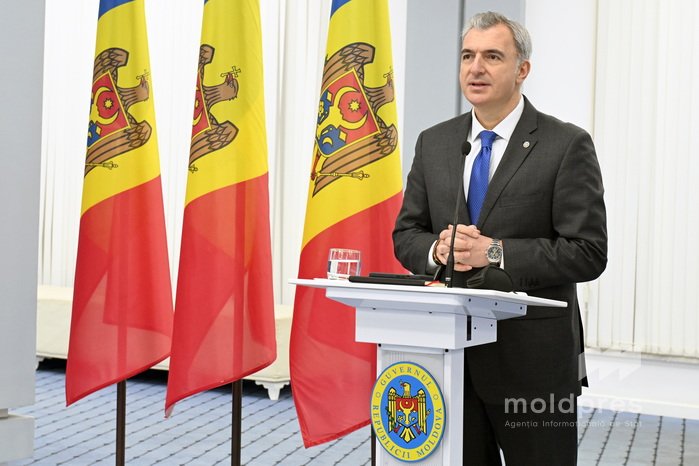
Moldovan Economic Development Ministry launches governmental programme “We Succeed,” to create simpler, more competitive business environment
The Economic Development and Digitalization Ministry (MDED) today launched the government programme, “We Succeed,” an initiative meant to support the creation of a simpler, easier-to-manage and more competitive business environment, aligned with European Union standards. The programme today was presented by Deputy Prime Minister, Economic Development and Digitalization Minister Eugeniu Osmochescu.

The reform aims to create a business environment comparable to the one of EU countries: clear, simple, with reasonable requirements, reduced costs and minimal risk of sanctions. The authorities thus intend to selectively transpose European legislation, based on the most favorable practices from member states, in order to retain and develop businesses of Moldova and attract foreign investments.

“Only together can we succeed in achieving the goals we have set and everything we have planned along our European path. That is why, we ruled to launch a campaign that will target society as a whole, the business community and citizens. Through this programme, we are coming with certain initiatives, but at the same time, we very much want to showcase the achievements of Moldova, of its citizens and of the business environment and to present success stories,” said Eugeniu Osmochescu at a news conference.

One of the priority directions of the “We Succeed” Programmeis the digitalization of services for the business environment. Deputy Prime Minister Osmochescu emphasized that 78 per cent of services for entrepreneurs were presently digitalized and the authorities aim to increase this share on the coming period.

Also, the focus will be placed on deregulation and simplification of the conditions for conducting business.

“We know very well that, in Moldova, we always tend to regulate far more than required, we overregulate. Therefore, we will align ourselves with the deregulation packages developed in the European Union. It is about the Omnibus packages, which cover democratization, digitalization and other areas,” the deputy prime minister said.

In the context, Eugeniu Osmochescu underlined that MDED was reviewing more than 300 normative acts, and as a result, 20 permissive acts have already been identified for elimination.

“We are examining more than 300 normative acts, in order to identify hidden permissive acts. Unfortunately, we have identified more of them and decided to do this in a structured and horizontal manner, checking all legislative and normative acts existing in Moldova, because, regrettably, in many cases measures were introduced ‘through the back door’ and, to the detriment of reform efforts, certain bureaucratic requirements were implemented which now represent a burden for the business environment. We are preparing a package through which, from the outset, we already know that 20 permissive acts will be eliminated, as we have identified them as being abusive in relation to the business community,” the official said.

At the same time, MDED has identified 444 legislative and normative acts that regulate the provision of services in Moldova. Of the total number, 106 will be amended, in order to simplify them and align them with European Union rules, to streamline the provision of services, as well as to make them more efficient and centralized.

Another measure to be implemented concerns a zero customs duty on the import of raw materials under the customs regime of final destination and on equipment.

“A producer in the bakery sector or in the meat products sector who imports raw materials to produce a final good will no longer pay the customs duty, which is currently 10–15 per cent of the value of the goods. This measure is necessary, in order to avoid intermediation, when the same raw material is resold more times, thereby increasing the final price of the product,” Osmochescu said.

At the same time, the authorities intend to develop a law to regulate the field of the digital economy and e-commerce.

“This is something new, which is not yet regulated. We are talking about online platforms, which unfortunately are not regulated, not even from a taxation perspective, and the state budget is losing revenue. Also, at the current stage, we are in the final phase of implementing the Know Your Customer platform. This refers to online identification and remote access to digital services,” Deputy Prime Minister Osmochescu pointed out.

In recent years, the Government has implemented more initiatives, in order to simplify the way businesses operate, to attract investment and to align with European standards.
 Facebook
 Instagram
 X/Twitter
 Telegram
Exports of Moldovan fruits to EU grow steadily: apples, sweet cherries record largest increases
VIDEO // Discussions on sugar market situation held in Moldova; economic development minister says compromise reached
National Bank of Moldova raises base rate for main monetary policy operations
Prime Minister met with IMF expert team
DOC // Single intermediary between producer and consumer
DOC // Unified taxes and excise duties on both banks of Dniester
First electrified railway segment of Moldova, part of connection with EU; Deputy PM says segment strategic step towards modern, cheaper, more efficient transport
VIDEO // Moldova Presents exhibition to be staged in Brasov on June 27–28
Energy Minister at SolarPower Europe Summit: Solar and storage systems are now instruments of sovereignty, resilience and secure access to energy
Deputy Prime Minister about sugar market situation: We will hold discussions with all stakeholders
IMF team of experts coming to Chișinău
Giurgiulești–Cahul railway line fully operational
Salary arrears of employees of Moldovan Railways company fully paid off
IMF team of experts comes to Chisinau during May 7–20
Moldovan deputy PM says more investment agreements to be announced at Moldova–EU investment conference
Promo-LEX organization of Moldova reports serious violations in case of a young detainee on left bank of Dniester
Moldovan Economic Development Ministry launches governmental programme “We Succeed,” to create simpler, more competitive business environment
International Museum Day marked in Moldova with special cultural programmes
MOLDPRES INTERVIEW // Director Lucia Țurcan: Center of Excellence in Construction aligns with European standards – ERASMUS+ projects, modern technologies and more practical training for students
Germany reconfirms support for European path of Moldova
Speaker at meeting with Germany’s Minister of State for Europe: Your support is very important for our EU accession process
 National Bank of Moldova
Germany reconfirms support for European path of Moldova
Speaker at meeting with Germany’s Minister of State for Europe: Your support is very important for our EU accession process
President pays visits to European Parliament, Netherlands
President on working visit to Tallinn: Estonia - reliable friend and supporter of Moldova’s European path, from which we have much to learn
Moldovan president to pay working visit to Estonia

Deputy Prime Minister pays visit to Germany
Around 19 thousand tons of gasoline and diesel imported last week into Moldova
Russia’s accredited ambassador summoned to Foreign Ministry
President pays visits to European Parliament, Netherlands
Preliminary results of 17 May local elections // First-round victories in six localities and tight race in Orhei municipality
BTA: Bulgaria's Dara Wins Eurovision 2026
General Police Inspectorate recorded 12 incidents and alleged violations during new local elections
Polling stations have closed. Over 24,600 citizens took part in new local elections and local referendums
New local elections: Around 30% of voters turned out by 6:00 p.m.
PHOTO // Nicolae Testemițanu USMF students managed emergencies and simulated clinical cases at SimOlympic
PHOTO // Museum Night at Parliament: Over 1,600 visitors discovered history and activity of legislative institution
New local elections. Over 10,400 citizens voted by 12:00
Speaker about Satoshi’s Eurovision performance
PHOTO // Universities across country showcase educational offer at new fair held in Orhei
PHOTO // Călărași Park modernized through project worth over 17 million lei
Citizens expected at polls to participate in new local elections and local referendums
Receive the latest news directly to your email

Receive the latest news directly to your email