
DOC // Unified taxes and excise duties on both banks of Dniester
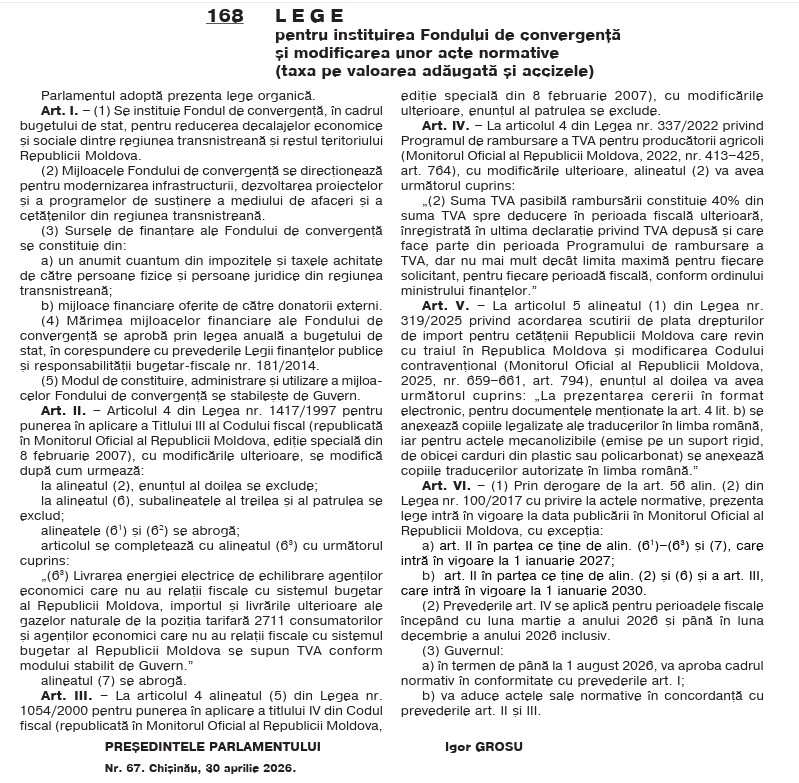
The promulgation decree and the Law providing for the gradual harmonization of the fiscal and customs regime throughout the territory of the Republic of Moldova, including in the districts on the left bank of the Dniester, were published today in the Official Journal of the Republic of Moldova and have entered into force.

The measure aims to eliminate tax discrepancies between the two banks of the Dniester and to establish a unified taxation system.

The document provides for directing revenues obtained from taxes and duties into a Convergence Fund, intended for economic and social development.

According to the document, the first changes will concern the elimination of tax exemptions for non-essential products, such as alcohol. Thus, these products will be subject to VAT and excise duties similar to those applied in the rest of the Republic of Moldova.

The provisions that allowed VAT exemptions for the supply of balancing electricity to economic agents not connected to the budgetary system, as well as for the import and supply of natural gas carried out by Moldova-Gaz to Tiraspoltransgaz are also eliminated. These provisions will enter into force on January 1, 2027.

The document also repeals the rules that allowed special import-export regimes for economic agents in the Transnistrian region, in order to ensure the uniform application of tax legislation throughout the country. In addition, special VAT rules are established for supplies of balancing electricity and natural gas. Starting from August 1, 2026, the Government will set the VAT rates depending on the outcome of negotiations.

The Convergence Fund will be financed from a share of the taxes and duties collected from natural and legal persons in the Transnistrian region, as well as from external contributions. The money will be used to modernize infrastructure, develop projects, and support the business environment and the population.

The authorities estimate that the implementation of these measures will bring additional revenues of approximately 3.3 billion lei annually to the state budget.
 Facebook
 Instagram
 X/Twitter
 Telegram
As of 1 July, new rules to come into force for imports from United States
Unified taxes and excise duties on both banks of Dniester approved by Parliament
Obtaining and renewing entrepreneur patents become fully digital starting 4 May
Energy Minister discussed with US and EU officials about investments in Moldova’s energy infrastructure
PHOTO // Railway of Moldova enterprise restores direct connection to Giurgiulesti International Port
Moldova launches negotiations for international road transport agreement with People’s Republic of China
DOC // Moldovan government allocates 110 million lei to fully compensate diesel excise duty for farmers; regulation sets ceiling of 200,000 lei per beneficiary
State to be able to intervene more quickly in energy alert situations; draft law to this effect registered in Moldova's parliament
ANRE requires suppliers to build up gas reserves for 2026–2027 winter
Modern recreational space to be created nearby MOLDEXPO
Over 6,600 tons of fuel imported into Moldova in recent days
Chisinau residents urged to buy local products: fairs held in all districts of Moldovan capital
DOC // State of emergency in energy sector ends in Moldova
Retailers of Moldova to be required to display country of origin for food products
Applications for accreditation of observers for new local elections and local referendums can be submitted until 10 May
DOC // Single intermediary between producer and consumer
VIDEO // Minister of Culture invites public to visit Moldova pavilion at Venice Biennale: Come support our artists and Republic of Moldova
DOC // Procedure for authorizing medicines to be streamlined: faster access to treatments for patients
DOC // Unified taxes and excise duties on both banks of Dniester
DOC // President appoints 16 judges to several courts across country
Prime Minister pays working visit to Bălți
 National Bank of Moldova
Prime Minister pays working visit to Bălți
Deputy Prime Minister for Reintegration attended meeting of EU's Political and Security Committee
Moldovan president meets North Carolina Secretary of State Elaine Marshall in Chisinau
All children with disabilities to receive annual allowance of 3,000 lei on 1 June
Combating high-level corruption and financial fraud to be carried out more rapidly and efficiently

Discover Moldova with #MOLDPRES // “Grotto of Wishes” at Tipova, labyrinth hidden in rock on Dniester Riverbank
Moldovan president meets North Carolina Secretary of State Elaine Marshall in Chisinau
ARMENPRESS: Latvia welcomes Armenia’s EU path
Moldova hosts global folklore event for the first time
First electrified railway segment of Moldova, part of connection with EU; Deputy PM says segment strategic step towards modern, cheaper, more efficient transport
Moldovan labour minister announces set of measures to prevent minors from leaving home
VIDEO // Moldova Presents exhibition to be staged in Brasov on June 27–28
Moldovan defense minister says Moldova directly threatened as long as Russia continues war in Ukraine
Moldova to conclude air services agreement with Bosnia & Herzegovina
Energy Minister at SolarPower Europe Summit: Solar and storage systems are now instruments of sovereignty, resilience and secure access to energy
Deputy Prime Minister about sugar market situation: We will hold discussions with all stakeholders
Travel alert for Belgium: air traffic to be disrupted due to national strike
Local Public Administration Reform: 435 decisions to launch amalgamation process approved
Government approves new regulation for Environmental Inspectorate
Prosecutors appealed court ruling in case of Vladimir Plahotniuc
All children with disabilities to receive annual allowance of 3,000 lei on 1 June
Receive the latest news directly to your email

Receive the latest news directly to your email