
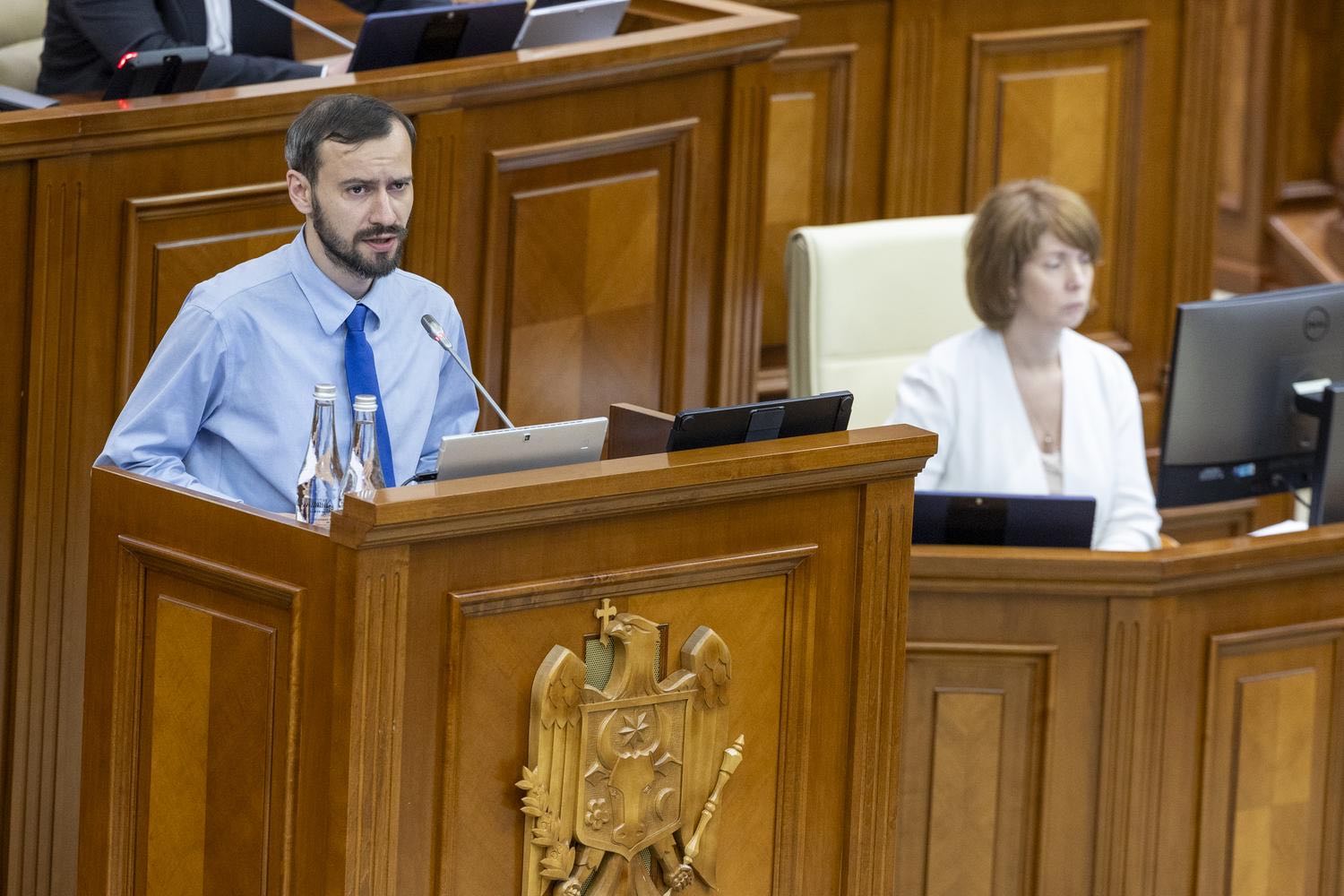
Term of inquiry commission investigating state-owned enterprises extended
Parliament has extended by 30 days the term of the Inquiry Commission investigating the activities of certain state-owned enterprises. The bill was supported by 53 lawmakers.

The initiative was presented by the chair of the Inquiry Commission, MP Dinu Plîngău, who argued that the extension was necessary because more time was needed to ensure that the commission’s work would conclude not only with a report, but also with the identification of legal solutions to the problems uncovered and the submission of legislative proposals.


“We need these 30 days to bring the state institutions together, because we have found that there is no very effective coordination among state institutions in resolving these issues. The most important thing is to identify legal solutions, so that the inquiry concludes not only with a report that could even be presented today on the violations identified, but, more importantly, with legal solutions, including legislative proposals that we can submit at the end of the inquiry,” Dinu Plîngău said.


The MP also presented several pieces of information obtained during the work of the Inquiry Commission.


“We began the commission’s work to understand how many state-owned enterprises the Republic of Moldova has. Since independence, the Republic of Moldova has had 1,359 state-owned enterprises. The very serious issue identified is the inconsistency between the data in the official registers provided by state institutions. Accordingly, as of today, according to the State Register of Legal Entities, 515 state-owned enterprises are registered. Of these 515 state-owned enterprises, 323 do not have an IDNO. The Public Property Register indicates that the Republic of Moldova has 163 state-owned enterprises. According to information from the State Tax Register, there are 609 state-owned enterprises,” Dinu Plîngău stated.


The MP emphasized that the commission’s work had also uncovered irregularities related to the appointment of individuals as members of the boards of directors of state-owned enterprises.


“A very serious violation in this context is the fact that there is a very frequent rotation of people on different boards of directors. A person may be a member of one board for two or three months and then, two or three months later, become a member of another board. The major risk is that the person is appointed not to directly perform duties related to the activity of that enterprise, but rather as additional remuneration on top of their basic salary,” Dinu Plîngău said.


The commission also analyzed salary levels in state institutions.


“The three companies with the highest average salaries per employee are MoldATSA, Energocom and Moldovagaz. The largest salary increase was recorded at MoldATSA over the past two years, amounting to 81% of the existing salary. In 2019, the average salary at MoldATSA was 32,000 lei; today, the average salary is around 63,000 lei. The largest increase, of 71%, was made over the past two years. The problem is that, in most cases, there is no confirmation or justification for these increases, even though the law allows them. In any case, there must be a justification every time such an increase is made, especially when we are talking about a 71% increase,” Dinu Plîngău noted.


The MP added that the commission’s work had also highlighted other violations, including discrepancies in tax and financial reports.

The Inquiry Commission on the activities of state-owned enterprises was established by Parliament at the beginning of July this year, at the proposal of a group of lawmakers from the parliamentary faction of the Party of Action and Solidarity. The commission consists of 11 MPs and is chaired by MP Dinu Plîngău.
 Facebook
 Instagram
 X/Twitter
 Telegram
Speaker’s Romanian Language Day message: We Have Managed to Do It Justice – Romanian language enshrined in Constitution
New Head of OSCE Mission to Moldova takes office
President’s message on Romanian Language Day
MFA: Russia’s opening of 16 polling stations in Transnistrian region without Chisinau’s consent unacceptable
Foreign affairs minister meets Polish Ambassador to Moldova
Turkish Ambassador to Chișinău awarded by Foreign Minister at end of term
Prime Minister’s message to Năsui and Osmochescu: They have difficult but very important mandates
Parliament to begin second 2026 session on 1 September
VIDEO // New Ministers Claudiu Năsui and Eugeniu Osmochescu took oath of office
CEC: Electoral period begins for elections to People’s Assembly of Gagauzia
Moldovan PM makes statements after discussions with presidents of Romania, Ukraine
Moldovan president speaks before citizens on Great National Assembly Square
Romania supports European path of Moldova; Romanian president: “It is an example for all candidate states”
Moldovan president says Moldova not to be intimidated
UPDATE // Heavy cross-border traffic at Costești border eased
Term of inquiry commission investigating state-owned enterprises extended
Protest note to Russia’s ambassador
Schools to come under Ministry of Education and Research and be managed by Territorial Education Agencies: reform approved by Parliament in second reading
 National Bank of Moldova
President meets with Ambassador of Turkey at end of term
Prime Minister and Denmark’s Ambassador approach new opportunities for investment and economic cooperation
Head of state, at 35th anniversary of National Army's establishment, says peaceful Moldova needs Moldova capable of defending its peace
Moldovan president’s speech at event on online safety, digital determinants of children’s, adolescents’ mental health, emotional well-being
Deputy PM for reintegration has meeting with new Head of OSCE Mission to Moldova

Solutions for children’s online safety analyzed in Chisinau; Romania's First lady: “We must work together to protect children in an ever-changing digital environment”
Moldovan deputy PM for European integration meets with Ukraine’s new deputy PM for European and Euro-Atlantic Integration
Head of state, at 35th anniversary of National Army's establishment, says peaceful Moldova needs Moldova capable of defending its peace
Moldova's foreign affairs minister to visit Lithuania: meetings' agenda
PHOTO GALLERY // Children’s online safety at center of international conference in Chisinau, attended by Moldovan president, Romania’s First Lady
Import of cereal, oilseed crops to be temporarily licensed in Moldova
Moldovan president, at international online safety conference, says each child must grow up healthy, free, safe in world where physical, digital realities intersect
Searches conducted in more settlements of Moldova in case concerning illegal financing of parties through cryptocurrencies
Moldovan president’s speech at event on online safety, digital determinants of children’s, adolescents’ mental health, emotional well-being
Electronic monitoring of domestic abusers to be strengthened: Moldova's National Probation Inspectorate to receive 200 new bracelets, 2027 budget to be doubled
Moldovan parliament speaker, on National Army Day, says National Army symbol of defending peace
MPs stand silent for one minute in memory of victim of tragedy in central Moldova village, femicide victims
PHOTO // Well-known Romanian actor, three memorable roles to be screened at Romanian Film Days
VIDEO // PM announces urgent measures following tragic case in central Moldova village
Moldova's Doctoral School in Medical Sciences holds admission competition for doctoral studies; applications may be submitted till September 4
Moldovan Central Electoral Commission says electoral period for elections of Gagauzia's governor starts in Moldova
Receive the latest news directly to your email

Receive the latest news directly to your email