
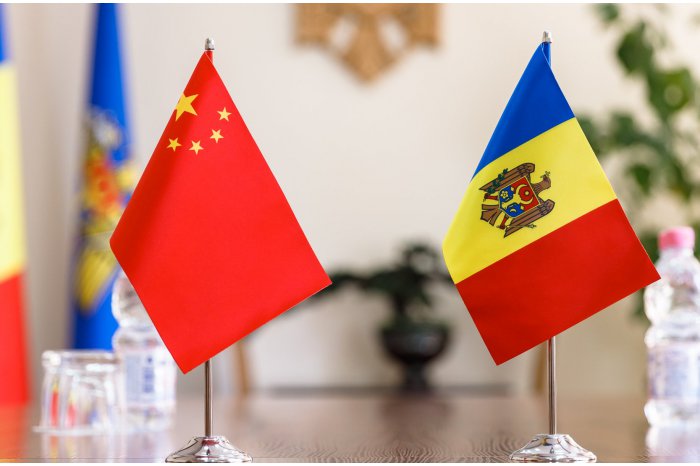
People’s Republic of China celebrates National Day
The People’s Republic of China is celebrating National Day today, marking 77 years since the founding of the state. With a population of more than 1.4 billion people and one of the world’s largest economies, China is strengthening its relations with international partners, including the Republic of Moldova, with which it has maintained diplomatic relations for more than three decades. The two countries aim to expand cooperation in areas such as trade, agriculture, energy, healthcare, education and culture, while 2027 will mark 35 years since the establishment of bilateral diplomatic relations.

The prospects for Moldovan-Chinese cooperation were discussed in Chișinău during a reception organized on the occasion of China’s National Day, attended by the Ambassador of the People’s Republic of China to the Republic of Moldova, Dong Zhihua, and Speaker Igor Grosu.

Ambassador Dong Zhihua said that bilateral relations had made progress in 2026 and that Beijing was interested in capitalizing on the potential for cooperation with the Republic of Moldova by turning joint initiatives into concrete projects.


“China is ready to work with Moldova to deepen cooperation in the fields of economy and trade, agriculture, energy, healthcare, education, culture and tourism, to expand exchanges at all levels and to turn an increasing number of shared visions for cooperation into concrete results,” the diplomat said.


For his part, Grosu stressed that relations between the two states had developed over the more than 30 years since their establishment, based on dialogue, mutual respect and cooperation in various fields.


“For more than three decades, the Republic of Moldova and the People’s Republic of China have built relations based on dialogue, mutual respect and cooperation in various fields,” Igor Grosu said.


One of Chișinău’s main areas of interest is expanding trade and diversifying Moldovan exports to the Chinese market. In this regard, the Speaker mentioned wine, fruit and vegetables, products that could benefit from additional opportunities for promotion and sale in China.


“We are interested in increasing and diversifying Moldovan exports to the Chinese market, as well as facilitating access for our quality products – especially Moldovan wines, fruit and vegetables – to consumers in China,” the Speaker said.


Commercial cooperation between the two countries is already taking shape through the export of Moldovan agricultural products. According to Ambassador Dong Zhihua, grape-seed flour and sunflower-seed flour from the Republic of Moldova are already being successfully sold on the Chinese market. In addition, agreements on the export of honey, cherries and grape seeds have been reached in principle.

A new opportunity to promote domestic products is the Republic of Moldova’s participation, for the first time with a national pavilion, in the China International Import Expo in Shanghai. The event will give Moldovan producers the opportunity to present their wines, agricultural products and other traditional goods to Chinese consumers and business partners.

Cooperation in the wine sector is also gaining an international dimension. After the Republic of Moldova hosted the 46th edition of the World Congress of Vine and Wine in Chișinău last year, the next edition will take place in October in the Chinese city of Yinchuan, becoming the first to be held in Asia.

In this context, Igor Grosu invited the diplomatic corps and tourists to attend National Wine Day, which will be held in the Republic of Moldova on October 3–4.

Moldovan-Chinese relations are also developing in areas involving cultural, educational and social exchanges. Ambassador Dong Zhihua mentioned the official launch of the third phase of the Chinese Traditional Medicine Center in the Republic of Moldova. Another project, aimed at rehabilitating and developing assistive technology services for people with disabilities, is due to be launched in cooperation with the United Nations Development Programme (UNDP).

In the cultural field, one of the year’s important events was the performance of Turandot by the China National Opera in the Republic of Moldova. The production gave audiences in Chișinău the opportunity to discover a work from the international operatic repertoire performed by Chinese artists.

The Speaker of Parliament welcomed this premiere and expressed hope that the project to modernize the stage of the National Opera and Ballet Theatre in Chișinău would be completed with China’s support.


“I would also like to express my conviction that the project to modernize the stage of the National Opera and Ballet Theatre in Chișinău will be successfully completed with the help of the Chinese people,” Igor Grosu said.


Cultural exchanges were also intensified through the first-ever organization of the China Days in Chișinău event, held on June 14 in the Ștefan cel Mare Public Garden. Thousands of visitors took part in activities dedicated to Chinese culture and civilization, discovering traditional cuisine, music, martial arts, historical costumes, technologies and traditional medicine.

The event was organized by the Chinese Embassy and gave the Chinese community in the Republic of Moldova the opportunity to present its country’s traditions and culture to the public.

Ambassador Dong Zhihua emphasized the importance of direct people-to-people contacts and intercultural dialogue, stating that no form of virtual communication can replace in-person meetings.

In addition, several educational institutions in the Republic of Moldova have introduced Chinese-language courses, contributing to the development of educational exchanges and familiarizing young people with Asian culture.

In 2026, bilateral cooperation was also supported by official visits and contacts. Deputy Prime Minister Mihai Popșoi paid an official visit to China, and held talks with Chinese Foreign Minister Wang Yi. At the same time, a multiparty parliamentary delegation from the Republic of Moldova visited China.

The Chinese ambassador noted that these contacts had contributed to strengthening bilateral dialogue and identifying new opportunities for cooperation.

As part of her diplomatic activity, Dong Zhihua visited several regions of the Republic of Moldova, including Soroca, Bălți, the Autonomous Territorial Unit of Gagauzia, Ungheni, Căușeni and Anenii Noi. The programme included meetings and visits to educational institutions, hospitals, farms, factories and wineries, giving her the opportunity to gain a better understanding of the country’s economic and social realities.

Interest in economic cooperation is also reflected in the presence on the Moldovan market of Chinese new-energy vehicles, which, according to the ambassador, are particularly popular.

Ambassador Dong Zhihua also presented China’s economic developments, noting that the country’s gross domestic product grew by 4.7% in the first half of 2026. At the same time, industries related to artificial intelligence recorded growth of more than 30%.

According to the diplomat, China seeks to expand economic openness and further liberalize trade and investment amid an international context marked by technological and economic transformations.

Since the launch of economic reforms in 1978, China has experienced rapid development, becoming one of the world’s largest economies and a central player in international trade. The country is a major exporter of machinery and industrial equipment, chemicals, textiles, clothing and agricultural products, as well as a major importer of raw materials, equipment and food products.

The Chinese economy plays a significant role in the dynamics of the global economy, consistently contributing to the growth of trade and the development of international production chains.

The Republic of Moldova and the People’s Republic of China established diplomatic relations in January 1992. Since then, bilateral cooperation has gradually expanded to include political dialogue, trade, projects in healthcare, education and culture, as well as contacts between institutions and communities.

The year 2027 will mark 35 years since the establishment of diplomatic relations, an anniversary that, according to the two officials, provides a new opportunity to strengthen dialogue and identify joint projects.

China’s National Day is celebrated annually on October 1 and marks the proclamation of the People’s Republic of China in 1949. The Asian state covers an area of approximately 9.6 million square kilometers and has a population of more than 1.4 billion people. The capital, Beijing, is one of the world’s largest political, economic and cultural centers.

China has 23 provinces, five autonomous regions, four municipalities under direct central government administration – Beijing, Tianjin, Shanghai and Chongqing – and two special administrative regions, Hong Kong and Macao.
 Facebook
 Instagram
 X/Twitter
 Telegram
VIDEO // Republic of Moldova presents candidacy for presidency of 82nd session of UN General Assembly
VIDEO // Message in Romanian delivered by Prime Minister from UN rostrum
PHOTO // U.S. Ambassador-designate to Moldova arrives in Chisinau
Moldovan Prime Minister holds talks with Croatian and Slovenian counterparts
VIDEO // Prime Minister for Fox News Podcasts: Moldova can be export and trade hub for entire region
Moldovan foreign affairs minister at UN says Moldova strengthening capacity to respond to health threats
Moldovan parliament speaker urges students not to be afraid to express their ideas, wishes
DOC // Regulation on e-Consulat System published in Official Journal
Moldovan, Dutch Prime Ministers discuss European path and investments
Moldova, Egypt discuss expanding economic relations
Moldova condemns Russia’s organization of parliamentary elections in Transnistrian region at OSCE
Moldova seeks to diversify imports of gas, oil products from Azerbaijan
China, Moldova prepare new cooperation projects; Chinese Ambassador: “We are ready to deepen relations”
VIDEO // Moldova completes 95 percent of actions planned to date under Growth Plan
Moldovan PM meets Ambassador of Kingdom of Saudi Arabia
Moldovan PM has meeting with U.S. Ambassador
Moldovan president awards Order of Honour to honorary consuls of Moldova in Denmark, Brazil
Moldovan president receives letters of accreditation on behalf of new ambassadors of United States, Turkey, Canada, Saudi Arabia, Algeria
 National Bank of Moldova
Moldovan PM meets Ambassador of Kingdom of Saudi Arabia
Moldovan PM has meeting with U.S. Ambassador
Moldovan president awards Order of Honour to honorary consuls of Moldova in Denmark, Brazil
Moldovan president receives accreditation letters on behalf of new ambassadors of United States, Turkey, Canada, Saudi Arabia, Algeria
Moldovan parliament’s standing bureau approves agenda for plenary meeting scheduled for October 2

Deputy PM for reintegration has courtesy meeting with Ambassador of Lithuania to Moldova
PHOTO GALLERY // Moldova Innovation Fund, officially launched with European Union's support
Moldova denounces agreement on cooperation between Commonwealth of Independent States member countries on combating crime in transport
Revenues of 63.3 billion lei collected in Moldova's national public budget in first half of 2026
Moldovan president to pay working visit to Finland
VIDEO // Moldovan PM speaks about insolvency administrators’ activities
Moldovan deputy PM for reintegration, delegation from Germany’s Federal Ministry for Economic Cooperation and Development discuss development projects benefiting residents on both banks of Dniester
Moldovan pupils propose draft laws on first job, free transportation, psychological counseling at sixth edition of educational game “LAW for YOU(th)”
Government seeks solutions to increase budget for energy compensation during cold season
VIDEO // Country's energy resource supply amid state of emergency: Energy Minister presents updated information
Fuel prices to fall in Moldova on October 1: drivers to pay less for petrol, diesel
Foreign Ministry condemns violation of Moldova’s airspace by drone
VIDEO // Prime Minister about situation on Dniester River: We must focus on solutions, not point fingers where cause of problem does not lie
National Army preparing projects for systems capable of intercepting drones and missiles
New actions for competitiveness and modernization of industrial sector
Office for Implementation of Strategic Projects “Moldova Proiect” to accelerate major infrastructure investments
Receive the latest news directly to your email

Receive the latest news directly to your email