
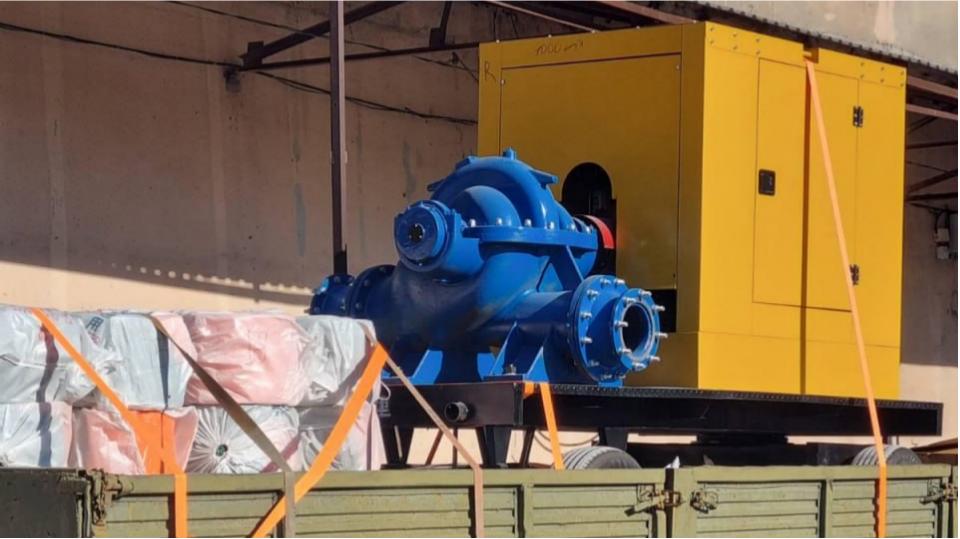
Government delivers three more pumps to Apă-Canal Chișinău for water intake from Dniester
The Government has delivered three more high-capacity pumps to the Apă-Canal Chișinău enterprise for drawing water from the Dniester River. The equipment adds to the five pumps allocated previously and will be used at the intake facility operated by the company responsible for supplying the capital with water.

The decision was approved by the National Crisis Management Commission (CNMC), and the pumps are already being delivered to Apă-Canal Chișinău.


“The decision comes in response to the request for assistance submitted by Apă-Canal Chișinău on October 1, amid the hydrological deficit on the Dniester River and the state of emergency currently in force,” Government spokesperson Dumitru Ciorici said.


The pumps will be installed at the Dniester water intake facility and will help ensure the necessary intake capacity amid the river’s low water level.

According to Dumitru Ciorici, the Government will continue to support local authorities in ensuring the security of critical infrastructure and the uninterrupted supply of drinking water to the population.

In recent months, the Republic of Moldova has been facing a severe hydrological deficit, caused mainly by the lack of precipitation in the upper basin of the Dniester. During the first 20 days of September, an average of approximately 23 m³ of water per second entered the Novodnestrovsk Reservoir, while downstream releases remained at 60 m³/s. During the same period, the reservoir’s level fell by approximately 68 centimetres.

In this context, the Republic of Moldova has been under a state of emergency in the hydrological sector since September 26, for a period of 60 days. The measure is preventive and enables the authorities to intervene quickly to prevent possible interruptions in the water supply and protect available reserves.

The authorities continue to monitor the situation on the Dniester and are preparing measures in case the river’s level continues to fall. These include checking the capacity of water intake stations, identifying alternative sources and preparing backup technical solutions.
 Facebook
 Instagram
 X/Twitter
 Telegram
President about hydrological crisis: We now all have one responsibility: to ensure that people have tap water
AGERPRES INTERVIEW // Moldovan PM: “We are major energy importers; every external shock worsens the situation”
Former MP to stand trial for illegal financing of Victory/Pobeda Bloc and money laundering
Pupil of Moldova wins silver medal at Balkan Olympiad in Informatics for Juniors
Severe hydrological conditions also affect Prut river
Chișinău International Airport launches app for more accessible travel
PHOTO // PM in New York tells Diaspora government willing to turn experience of Moldovans from United States into projects for country
Moldova under emergency state in energy, hydrological sectors as of September 26; what measures take effect
Balti Clinical Hospital to receive ultrasound machine through grant provided by government of Japan
Japan supports modernization of Balti Clinical Hospital with grant worth over 95,000 dollars
Moldova's Border Police receive six special vehicles on behalf of FRONTEX
Moldovan president attends events dedicated to 35th anniversary of foundation of Academy of Economic Studies
New charges brought against former Moldovan president Igor Dodon in “Kuliok” case; prosecutors seek harsher sentence
Mircea Eșanu on nomination to lead Moldova Project: More information could become known in October
Energocom company of Moldova estimates gas price for October at 76.35 euros/MWh
PM says European integration Moldova's national project
VIDEO // Moldovan parliament speaker says local administration reform must lead to stronger local administrations, better services
Moldovan government, European Commission, partners from international financial institution discuss investment priorities under Moldova Growth Plan
 National Bank of Moldova
PM says European integration Moldova's national project
Moldovan government, European Commission, partners from international financial institution discuss investment priorities under Moldova Growth Plan
Moldovan PM participates in third edition of Pro-Industry Dialogue
New concept for reorganizing local administration discussed with district presidents, mayors of cities from Moldova
Deputy PM for reintegration has meeting between with Ambassador of Kingdom of Sweden to Moldova

Moldovan government's secretary general says stakes of reform stronger communities, administration capable of developing them
PHOTO // Theaters from Moldova, Azerbaijan to develop joint artistic projects under Memorandum
Moldova’s candidate re-elected as member of United Nations Subcommittee on Prevention of Torture
Deputy PM for reintegration has meeting between with Ambassador of Kingdom of Sweden to Moldova
Moldovan government to provide Apa-Canal Chisinau enterprise with three additional pumps to draw water from Dniester
Russia’s Ambassador-Designate summoned to Moldova’s Foreign Affairs Ministry; Oleg Ozerov receives protest note, after three drones violated Moldova’s airspace in a single day
Government approves construction of UEFA Category 4 stadiums
Moldovan president, European commissioner discuss EU's support for Moldova's economic development
Yellow frost warning issued for Moldova on October 3-4
DOC // Moldovan PM speaks about districts' reorganization: ''We do not move the services. We move the administration above them.''
Moldovan MP participates in 67th meeting of PABSEC Committee on Economic Policy and Development
Stronger city halls, three regions and new municipality: Government presents concept for reorganizing second-tier local public administration
New working session of special commission on reintegration policies of Moldova
Ministry of Labour nominates winners of 2026 National Award for Seniors
MOLDPRES INTERVIEW // Ambassador Zhihua Dong: Moldova's European integration opens up new opportunities for cooperation. China promoting direct freight route
Seven students of Moldova's Nicolae Testemitanu State University of Medicine and Pharmacy to receive state merit scholarships
Receive the latest news directly to your email

Receive the latest news directly to your email