
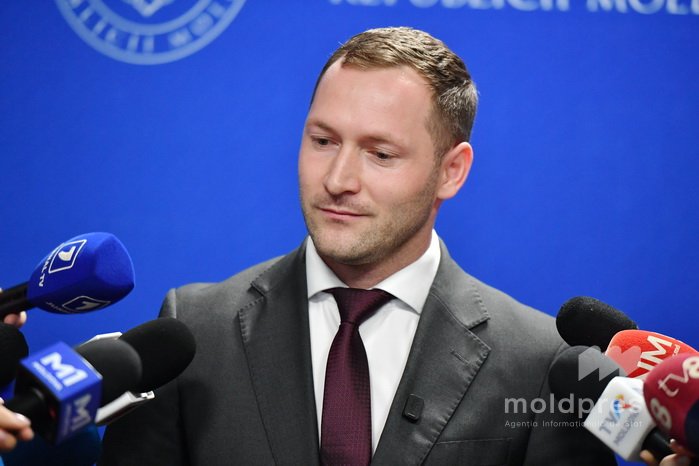
Environment Minister: Rising water levels in Dniester River may bring in petroleum residues. We are intervening quickly to maintain water quality
The rising water level in the Dniester River may bring in petroleum residues accumulated on the riverbanks and in vegetated areas. Response teams are prepared to extract them in order to maintain water supply to localities. Environment Minister Gheorghe Hajder made the statement at a TV show.

The official stressed that during his visit to Ukraine, he ensured that the source of pollution of the Dniester River had been stopped, a necessary step for preparing possible intervention actions.

“In Ukraine we carried out a complex assessment, which confirmed that the source of pollution has been stopped. It is very important to be prepared for any scenarios, since the Dniester River supplies more than 80% of the population of the Republic of Moldova and over 98% of the inhabitants of Chisinau municipality. We will continue to monitor the situation. Even though the source has been stopped, oil slicks are still coming in, which had been deposited on the banks or in vegetation, given that the river is flowing and its level fluctuates. Thus, once the flow increases or decreases, certain quantities of substances appear on the water surface and we must be ready to extract them so that we can maintain water quality,” said Hajder.

The minister mentioned that laboratory analyses detected in the Dniester River water compounds or derivatives of petroleum products.

“More than 160 samples have been taken both in the Republic of Moldova and in Romania, which indicated the absence of heavy metals; at least that is good news. We will also request further tests carried out abroad in order to understand the medium- and long-term impact. Referring to the quantities of substances that entered the Dniester, the Ukrainian side initially informed us that it was about one and a half tons. Specialists from the Republic of Moldova and Romania found that the situation is much more serious and that the quantities of discharged petroleum products were higher. The Ukrainian side also informed us that there is a commission analyzing all the circumstances of the case and that the established information will be sent to the Moldovan authorities,” the official said.

Gheorghe Hajder emphasized that the authorities are currently preparing a strategy that will include an action plan to be implemented in such emergency situations, in the context of the ongoing war in the neighboring country.

“In parallel, we are already purchasing equipment from the domestic market. We are also benefiting from assistance through the European Union Civil Protection Mechanism. We are building up reserves in case there are further pollution incidents. We must be prepared to intervene and eliminate pollution as quickly as possible. This is a lesson that has shown we need to strengthen protection and resilience measures – and we will certainly do that. Thus, we need to have sufficient materials in our warehouses and technically trained personnel who know exactly how to intervene and how to cooperate between institutions. We managed to handle this crisis thanks to the support of our European partners, especially Romania. We succeeded in intervening quickly because every hour mattered greatly. Had we allowed these quantities of petroleum substances to reach the central area of the country, we risked disconnecting other localities from the water supply,” the minister noted.

With regard to the damage caused by the pollution, Gheorghe Hajder specified that it amounts to billions of lei.

“We are not talking only about material damage – investments or what has been purchased, the aid we have received – but also about damage to the environment, soil, fish and water. When this crisis ends, we will start a process of calculating the damage that has been caused, first and foremost to the environment. We hope that the party responsible, in this case the Russian Federation, will be compelled to pay for the damage. The Ministry of Environment will present all the necessary evidence to the court and we hope that justice will be done and that the party responsible will pay for all these losses,” the official added.

The pollution of the Dniester occurred during the night of March 6 to 7, following a Russian attack on the Dniester Hydropower Complex in Ukraine, when explosions caused discharges of technical oils and petroleum products into the water.

Authorities announced today that a new wave of petroleum slicks has been detected on the Dniester River following the rise in water level. Thus, during an emergency meeting, it was decided to reinforce and extend the anti-pollution barriers on the Dniester, including the installation of new retention points. In addition, response teams will intensify the replacement of absorbent materials.

Currently, 22 functional absorbent filters are installed on the Dniester River, and the water intake stations are additionally protected with four absorbent filters each.
 Facebook
 Instagram
 X/Twitter
 Telegram
Student scholarships to be increased as of 1 September
Competitions for hospital leadership: Ministry of Health seeks managers for 20 institutions
Over 51,000 medical leave certificates issued digitally in first month after portal’s launch
As of 1 April drivers may drive without using low beam headlights during day
Higher pensions and social benefits: 6.84 percent indexation applied as of today
Over 1,800 hectares of forest to be planted in 15 districts along Dniester River, under World Bank–supported programme
Over 900,000 unique beneficiaries, representing 38% of population received reimbursed medicines through ePrescription system
Ben Gurion Airport in Tel Aviv remains closed until 16 April
Another Shahed-type drone detected while unauthorizedly flying over national airspace in Transnistrian segment
DOC // Official Journal publishes implementation mechanism for CEEPUS IV
Moldova’s airspace violated again: Shahed drone found in Dubăsari–Orhei area
Nicolae Testemitanu Medical University of Moldova launches new master’s programme, Health Promotion and Protection
Permanent teaching grades and less bureaucracy in schools
Prosecutor’s Office provides new details on investigation into death of Ludmila Vartic
PHOTO // Moldova expands presence in China through future local administration cooperation agreements
Environment Minister: Rising water levels in Dniester River may bring in petroleum residues. We are intervening quickly to maintain water quality
New oil slicks on Dniester River; Moldovan authorities order reinforcement, expansion of anti-pollution barriers
New wave of oil products' slicks detected on Dniester River; authorities convene for emergency meeting
Moldovan PM participates in awards ceremony recognizing rescuers' achievements
Large wind farms with energy storage systems to be built in Moldova: 16 bids submitted in tender
Environmental protection experts from two banks of Dniester hold new working meeting
 National Bank of Moldova
Moldovan authorities step up prevention, response measures on Dniester, amid anticipated new pollution wave
Moldovan PM participates in awards ceremony recognizing rescuers' achievements
Environmental protection experts from two banks of Dniester hold new working meeting
Moldovan deputy PM has meeting with Ambassador of Germany
President met with U.S. Senator

Moldovan deputy PM has meeting with Ambassador of Germany
New milestone for green energy: Moldova surpassed 1 Gigawatt of installed renewable energy capacity
President met with U.S. Senator
PAS faction to have new MP
VIDEO // Single institution to manage Moldova’s forests
CNMC: Eenergy sector remains fragile, ending state of emergency requires caution
Foreign Ministry: We condemn violation of airspace. Such actions endanger citizens’ security
Support for export promotion: 16 business associations to receive 14.6 million lei through Bridge Export Program
Over 20 media projects to get funding from media subsidy fund
Shahed drone illegally flew over airspace of Moldova
Over 25,000 residents from left bank of Dniester commute daily to right bank, Deputy Prime Minister for Reintegration says
BTA: Bulgarian Literature Has Become Increasingly Visible on International Stage - Deputy Culture Minister Stoyanov
Simple motion on public policies implemented by Ministry of Labour and Social Protection failed
Proposals for improving efficiency of ministries discussed at roundtable
PHOTO GALLERY // Premiere at Mihai Eminescu National Theater: “Intrigue and Love,” directed by Alexandru Cozub
Moldova to sign social security agreements with Quebec (Canada), Albania, Croatia and Ireland
Receive the latest news directly to your email

Receive the latest news directly to your email