
Parliament prepares tougher sanctions for child support debtors
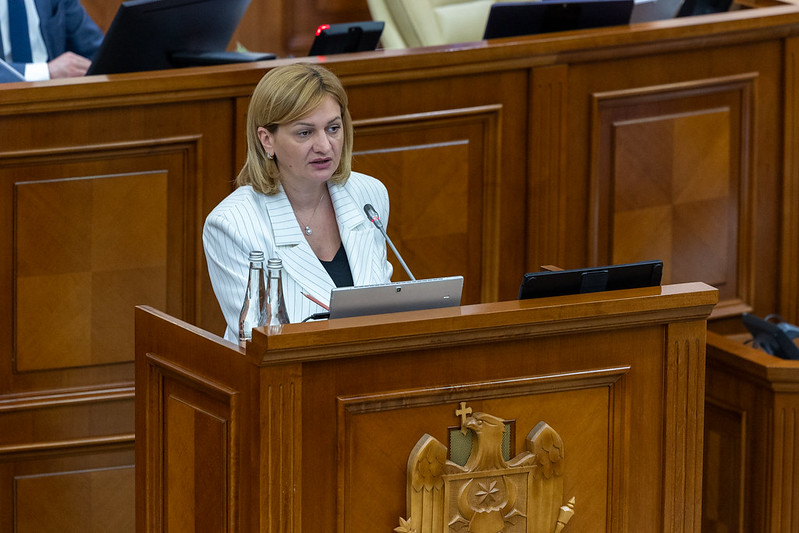
Vice President of Parliament Doina Gherman announced today in the plenary session of the Legislature the registration of a draft law that provides tougher sanctions for parents who do not pay child support, as well as measures designed to protect children’s rights. The statements were made on the occasion of International Women’s Day, in the presence of a group of mothers who are raising their children alone.

“Today, in the plenary of Parliament, we have a group of mothers who are raising their children on their own and who have brought to our attention the problems they face. Today we have registered a draft law that comes with concrete and necessary solutions to respond to these difficulties,” said Doina Gherman.

The MP stressed that the phenomenon of not paying child support affects a significant number of children.

“Every tenth child in the Republic of Moldova receives child support late or does not receive at all the alimony to which they are legally entitled. That is why we are introducing amendments that provide for tougher sanctions, because a simple fine is not enough,” Gherman explained.

According to the draft law, sanctions for parents who do not pay child support include: up to 15 days of administrative arrest or 60 hours of unpaid community service; a travel ban for parents who fail to fulfill their obligations and attempt to cross the border. Children will also be recognized as direct beneficiaries and creditors of child support, in order to eliminate excuses related to non‑payment.

“The most important thing is that, according to the draft, children become the effective beneficiaries of these payments, so that the money always reaches where it is supposed to,” Gherman added.

The bill also includes amendments regarding the establishment of visitation schedules between parents and children. Currently, this schedule is set by the guardianship authority, but the new proposal provides for the direct involvement of the court in order to reduce procedural issues that complicate the lives of parents and children.

“We propose that the establishment of the visitation schedule be carried out directly by the court, as is done in most countries,” noted the Vice President of Parliament.

The legislative initiative is part of a broader package of amendments targeting the Family Code, the Contravention Code, and the Enforcement Code. The first round of public consultations on the draft will take place on March 20, 2026.
 Facebook
 Instagram
 X/Twitter
 Telegram
PHOTO // Study in Moldova national campaign: around 500 high school pupils from Chisinau discover educational offer of Nicolae Testemitanu State University of Medicine and Pharmacy at Open Day
Moldovan Ambassador to Israel: Over 15,000 Moldovans in Israel, but only small number request consular assistance
Conflicts in Middle East: Foreign Ministry has not received requests for assistance from citizens of the Republic of Moldova
Over 2,300 digital medical certificates issued on very first day after launch
Over 95% of newborns in Moldova tested free of charge for hearing loss detection
PHOTO // Stories of sacrifice: files on fallen heroes of Dniester War preserved at Ștefan cel Mare Academy of Ministry of Internal Affairs
PHOTO GALLERY // Day of Remembrance and Gratitude through the lens of MOLDPRES: tribute to heroes who died for Moldova's Independence
Parliament speaker warns people who defy authorities of Moldova may lose citizenship
Chisinau International Airport launches strategic digitalization project: integrated online platform directly connected to operational systems
15 citizens of the Republic of Moldova in Middle East requested consular assistance from diplomatic missions
President: Aggression against our country has not disappeared even today – only methods have changed. We are living through genuine cognitive war that targets our memory and identity and seeks to confuse victim with aggressor
PHOTO GALLERY // War on Dniester through lens of MOLDPRES: documentary photographs from front line
Foreign Ministry: No Moldovan citizens among victims in Middle East conflict zones
LIVE // Rally commemorating heroes fallen in war for independence of Moldova
State authorities of Moldova levies distraints totaling 7.57 billion lei in Bank Fraud case
More Moldovan citizens report intimidation or detention actions in Russia; Foreign Affairs Ministry says Moldova's Embassy in Moscow makes efforts to secure their release
Speaker: Moldova’s withdrawal from CIS could be completed by Easter
Domestic energy consumption covered 79 percent by renewables at midday on Thursday
VIDEO // German Foreign Minister: Moldova achieved remarkable progress in EU accession process. It is very important not to slow down pace of reforms
ANRE: gasoline and diesel stocks managed under increased control
Head of Moldova's National Anticorruption Center in parliament says crime rings used sophisticated ways, including cryptocurrencies, to influence vote in Moldova
 National Bank of Moldova
Journalists’ access to Joint Control Commission's meetings, to Security Zone topic of discussion in Bender
EU and EBRD strengthen support for Government’s reform agenda
Valeriu Chiveri: Evolution of situation in Transnistrian region – from economic and social point of view – is currently completely dependent on Chișinău
Government declares state of alert in energy sector in connection with external situation to maintain stability of energy system
Government maintains 70% support for agricultural insurance policies

MOLDPRES REPORT // Moldova Agro-Invest 2026 – path from strategic reforms to major inflows of European capital
Crisis Cell: Over 80 Moldovan citizens arrived in Chișinău from Dubai
PHOTO GALLERY // Officials, investors, producers gathered at 2026 Agri-Food Investment Forum
Around 500 attempts to bribe reported by police officers
Speaker: Competition Council and ANRE must keep close eye on fuel prices at pump
State of alert in energy sector. Customs Service introduced temporary measures on export and re-export of petroleum products
Valeriu Chiveri: Evolution of situation in Transnistrian region – from economic and social point of view – is currently completely dependent on Chișinău
Speaker’s March 8 message: Voice of women in Moldova increasingly strong
Parliament prepares tougher sanctions for child support debtors
UPDATE: Heavy cross-border traffic eased in Leușeni
PHOTO // Seven Students from Nicolae Testemitanu State University of Medicine and Pharmacy complete academic exchange at Lisbon School of Health
Progress of works on Vulcănești–Chișinău power line assessed by European Commission delegation
DOC // Published in Official Journal: Government maintains 70% subsidy for agricultural insurance policy
Protection guidelines for Moldovan citizens in Israel
Moldovan parliament to hold plenary meeting on March 5: drafts in agriculture, justice, transport sectors on agenda
Moldovagaz to stay responsible for supplying natural gas to Transnistrian region in continuation
Receive the latest news directly to your email

Receive the latest news directly to your email