
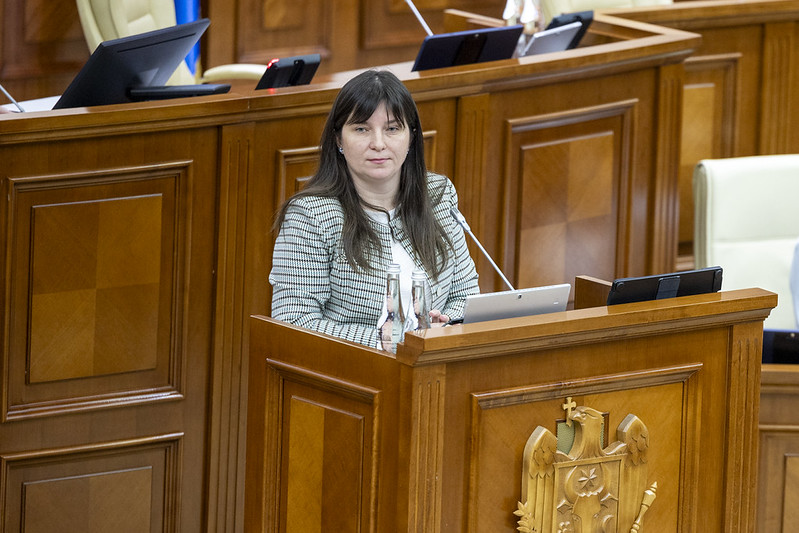
Draft Fiscal Policy for 2027 presented in Parliament
The draft fiscal policy for 2027 was presented today in Parliament by Finance Minister Victoria Belous. The official emphasized that through the proposed amendments, the authorities aim to support work, encourage investment and tax vices more heavily. Calculations show that the new fiscal policy will generate approximately 5.1 billion lei in additional budget revenue.


“In any state, the Republic of Moldova is no exception, state institutions, schools, hospitals, roads and infrastructure modernization are based on financial resources. In most countries, these financial resources come from taxes and duties. Accordingly, citizens’ contributions are reflected in the service quality and infrastructure modernization. Through the 2027 fiscal policy, we are trying to support work, support investment and tax vices more heavily, so that we can achieve a balanced increase in the tax burden,” Finance Minister Victoria Belous told the Parliament session.


Higher personal exemption

The most significant amendment concerns increasing the personal exemption from 29,700 to 40,020 lei, as well as raising the personal exemption for persons with disabilities from 34,620 to 40,020 lei annually.


“This increase in the personal exemption will leave approximately 1,236 lei more per year in the pocket of every taxpayer who has taxable income. The cost of this measure is significant for the national public budget, as this measure will result in approximately 780 million lei not being collected by the national public budget,” the Finance Minister explained.


Another measure concerns the capital increase quota, which will remain at 12%, but will be applied in full, without the 50% discount on the excess amount.


“We are introducing amendments regarding capital gains. Currently, capital gains are taxed on only 50% of the taxable income earned. Through the measure proposed in the tax policy, we are seeking to tax capital gains fairly at a rate of 12%. I would like to mention that capital gains resulting from the sale of a primary residence and vehicles that have been owned for more than three years will not be taxed. We have had several problems in the area of capital gains and real estate sales. The biggest problem we have observed so far concerns citizens who owned a single home but, by mistake, had not established their domicile there. When selling that home, they discovered that they had to pay income tax, even though they had carried out renovations and the property was, in fact, their only home. Through the 2027 fiscal policy, we are trying to protect citizens who own a single home and who failed to establish their domicile there merely because of an error. We are introducing an amendment stating that a property will be considered a primary residence, and the income obtained from capital gains will not be taxed, if it is the only home owned by the citizen and has been owned for more than three years,” the Finance Minister said.


At the same time, the dividend tax rate will increase from 6% to 8% for profits generated starting in 2027.


“These two percentage points will apply to profits related to 2027, and we hope that this measure will generate an additional 472 million lei for the budget. At present, when a legal entity makes a payment to an individual, the legal entity withholds 6% at source. We believe that every source of income should be taxed fairly, regardless of whether it comes from work or other sources. We propose harmonizing these incomes by taxing them at the general rate of 12%,” the minister said.


A 6% tax on vices

The package also provides for setting up a 6% vice tax on participation in gambling and lotteries. It will apply to the funds deposited to top up gaming accounts and to the price of lottery tickets. The measure is also intended to offset the social costs generated by the gambling industry for public healthcare and social assistance systems.


“Through the 2027 fiscal policy, we are trying to tax vices, including as an additional source of budget revenue. This mechanism will not affect every citizen, but only those who play the lottery or gamble. We are introducing a 6% tax for people who participate in gambling or purchase lottery tickets online or in physical locations. The tax base consists of the amounts deposited to top up gaming accounts and the price of lottery tickets. The gambling operator or the company collecting these funds will withhold the tax and transfer it to the budget. We hope that this vice tax will generate approximately 500 million lei in additional budget revenue in 2027,” Belous argued.


Supporting investment

Through the measures proposed in the 2027 fiscal policy, the authorities aim to continue supporting investment and small and medium-sized enterprises. In this regard, the most important measure is the continuation of the zero-rate tax holiday for undistributed profits.


“This provision was introduced in 2023. To ensure predictability for the business environment, we propose establishing this mechanism until 2029. The current threshold is a monthly turnover of 100 million lei. We intend to extend this facility to medium-sized companies with sales of up to 200 million lei. All companies engaged in entrepreneurial activity that do not withdraw dividends or use profits to cover losses from previous years and have fewer than 249 employees will be able to benefit from this provision. Through this measure, we are supporting businesses with 2.2 billion lei annually,” Victoria Belous told Parliament’s plenary session.


At the same time, for 2027 the authorities propose introducing a solidarity tax for companies with consistently high profits, namely those engaged in entrepreneurial activities providing financial and insurance services.


“It is proposed that, during the 2027 tax period, the corporate income tax rate on entrepreneurial activity profits be increased by 50% to 18%. The measure targets financial institutions, non-bank credit organizations, insurance companies and currency exchange offices. Through this measure, we hope to collect an additional 448 million lei for the budget in 2027,” the minister argued.


VAT application: proposed amendments

Regarding Value Added Tax (VAT), the draft provides for maintaining the 8% rate for bread, milk, certain vegetables and fresh fruit grown in Moldova, as well as essential products, while extending the reduced 8% rate to eggs and poultry meat.


“We propose introducing an intermediate rate that is lower than the standard rate. We are maintaining the 8% rate for products that are important in every citizen’s consumption basket, namely fresh vegetables and fruit grown in the Republic of Moldova, bread and dairy products. We are also proposing adding chicken eggs and poultry meat to this package of goods subject to the reduced rate, in order to ensure that every citizen has access to a source of protein at the lowest possible cost,” the minister said.


Likewise, a reduced 12% rate will be introduced for livestock, crop and horticultural production, as well as for certain fresh fruits, while maintaining preferential treatment compared with the standard rate. The VAT rate for HoReCa sector will increase from 8% to 12%, while retaining preferential treatment compared with the standard rate.

In addition, starting April 1, 2027, the authorities propose applying an 8% VAT rate to household natural gas consumption of up to 150 m³ per month for each dwelling.


“At the current rate and the already increased price in force, the VAT included in the price amounts to 1.50 lei for up to 150 m³. Average consumption during the warm period of the year is 10–15 m³ per month. Consumption during the cold period is between 150 and 200 m³ per month. Accordingly, during the warm period, from May to September, practically no one will be affected by this increase. If we estimate the impact during the cold period, there will be no impact on the first 150 m³. For the quantity consumed above 150 m³, at the current price, an additional VAT of 2.26 lei will apply for each cubic meter. The Government has already confirmed that it will continue the program supporting vulnerable people in order to reduce the impact of gas and energy tariffs,” the official emphasized.


For electricity, the VAT exemption with the right to deduct, capped at 100 kWh, will also be maintained.


“Through the 2027 fiscal policy, we propose a modified taxation regime for electricity. Thus, we propose maintaining a zero-rate tax regime for electricity supplied to citizens for monthly consumption of up to 100 kWh at each consumption point. According to data from the National Energy Regulatory Agency, average annual consumption is 140 kWh. Therefore, the VAT rate will be zero up to 100 kWh, and there will be no impact. Consumption exceeding 100 kWh will incur an additional charge of 70 bani per kWh,” the minister argued.


Another measure concerns goods imported through distance sales, with a value of up to 150 euros per parcel. In these cases, a special VAT regime and a management fee of 12 lei per parcel will be introduced.


“The parcel fee is proposed to apply starting January 1, 2027, rather than October 1, 2026,” Victoria Belous said.


Excise duties to increase gradually

The document also provides for a gradual increase in excise duties over the next three years, with the aim of ensuring predictability for both the business environment and budget planning.

Thus, for tobacco products, the increase will be 20% in 2027 and 15% in 2028 and 2029. For electronic cigarette cartridges and tanks, the increase will be 15% in 2027 and 10% in 2028 and 2029. An excise duty will also be introduced for nicotine-free liquids intended for electronic cigarettes, while the coefficient used for the reference price of cigarettes will be revised from 1.46 to 1.57. The draft also regulates the introduction of excise duties on certain non-alcoholic carbonated beverages containing sugar or sweeteners, energy drinks and recreational pyrotechnic articles.


“The largest increase is proposed for the excise duty on tobacco and related products. A more significant 20% increase is also proposed for diesel fuel. Here I want to anticipate some questions. First, the Government is examining the possibility, and we want this 20% increase not to have an impact on farmers. Through the AIPA subsidy programs, we intend to fully reimburse farmers for this increased amount starting in 2027. (...) A 20% increase does not automatically mean that the price of diesel will rise by 20%,” the Finance Minister stressed.


At the same time, the draft provides for a 10% increase in the excise duty on vehicles with internal combustion engines and the introduction of an excise duty on fully electric vehicles, calculated according to the vehicle’s weight, while maintaining a rate of up to 25% for electric and plug-in hybrid vehicles.

The authorities also propose introducing a new excise duty on carbonated beverages containing sugar or sweeteners sold on the domestic market, as well as on energy drinks. The proposed excise duty for 2027 is 1.60 lei per liter. In 2028 and 2029, this excise duty will increase by 10%.


“We are also proposing a new excise duty on pyrotechnic articles. In addition to generating budget revenue, this measure has a social purpose: discouraging the consumption of products that pose increased health risks, including pyrotechnic articles that can also harm the environment,” the minister said.


The excise measures are expected to bring an additional 2.7 billion lei in budget revenue, according to the authorities’ calculations.

Other amendments concern tax administration, through the digitalization and streamlining of processes, the classification of violations according to their severity and the application of proportional fines. Outstanding amounts of up to 20 lei per economic classification will be cancelled automatically.

The wealth tax will also be simplified by setting a threshold of 4 million lei for the assessed value of residential real estate, including holiday homes. The 0.8% rate will apply only to the value exceeding this threshold.

Regarding local taxes, the amendments aim to strengthen predictability, decision-making transparency and proportionality in setting rates by local public authorities. For road taxes, the deadline for paying the annual tax will be aligned with the date of the vehicle’s periodic technical inspection.

The estimated direct positive budgetary impact of the measures is approximately 5.1 billion lei, including 820 million lei from income tax and the vice tax, 1.6 billion lei from VAT and 2.7 billion lei from excise duties.

After presenting the draft, the Finance Minister answered lawmakers’ questions regarding the proposed amendments. The question-and-answer session will be followed by a vote by lawmakers on the draft.
 Facebook
 Instagram
 X/Twitter
 Telegram
Term of inquiry commission investigating state-owned enterprises extended
Moldovan parliament proposes new regime for strategic investments
Import of cereal, oilseed crops to be temporarily licensed in Moldova
Railway of Moldova state enterprise transports over 46,000 tons of export, transit goods in last August
Energocom company of Moldova says natural gas price continue to rise on European exchange
New Economy Minister optimistic about country’s financial situation
Government offers 4.5 billion lei to city halls choosing to merge, with three types of incentives
Energy compensation to be provided next cold season: Government allocates 550 million lei for 2026
Companies of Moldova can access business development grants: over 61 million lei available for September
Gradual standardization of tax regime for economic operators in Transnistrian region: Which categories of goods targeted starting 1 September
Local Product // Speaker urges citizens to buy local products
PHOTO // National record in Chișinău: Milina – largest sour cherry pie in Moldova
Fewer unemployed in Moldova: Over 4,800 people found jobs
PHOTO GALLERY // Local Product 2026
PHOTO // Polish cyclist Radosław Frątczak wins first stage of Tour of Romania, held for first time in Moldova
Energocom purchased natural gas for August at €57.80/MWh
Warning for Moldovans seeking work in Greece: some offers may conceal illegal activities
Moldovan lawmakers held minute of silence in memory of victims of 11 September 2001 attacks
 National Bank of Moldova
Prime Minister attends opening of Meeting of Romanian National Theatres
Moldovan PM announces concept for deregulation, simplification of inspections
New ways to advance Moldova-Bulgaria relations on agenda of discussions between Moldovan foreign affairs minister and Bulgarian MPs
Moldovan PM has phone conversation with Dutch counterpart
Moldovan PM visits Superior Council of Magistracy

Euronews: Chișinău advanced faster than Brussels’ assessment capacity, prompting European Commission to redirect resources to Moldova
Speaker on Local Public Administration Reform: Moldova’s new administrative map to have fewer than 10 regions
DOC // Moldova prepares national aviation sector for implementation of Single European Sky requirements
DOC // Law on Road Safety Assessment published in Official Journal
Deputy Prime Minister in Sofia: Bulgaria - reliable partner of Moldova and supporter of European path
Speaker on PAS participation in Gagauzia elections: For now, we have no decision
Authorities issue clarifications following Norwegian prime minister's statement about Ukrainian President's plane
Meeting of Romanian National Theatres opens in Chișinău
Speaker on Russia’s attack on Starokazacie, near Moldova’s border: It was deliberate. Civilian location was attacked
Moldovan foreign affairs minister has meeting with President of Bulgaria
VIDEO // Changes made to leadership of parliamentary commissions of Moldova
Moldovan PM announces simplified procedures for entrepreneurs, reform of inspections; about 80 permits might be eliminated or simplified
Moldovan PM announces concept for deregulation, simplification of inspections
Moldovan MPs to convene at plenary meeting on September 10; agenda includes budget, energy security, EU legislation
New ways to advance Moldova-Bulgaria relations on agenda of discussions between Moldovan foreign affairs minister and Bulgarian MPs
Deputy parliament speaker says women of Moldova earn, on average, 2,615 lei less than men
Receive the latest news directly to your email

Receive the latest news directly to your email