
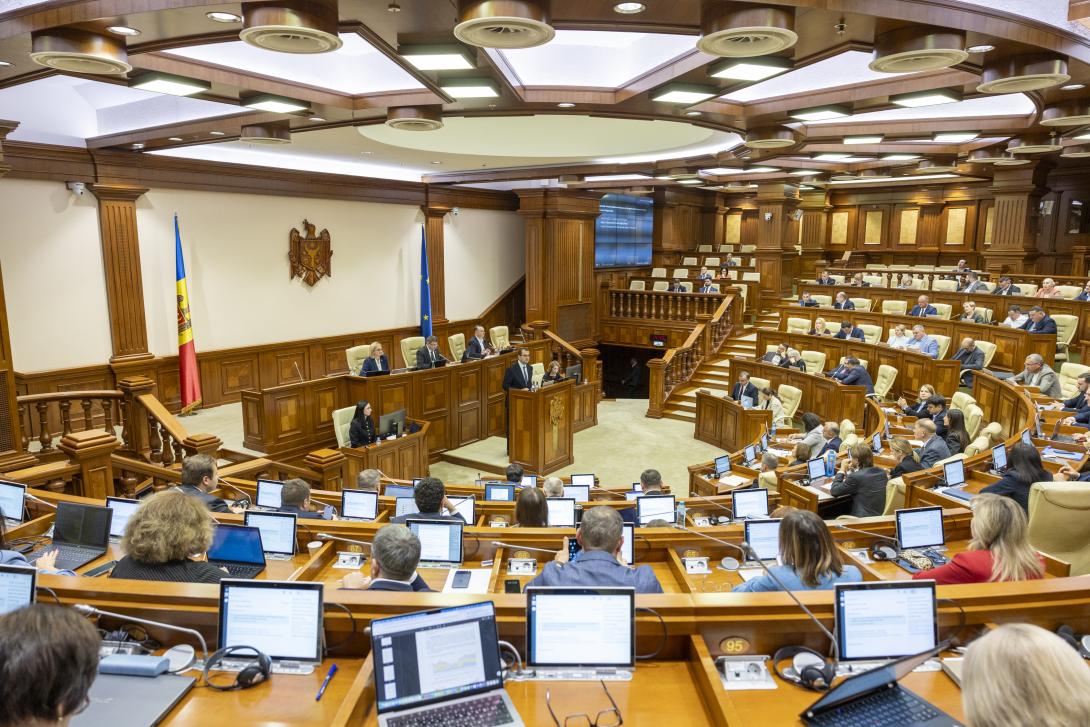
Moldovan PM's speech at parliament's plenary meeting on establishment of emergency state
The government today comes to parliament with a proposal to declare a state of emergency in the energy and hydrological sectors for 60 days, starting from September 26.

I understand how important this decision is and how much responsibility it places on the parliament and the government. That is precisely why I want to explain very directly why we believe this is the right decision in the present context.

I am not saying that tomorrow we will run out of gas, diesel, electricity or water. On the contrary, over the past two months, we have managed to stabilize more difficult situations.

The problem is that we are entering the cold season with more major risks overlapping at the same time. We are facing, in effect, a perfect storm.

The first risk is gas.

For more than half a year, the crisis in the Strait of Hormuz has disrupted one of the world’s most important hydrocarbon export routes. Moreover, Saudi Arabia’s East–West Pipeline, through which 4–5 million barrels of oil per day were transported, has also been damaged. In Qatar, attacks on Ras Laffan have taken approximately 17 per cent of the world’s liquefied natural gas export capacity out of service.

The consequence is directly reflected in prices.

European TTF gas reached approximately 84 euros/MWh, or more than 1,000 dollars per 1,000 cubic meters, in the first half of September, which is 50 per cent above the benchmark used to calculate the current, already increased tariff.

We have contracted more than 90 per cent of the gas needed for the winter. That is the good news.

However, a large part of this gas is indexed to TTF—the market price applicable at that time. In other words, having the volumes contracted does not mean that we also have the final price fixed. The price will depend on the market at the time of delivery—in November, December, or January—when those deliveries take place.

Therefore, our risk is no longer simply whether gas is available. It is the price at which we purchase it, how we finance the purchases and how we replenish stocks before winter.

The second risk is diesel and fuels in general.

Refineries and production facilities have been damaged or taken out of service both in the Middle East and in Russia—you know the reasons. Diesel exports from the Middle East have declined sharply, while international prices have reached record levels. Diesel quotations have exceeded 1,650 dollars in the Mediterranean Basin, according to Platts.

We already felt this problem in last August. Diesel stocks had fallen to fewer than four days’ supply and 109 gas stations reported diesel shortages. We intervened. Today we have approximately 10 days of stock and the number of stations experiencing problems has fallen from 109 to 8.

This shows us two things. First, the risk is real. Second, when the state has the necessary instruments and intervenes in time, we can stabilize the situation.

The third risk is water.

Drought is no longer just a problem for agriculture. It has become a problem of water supply and energy security.

On the Dniester, in recent weeks, the Novodnistrovsk reservoir has received an average of approximately 22 m³ of water per second, while we need to maintain a discharge flow of at least 60 m³/s; under normal conditions, the flow is more than 100 m³/s.

You do not need to be a hydrologist to understand that this arithmetic cannot continue indefinitely. If 22 enters and 50 leaves, the reservoir will fall. And that is exactly what is happening, creating technological risks for the power plant there.

The problem is not limited to the Dniester. Danube flows are also very low. This reduces hydropower production in the region and affects both power plants on the Danube and hydroelectric and nuclear power plants. You know that Hungary’s Paks nuclear power plant temporarily operated at approximately 10 per cent of capacity and that Cernavoda and the hydropower plant on the Danube also experienced major problems, further reducing electricity supplies in our region.

Less water means less energy available precisely when we are entering the months in which we need to import more.

At Costesti, on the Prut, hydropower production has fallen by approximately 55 per cent because of the drought.

Water and energy are directly connected. If major pumping stations remain without electricity for more hours, an energy problem can very quickly turn into a humanitarian problem involving the water supply of Chisinau and Balti.

The fourth risk concerns Ukraine and the coming winter.

Today, Ukraine is still managing to export energy to Moldova. This is a good thing and it helps us. But we cannot build our winter security on the assumption that this situation will remain unchanged.

Ukraine’s energy system has suffered massive destruction as a result of Russia’s attacks. According to our assessment, before the war Ukraine had approximately 70 GW of installed electricity-generation capacity; today, that capacity has fallen to 11–12 GW. This is a very serious problem for the region’s energy stability and we face a structural deficit of approximately 7 GW of electricity in our region.

We have already seen how tightly stretched the system is. On August 5, in order to maintain grid balance during peak hours, 100 MWh of emergency assistance from Ukraine was needed.

For Moldova, the figure that matters this winter is very simple. During peak hours, we will need to import 400–450 MW. On the Romanian side, however, we have a capacity limitation of 360 MW. Therefore, the deficit will have to come from Ukraine. If Ukraine has a difficult winter, with additional damage to its generation capacity, we will not be able to find these volumes for emergency electricity imports.

This is the problem. These multiple risks do not exist separately:

The real risk is not that one of these things will go wrong. The risk is that two or more risks will materialize, leaving us totally unprepared to respond to a truly major crisis.

And this brings me to the natural question: Why a state of emergency and not simply a continuation of the state of alert?

I want to be very precise here: the state of alert has worked and has given us real instruments.

We have been able to require daily reporting on stocks and import plans.

We also analyzed the option of continuing the state of alert, but we would not have all the necessary instruments, if more of these risks materialized simultaneously. The state of emergency allows us to go further, where the alert framework is no longer sufficient.

If critical infrastructure is damaged, we must be able to immediately purchase the necessary equipment through accelerated procedures. That is exactly what we did in March, when Moldelectrica was able to procure critical equipment directly and the Vulcanesti–Isaccea line was repaired in five days.

If we need to quickly install storage systems, generators or other emergency capacities, we must be able to temporarily simplify procedures and permitting requirements. This instrument was also used during the state of emergency in the spring.

If district-heating systems need to operate temporarily under different parameters in order to maintain heat and electricity supplies, we must have a legal basis for that.

If the international shock affecting fuel or gas becomes extreme, we need a legal framework that allows for temporary measures and regulatory or tax exemptions—changes to value added tax (VAT) or excise duties.

And if the water situation worsens, we must be able to prioritize drinking-water supplies, temporarily limit non-essential uses and rapidly mobilize pumps, generators and other necessary resources.

These are reserve instruments. I hope they will not be needed.

But it would be irresponsible to enter winter, see all these risks and wait for the crisis before coming to parliament to request the instruments we need.

We are requesting a state of emergency, as we are entering a period in which the risks are greater and more interconnected than the instruments provided by the state of alert. The government’s explanatory memorandum explicitly analyzes the option of continuing the state of alert and concludes that it would not cover some of the more severe scenarios that we must be prepared to manage.

And I want to be absolutely clear: we are not asking for a blank check. We are not asking for unlimited freedom.

Precisely because the instruments are stronger, responsibility and oversight must also be greater. The parliament is the body that declares the state of emergency.

The decisions of the National Crisis Management Center must be justified and remain subject to parliamentary oversight. The draft also expressly states that declaring a state of emergency does not suspend or affect the conduct of electoral processes.

The current state of alert expires on September 25 and reaches the limit of the period under the government’s authority. The risks, however, do not expire on September 25.

On the contrary, we are entering a period in which consumption begins to increase, temperatures fall and our safety margin becomes smaller.

The government’s role is not to wait for a crisis to occur and then explain why it failed to act.

We must have the instruments before these crises materialize. In August, we reached fewer than four days of diesel supplies and because we intervened, we managed to stabilize the market.

I would rather come before parliament today, explain the risks transparently and be prepared than find ourselves in January in a situation in which we need these instruments and do not have them available.

I hope that, in 60 days, we will be able to say that many of these instruments—or ideally all of them—were not needed. That would be the best outcome.

But preparing for a crisis does not begin when the lights go out, the pump stops or diesel disappears from gas stations. It begins before the crisis has struck with full force—it begins today.

That is why, the government is requesting parliament’s support for declaring a state of emergency in the energy and hydrological sectors.
 Facebook
 Instagram
 X/Twitter
 Telegram
PM, at Etno Fest Taraclia, says diversity of cultures, traditions makes Moldova richer
Art Comes to Life – immersive exhibition hosted by Moldova's parliament
Data of 2024 Census used in public policy development in Moldova
Moldovan PM meets with Head of Council of Europe Office in Chisinau
Moldovan PM to attend 81st session of United Nations General Assembly
Prime Minister visits Zarea Hotel: We want transparent auction and as many bidders as possible
New edition of program „Sub cușma lui Guguță” launched at Parliament
Reforming recruitment in civil service: from legal framework to implementation
Summary of Moldovan parliament's plenary meeting held on September 17, 2026
Roman Rosca takes over as chair of special parliamentary commission for monitoring and oversight of Moldova’s reintegration policy
Working of small farms in built-up areas of localities to be regulated by law in Moldova
Moldova accedes to convention in marine environmental protection sector
Moldovan deputy PM for reintegration has meeting with Sweden’s Ambassador
Moldovan PM meets Director of European Bank for Reconstruction and Development for Ukraine and Moldova
Moldovan PM presents draft law establishing state of emergency in parliament
Moldovan PM says over 620,000 households might benefit from energy compensation during this season
LIVE // Moldovan PM in parliament: government calls for establishing state of emergency in energy, hydrological sectors
Moldova, Austria strengthen cooperation; Moldovan parliament speaker meets new Austrian ambassador
Bypass road of over 7 km to be built in Cimislia town of Moldova under a 43.3 million-euros-worth contract
Moldovan president, delegation of Czech senators discuss Moldova’s European path, bilateral cooperation
Moldova establishes diplomatic relations with Togo
 National Bank of Moldova
Moldovan president, delegation of Czech senators discuss Moldova’s European path, bilateral cooperation
Government improves financing mechanism for regional and local development projects
National railway infrastructure program for 2026–2030 approved by Government: Railway to be modernized and passenger transport expanded
Crime victims to gain easier access to support and compensation
Chisinau's Triumphal Arch to be restored

Czech Senator: Moldova belongs at European table and is part of European project
Environment Minister on Dniester situation: Water reserves three times lower than discharges, situation worsened
Energy Minister on declaring state of emergency: We must be prepared to act quickly
Council of Europe Office to UN inaugurated in New York
Government improves financing mechanism for regional and local development projects
National railway infrastructure program for 2026–2030 approved by Government: Railway to be modernized and passenger transport expanded
Crime victims to gain easier access to support and compensation
Chisinau's Triumphal Arch to be restored
Government begins reorganization of central public administration to reduce expenditures
Serghei Diaconu on state of emergency: Any scheme in procurement procedures applied in crisis situations ruled out
Moldova and India expand cooperation: investments, exports and new agreements on bilateral agenda
Number of families eligible for energy compensation to increase
Chisinau’s Triumphal Arch to be registered as state public property
Government proposes declaring state of emergency in energy and hydrological sectors for 60 days
Government approves declaration of state of emergency in energy and hydrological sectors
Moldova and Hungary to boost economic cooperation
Receive the latest news directly to your email

Receive the latest news directly to your email