
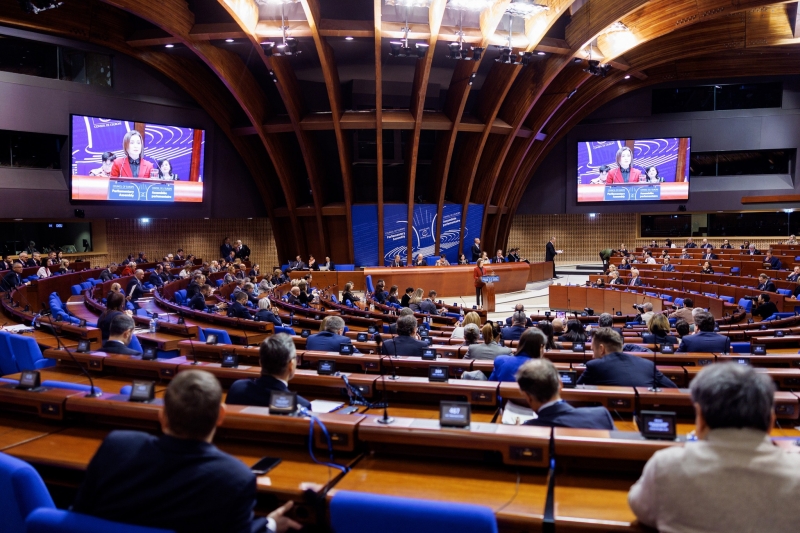
Moldovan President in Strasbourg: Today Europe is facing two wars – one that destroys cities and another that erodes democracies
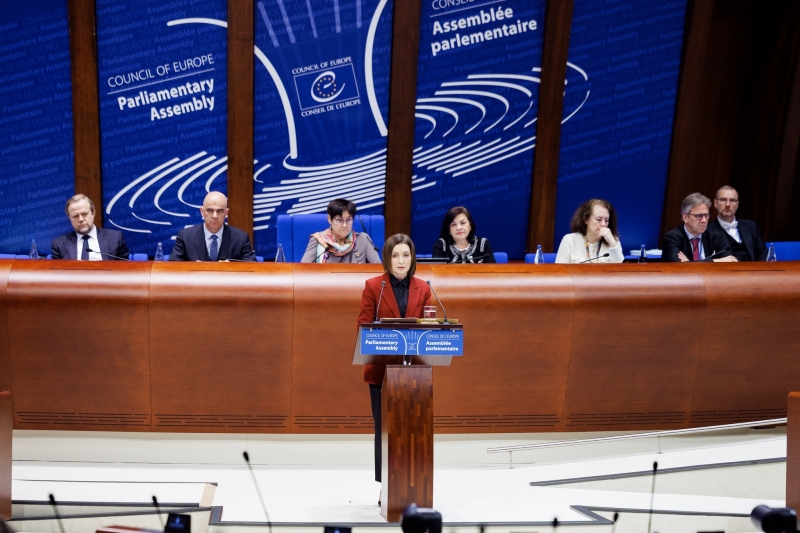
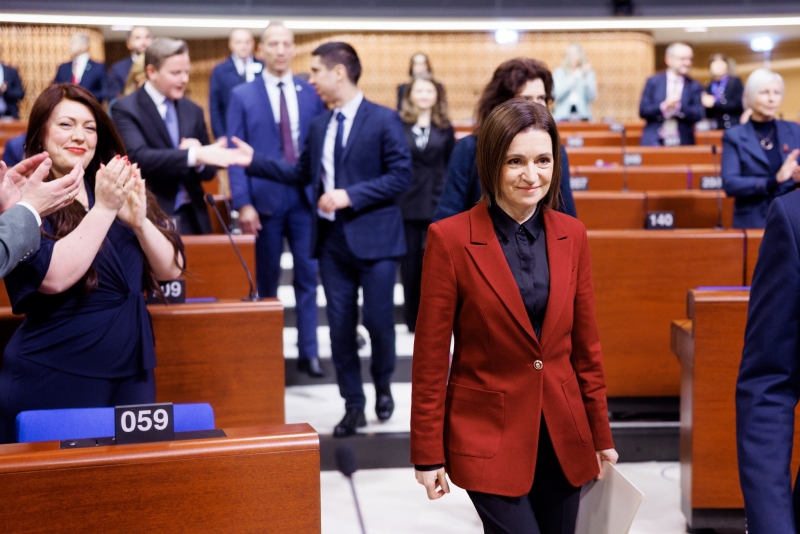
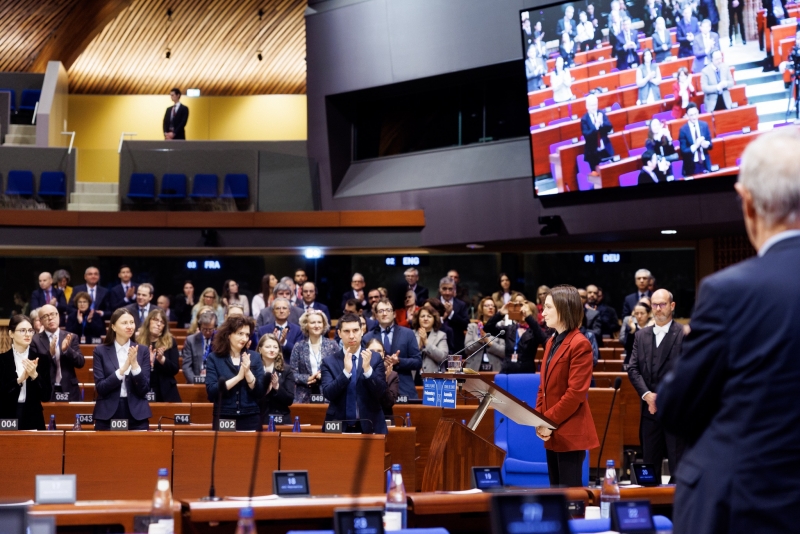
President of the Republic of Moldova Maia Sandu delivered a speech before the Parliamentary Assembly of the Council of Europe, on the occasion of our country holding the Presidency of the Committee of Ministers of the Council of Europe, in which she warned about the most serious threats facing Europe: the Russian Federation’s military aggression against Ukraine and the hybrid war being waged against European democracies.

“The Council of Europe was born as a result of the failure of European democracies to protect themselves in time,” Maia Sandu underlined, recalling that peace without democratic resilience is temporary. “The Council of Europe was never meant to be a comfort zone. It was meant to be a line of defence.”

Referring to the war in Ukraine, the President of the Republic of Moldova firmly condemned the Russian Federation’s aggression and the deliberate use of civilian suffering as a weapon of war. “Millions of Ukrainians live in darkness and cold — not because of the weather, but because Kremlin has turned the freezing of civilians into a weapon of war,” Maia Sandu said.

The Head of State spoke that for the Republic of Moldova this war is not a distant one. “We know that we owe our peace to Ukraine’s resistance,” the Head of State stressed.

In her speech, Maia Sandu also drew attention to the second war, less visible but just as dangerous: the hybrid one against democracies. “This war is waged within our societies, a hybrid war, an information war, a war meant to divide people and to control our hearts and minds,” the Head of State noted, pointing out that one of these wars destroys cities while the other destroys trust.

The President reiterated that the Republic of Moldova is on the front line of these threats. “For two consecutive years, our country has faced massive electoral interference,” Maia Sandu said, mentioning the artificially provoked energy crisis, political corruption, cyberattacks, and online disinformation campaigns.

Drawing on Moldova’s experience, the Head of State said that one of the greatest threats to democracies is disinformation amplified by technologies and social networks, by opaque algorithms and by the potential abuse of artificial intelligence. “Algorithms increasingly determine what people read, watch, and believe, while the logic of these algorithms remains largely opaque,” the President warned, stressing that this type of manipulation enables rapid, massive, and hard‑to‑detect attacks on democratic societies.

Maia Sandu expressed particular concern about the impact of this phenomenon on young people, given that technologies have the capacity to directly affect the freedom of thought of new generations. “If we do not act, those who control technologies will come to control how people think,” the President explained, emphasizing that “if we want democracies capable of resisting manipulation, we must protect the freedom of young minds.”

In this regard, the Head of State insisted on the need for urgent and coordinated action to defend democracies: “Our democracies are under direct attack,” warning at the same time that we cannot respond only with long‑term strategies while elections are being manipulated in real time. The President advocated for a clear legal instrument of the Council of Europe on combating information manipulation and foreign interference.

“We must act at the same speed as the threat,” concluded the President of the Republic of Moldova, stressing that “the Council of Europe was created for moments like this — not when democracy is in a comfort zone, but when it is under challenge.” The Republic of Moldova will exercise the Presidency of the Committee of Ministers in line with this responsibility.
 Facebook
 Instagram
 X/Twitter
 Telegram
Moldovan PM has discussions with Romania's president
Moldovan deputy PM for reintegration has meeting with Secretary-General of Federal Ministry for European and International Affairs of Austria
Moldovan PM invites members of American Chamber of Commerce in Romania to invest in Moldova
Moldovan parliament speaker participates in Bucha Summit
Prime Minister at Romania Government Roundtable Conference
Moldovan president’s working visit to Finland postponed later date
PM meets Ambassador of Czech Republic to Moldova
Moldovan president has meeting with delegation of European affairs committees from, Baltic, Nordic states, Poland
Interreg Europe Programme in Moldova: funding opportunities, interregional cooperation
Moldovan PM to pay official visit to Bucharest
President to pay visits to Finland and Latvia
Moldova switches to daylight saving time on night of March 28 to March 29
Moldovan government joins Earth Hour international initiative
Moldovan president, EU Commissioner for Justice discuss accelerating justice reforms
CNMC: Eenergy sector remains fragile, ending state of emergency requires caution
Foreign Ministry: We condemn violation of airspace. Such actions endanger citizens’ security
Support for export promotion: 16 business associations to receive 14.6 million lei through Bridge Export Program
Over 20 media projects to get funding from media subsidy fund
 National Bank of Moldova
President met with U.S. Senator
Proposals for improving efficiency of ministries discussed at roundtable
Prime Minister visited agricultural business in Unguri village, Ocnița district
Prime Minister visited rescuers and firefighters unit in Ocnița
Weekly meeting of Joint Control Commission of 2 April 2026

Simple motion on public policies implemented by Ministry of Labour and Social Protection failed
Proposals for improving efficiency of ministries discussed at roundtable
PHOTO GALLERY // Premiere at Mihai Eminescu National Theater: “Intrigue and Love,” directed by Alexandru Cozub
Moldova to sign social security agreements with Quebec (Canada), Albania, Croatia and Ireland
Around 622,000 vulnerable families receive energy compensation
Prime Minister visited agricultural business in Unguri village, Ocnița district
Minister of Labor and Social Protection: Deficit of state social insurance budget decreased to 3.6 billion lei in 2026
Prime Minister visited rescuers and firefighters unit in Ocnița
Eastern European plants used in Chinese medicine: book by Wang Yifeng launched in Chișinău
PHOTO GALLERY // About 160 companies gathered at Moldconstruct and Moldenergy exhibitions: innovation and cutting-edge technologies
Weekly meeting of Joint Control Commission of 2 April 2026
Energy and infrastructure – essential pillars in Ukraine’s reconstruction
Specialized international exhibitions Moldconstruct and Moldenergy open at Moldexpo
Deputy Prime Minister for Reintegration meets Ambassador of Romania to Moldova
Speaker about permanent withdrawal from CIS statutory bodies: Moldova has sovereign and independent right to decide which union to be part of
Moldovan government representatives to present to parliamentary factions actions taken during emergency state, proposals on future developments
Receive the latest news directly to your email

Receive the latest news directly to your email