
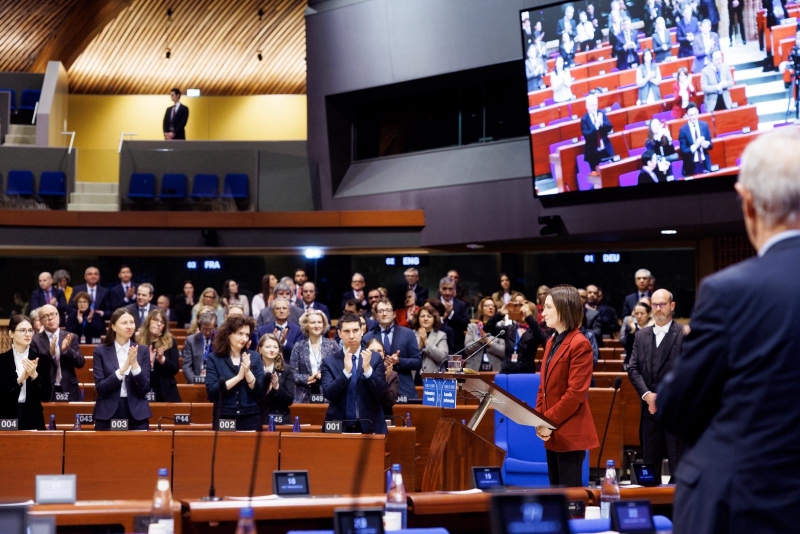
Moldovan President’s address to plenary of Parliamentary Assembly of Council of Europe
President of the Assembly, Madam Petra Bayr, congratulations on your election,
Secretary General Alain Berset,
Honourable Members of Parliaments,
Distinguished guests,Today I want to speak about the two wars Europe is facing, how our democracies are being attacked, how those attacks are amplified by technology, and what we should do to protect our peace, our democratic choices and our freedom.
As Moldova holds the rotating Presidency of the Council of Europe’s Committee of Ministers, allow me to remind us that the Council of Europe was born from the failure of European democracies to protect themselves in time. From the realisation that peace without democratic resilience is temporary.
The Statute of the Council of Europe is explicit.
Its purpose is to achieve greater unity.
To safeguard human rights.
To uphold democracy and the rule of law.Not as ideals alone.
But as systems that must withstand pressure, manipulation, and abuse.The Council of Europe was never meant to be a comfort zone.
It was meant to be a line of defence.And today, Europe is at war again. Two wars, in fact.
The first is visible, brutal, and devastating.
Russia is waging a conventional full-scale military invasion of Ukraine. Cities are destroyed. Civilians are killed. Energy infrastructure is deliberately targeted. This winter, millions of Ukrainians are living in darkness and cold — not because of the weather, but because Kremlin has made freezing civilians a weapon of war.
To break the will of a nation by making life itself unlivable.
For most of us, this kind of suffering is impossible to imagine. But for Ukrainians, it is daily life. And it demands not only our solidarity — but our responsibility.
For Moldova, this war is not distant.
In Moldova we know that we owe our peace to Ukraine’s resistance.
We know that if Ukraine falls, Russia will not stop at Moldova.
Ukraine’s fight is therefore about the security of Moldova, of the region, and of Europe as a whole.
And this is also why there can be no lasting peace without accountability for Russia’s aggression. Without justice, war does not end — it only pauses and prepares to return.
Here, the Council of Europe has a vital role to play — not as a neutral observer, but as a political guardian of democratic values and international law. The accountability mechanisms developed within this Organisation, including the register of damage and work to ensure justice for victims, are essential to restoring trust in the rules that protect us all.
But while our attention is rightly focused on this war, a second war is unfolding.
This is the war against our democraciesIt is less visible.
But it is no less dangerous.This war is being fought inside our societies.
It is a hybrid war.
An information war.
A war to divide people and control our hearts and minds.This war is accelerated by technologies we do not fully see and understand. By algorithms that increasingly determine what people read, watch, and believe, while their logic remains largely opaque.
These two wars are not separate. They reinforce one another.
Russia’s military aggression and its hybrid operations pursue the same objective: to undermine, control, and divide Europe.
One destroys cities.
The other erodes trust.One uses missiles.
The other uses money, narratives, and manipulation.This is how democracies are attacked — from within.
At the core of this second war are two things.
Dark money.
And dark politics.Dark money fuels dark politics.
Illicit financial flows make manipulation scalable and persistent. They pay for influence operations, political capture, and disinformation designed to divide societies and turn people against themselves — against their own state, democracy, and freedom.
Moldova has been — and still is — on the frontline of this second war.
For two consecutive years, our country has faced massive electoral interference. It was multi-domain.
An energy crisis designed to put economic pressure on vulnerable citizens.
Political corruption targeting parties and candidates.
Information warfare across online platforms.
Cyber operations aimed at institutions and voters.All with one objective: to seize Parliament, install a Kremlin-controlled government, crush our democracy, drag Moldova into Russia’s sphere of influence, and use it against Ukraine and against Europe.
And if that failed, to delegitimise elections, provoke unrest, and weaken trust in our institutions.
Social networks became central battlegrounds in this war. What we saw in Moldova was not a spontaneous expression. It was organised, funded, and scaled by AI.
One single coordinated network of just over 100 fake accounts on TikTok, operating for less than three months, generated around 50 million views, over 100,000 comments, and more than 1.5 million interactions — in a country of 2.4 million people.
The goal was to create a false impression of overwhelming anger and social collapse — to exhaust citizens, amplify fear, and discourage democratic participation. This was not an isolated case.
We also documented the activity of an influence network, already identified by European partners, which produced more than one thousand coordinated publications about our country in just a few months.
These messages accumulated tens of millions of views and were deliberately laundered through seemingly credible voices before being amplified by inauthentic accounts.
This targeted Moldova’s image abroad.
When traditional propaganda channels were restricted, hostile actors adapted again.
Content linked to Kremlin-affiliated broadcast media was delivered directly into people’s homes through mobile applications, bypassing audiovisual regulation entirely.
When exposed, these outlets did not disappear.
They changed domains and jurisdiction.
They rebranded and resumed operations within days.This adaptability tells us something essential.
We are facing professional, well-funded, long-term operations — built on the systematic identification of vulnerabilities, enabled by transnational infrastructure, and sustained by the exploitation of legal loopholes.
Moldova is not the only country facing these challenges.
We see similar pressures across Europe.I am proud to say that Moldova resisted this two-year assault through a whole-of-society effort. Our citizens proved their commitment to peace, to Europe, and to democracy.
But I regret to see Georgia, where — despite the courage of the Georgian people, who continue to stand up for democratic values, European aspirations, and the right to decide their own future — Russia pulled Georgia back into its orbit by weaponising the fear of war, signalling that the wrong electoral choice would come at the cost of peace.
Now Armenia is becoming a target of the same strategy — aimed at weakening sovereignty, influencing democratic choices, and exploiting internal vulnerabilities.
We stand with Armenia and its people as they work to resist these pressures and defend their democratic future.
Among all the ways this hybrid war is waged, the most dangerous for the future of our democracies is information manipulation amplified by technology, opaque algorithms, and artificial intelligence.
If left unchecked, those who control technology will increasingly control how people think.
I am particularly concerned about the impact of this cognitive war on the younger generation.
If we want democracies that can resist manipulation, we must protect the freedom of young minds.
This is not only a question of technology or regulation.
It is a question of democratic resilience.Trust, critical thinking, and mental wellbeing are essential conditions for free societies.
The Council of Europe has already given us a clear starting point: children’s rights apply fully online, and states have a responsibility to protect their best interests in the digital environment.
Moldova’s experience shows why this matters: disinformation works by exhausting societies — by making people fearful, divided, and distrustful. And it is especially effective where young people are left unprotected in digital spaces designed to exploit attention and emotion.
This brings me to what I think we should do.
Long-term efforts alone will not meet the urgency of this threat.You do not respond to a patient in cardiac arrest by announcing a long-term public health strategy.
You act immediately.
You stabilise the patient.
You stop the bleeding.
And then you invest in prevention and resilience.Today, our democracies are under acute attack.
Treating this only as a long-term challenge — while elections are actively manipulated and institutions destabilised — leaves democracies exposed at the very moment they need protection.
We must act at the speed of the threat.
And we must protect our democracies without betraying democratic principles.Here, the Council of Europe has a unique role to play.
We need a clear and comprehensive legal instrument on foreign information manipulation and interference — one that addresses election interference, media concentration and capture, organised crime, cybercrime, corruption, and the malign use of artificial intelligence and other technologies.
This should allow us to act before damage is done — not after.
After two years of resisting Russian interference, here is what has worked for us.
Coordinated disinformation campaigns must be exposed and disrupted before they shape voters’ perceptions and distort democratic debate.
For this, journalists and civil society must be protected.Foreign interference and proxy actors must be exposed before trust in elections is undermined.
Illegal party financing must be tracked before those who benefit from it gain power through the ballot box.
And I cannot emphasise elections enough.
In democracies, they are the most vulnerable entry point for foreign manipulation — and the most decisive one. This is where trust can be broken fastest, where disinformation has the greatest impact, and where illicit money can translate directly into power.
That is why monitoring must begin months before voting day and extend fully into the online space.
Digital interference must be detected in real time, not reconstructed afterwards.
And illegal money must be identified and stopped before it distorts the will of voters.
Cutting off the financial lifelines of interference, including through cryptocurrency, is essential to stopping manipulation at scale.
The work of the Financial Action Task Force and MONEYVAL has been essential in strengthening anti–money laundering frameworks across Europe. Moldova is also largely compliant with MONEYVAL standards. Yet our experience shows that even strong AML systems are not enough.
We lacked the legal and operational tools to act fast against illicit financial flows specifically designed to interfere with elections.
Money fuels interference. Technology amplifies it. Therefore we must govern the digital space responsibly.
The internet and social platforms have strengthened freedom and connection. They are among humanity’s great innovations. But no invention exists without rules. Electricity requires safety standards. Cars require traffic rules — especially near schools. The digital space is no different.
Children’s wellbeing must be protected.
Freedom of expression must be protected from fake accounts posing as free voices.
Artificial intelligence must be governed with care.
Taken together, these are acts of democratic self-defence. And they define whether democracy remains a living system — or becomes an open target.
So we must move faster than the threat and take the initiative.
The Council of Europe was created for moments like this — not when democracy is comfortable, but when it is contested.
Moldova’s presidency of the Committee of Ministers of the Council of Europe will act with this responsibility in mind.
Thank you.
 Facebook
 Instagram
 X/Twitter
 Telegram
President to hold press conference today, July 3
Social benefits totaling 76.3 million lei provided to citizens of Moldova residing in Transnistrian region in first half of 2026
Government Program: 85 young people to complete paid internships within public authorities
Prime Minister met with EU Representative for Transnistrian settlement
Prime Minister and Strategic Counsellor at Tony Blair Institute discuss support for European reforms in Moldova
President met with former Prime Minister of Finland
20 model schools to undergo major modernization: Government approves ratification of Financing Contract between Moldova and EIB
President announced measures following abuses at MoldATSA
President’s statements on measures announced following abuses at MoldATSA
116 projects, including for opening new nursery groups included in Single Programming Document for 2025–2027
More road safety: Government sets clearer rules for market surveillance of motor vehicles
Victims of human trafficking to benefit from greater protection and faster assistance
Better conditions for businesses in northern Moldova, at Multifunctional Industrial Park in Ocnița
Deputy Prime Minister for Reintegration meets with EU Representative for Transnistrian settlement
VIDEO // Moldova requests disbursement of 191.5 million euros from EU Reform and Growth Facility
Harvard Business School graduate and investor in major Moldovan companies: Profile of PAS candidate for Prime Minister, Vasile Tofan
Republic of Moldova opens accession negotiations with EU for External Relations Cluster
Vasile Tofan, PAS candidate for prime minister: I will channel all my energy and experience to complete European integration process
MP Alex Trubca resigns
Breaking news
VIDEO // Vasile Tofan is PAS’s candidate for prime minister
Cyber defence and combating hybrid threats on agenda of Moldovan-Swiss consultations in Bern
 National Bank of Moldova
Bootcamp of Joint Internship Programme of European Union and Moldovan Government
Government’s State Secretary for Reintegration meets with Ambassador of Croatia
Participation of Deputy Prime Minister for Reintegration in roundtable on Transnistrian conflict settlement process, held in Vilnius
Republic of Moldova implemented over 90% of reform measures planned for first half of 2026
President met with Head of Council of Europe Office in Chișinău

Republic of Moldova implemented over 90% of reform measures planned for first half of 2026
Acting Deputy Prime Minister to Xinhua News Agency: Relations and cooperation between Moldova and China have significant development potential
Sunflower seeds and cables among Moldova’s top exports in first half of year
President met with Head of Council of Europe Office in Chișinău
Parliamentary opposition boycotts consultations launched by Head of State on appointment of new Prime Minister
Dynamics of vehicle registration with national and neutral license plates in Transnistrian region
PHOTO // Parliamentary delegations from France and Poland visit Chișinău to support European path of the Republic of Moldova
Head of State invites parties to consultations on appointing new Prime Minister
PHOTO // Ialoveni and Chinese city of Yiwu sign cooperation agreement to develop economic and trade relations
Parliament adopts National Program for Preventing and Combating Money Laundering for 2026–2030
Works on Slobozia Mare bypass ring road reached over 97%
Moldova joins international efforts to compensate damage caused to Ukraine
Working visit of State Secretary of Government for Reintegration to localities of Copanca and Grădinița, Căușeni district
Constitutional Court annuls right of Comrat authorities to appoint heads of Interior, Intelligence and local electoral bodies
ARMENPRESS: TRIPP project also serves Iran’s interests, Pashinyan says
VIDEO // Voluntary amalgamation process to end on July 31
Receive the latest news directly to your email

Receive the latest news directly to your email