
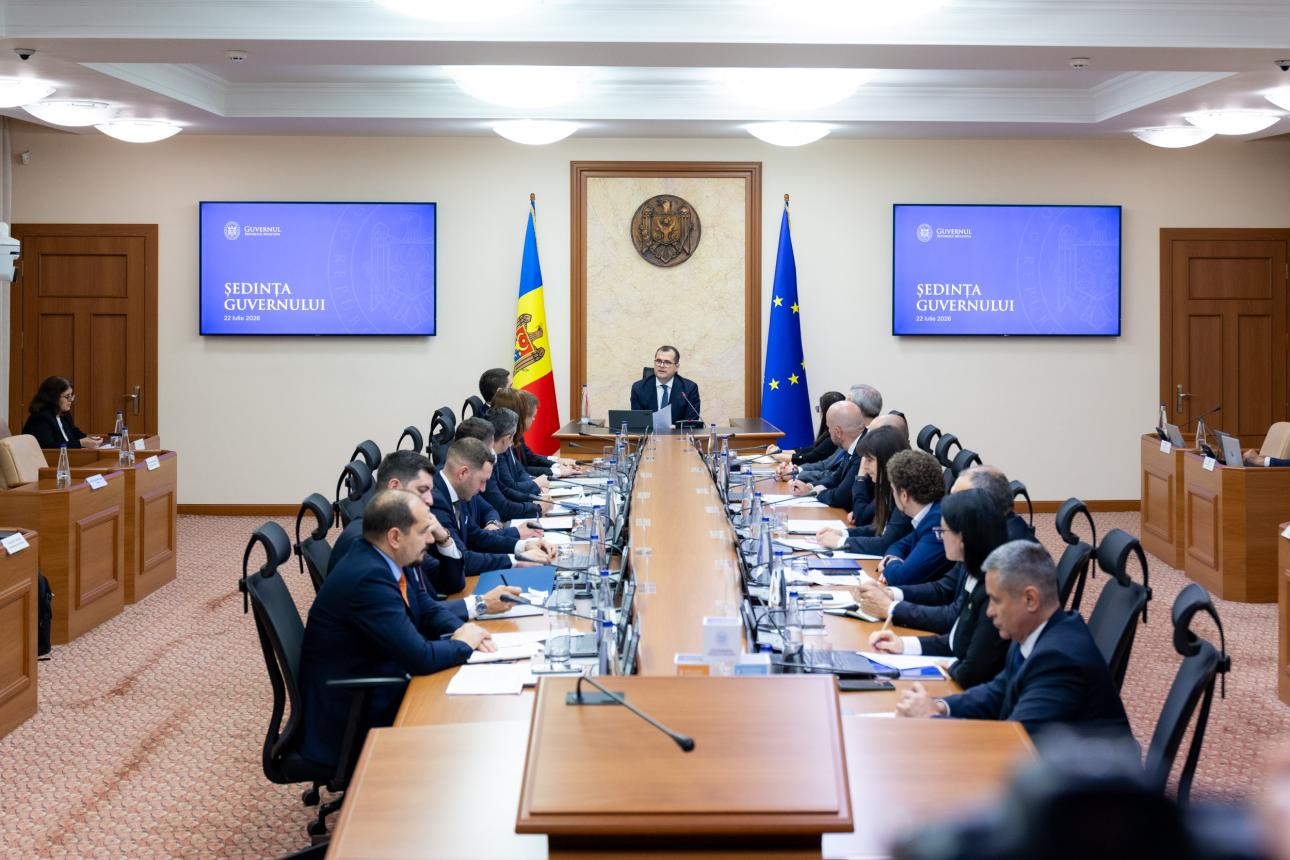
Moldova's schools to be transferred under subordination of Education Ministry; government approves Restart in Education reform
The schools of Moldova will be placed under the subordination of the Education and Research Ministry (MEC), with the establishment of the Territorial Education Agencies (ATE). This measure is provided for in the Restart in Education reform, approved by the government.

Presently, schools are administered by district and municipal councils through local education departments. The new agencies will replace these departments and will become the founders of primary schools, gymnasiums, lyceums, and special education institutions. Kindergartens and extracurricular institutions will remain under the administration of local public authorities.

The ATEs will manage the funding of institutions, approve the number of classes and staffing schemes, set school districts, monitor compliance with compulsory schooling, intervene in the management of infrastructure and budgets, combat absenteeism and bullying and support children with special educational needs. For pupils and parents, the reform will ensure faster interventions and more efficient support services, while for teachers and headmasters it will provide access to specialists and resources that many schools currently lack.

“The switch of schools under the Ministry of Education’s subordination, through the Restart in Education reform, aims to ensure that every child benefits from the same standards of quality, support and safety, regardless of whether they study in a big city or in a small village. Today, the quality of education a child can access depends heavily on the capacity and involvement of district councils, which are the founders of schools. In some districts, there are specialists, resources, and support, while in others schools must largely manage on their own. The place where a pupil is born must not determine their future and state education policies must be implemented uniformly across the entire country,” said Education and Research Minister Dan Perciun.

The Restart in Education reform has three major objectives:

1) Strengthening the administrative capacity of the structures responsible for managing schools by increasing salaries, reducing the number of vacant positions, digitizing processes and introducing modern management based on objectives and measurable results.

2) Ensuring the coherent and effective implementation, at the level of every school, of the policies promoted by the Education and Research Ministry. The reform targets the strengthening of schools’ institutional and financial autonomy, de-bureaucratization, transforming inspections from a punitive mechanism into a tool for support and quality improvement, reducing informal payments, promoting inclusion, preventing and combating bullying, promoting patriotic education and national values, as well as ensuring integrity at examinations. The ATEs will ensure the consistent, top‑down implementation of state educational policies, eliminating the fragmentation of responsibilities.

3) Establishing an education governance system based on the best interests of the child and, equally, on data and evidence. The ATEs will help limit the influence of local political factors on the allocation of investments, the selection of principals, and the organization of the school network, so that decisions are transparent, equitable and grounded in the real needs of pupils and communities.

Once they are transferred to the Territorial Education Agencies, schools will be funded directly from the state budget based on a standard cost per pupil. At present, the money reaches institutions through local budgets. School budgets and reports on their implementation will be published online, so that parents and communities can see how public funds are spent.

The directors of the Territorial Education Agencies will be selected through open competitions and appointed for five‑year terms. The same person will not be able to lead an agency for more than two terms. Civil servants from the current district and municipal education departments will be eligible for transfer to vacant positions at the new agencies.

The document guarantees the continuation of funding for extended‑programme groups and classes with arts or sports profiles that operated in the 2025–2026 school year. If the number of such classes or groups changes, the earmarked financial resources will not be withdrawn from the territorial agency’s budget, but may be used for institutions in its service area.

The government is to establish, by October 30, 2026, the 35 ATEs, along with their structure and staffing limits. The transfer of schools and the application of the new funding system are scheduled for January 1, 2027. Under the special law on the autonomy of the Autonomous Territorial Unit of Gagauzia, schools of the region are not covered by the reform.
 Facebook
 Instagram
 X/Twitter
 Telegram
Clear rules for traffic organization, public transport development and establishment of paid parking
Prime Minister meets with IMF Mission visiting Chișinău
More opportunities for small and medium-sized enterprises
Moldovan parliament's standing bureau approves agenda of parliament meeting of October 22
Topics examined at meetings of Moldovan parliament's standing commissions on 20–21 September 2026
Moldova's state secretary for reintegration has meeting group of students, young professionals
Moldovan government approves national strategy on drugs, addictions for 2026–2032
Clear-cut rules for traffic management, public transport's development, paid parking arrangements in Moldova
Balti municipality's mayor to be able to be assisted by own cabinet
Government approves creation of 34 territorial education agencies to administer country’s schools
Better medicines, medical devices and technologies: Government approves single national assessment mechanism
Moldova accelerates transition to electric transport: at least 600 charging points by 2030
Moldovan citizens working in Ireland to receive pensions for years worked in both countries
French support for continuing reforms in energy sector
Online services for submitting, issuing permits restored after cyberattacks in Moldova
Chisinau Airport to operate direct flights to 61 destinations during next winter season
START Enterprise: Moldovans might launch businesses from their phones, without prior approvals
Moldovan PM pays working visit to Ukraine: meeting with Ukrainian head of state, participation in International Economic Forum
Romanian Army Day. President: Institution Romanians trust most
PM: Commissioning Chișinău power substation to reduce risk of blackout
Tofan Government’s 100-day report to be presented on 5 November
 National Bank of Moldova
Moldovan PM pays working visit to Ukraine: meeting with Ukrainian head of state, participation in International Economic Forum
Moldovan President meets with Hungarian President and Prime Minister
President attends commemoration in Budapest marking 70th anniversary of 1956 anti-communist revolution
Moldovan PM meets young people who won three medals for Moldova at World Robotics Championship
Moldovan PM, vice-president of European Investment Bank discuss accelerating development projects in Moldova

Cyberattack on digital public services: authorities block about 11 million access requests
PHOTO // Austria’s National Day marked in Chisinau
President holds meetings with Hungary’s leaders in Budapest
Moldovan President meets with Hungarian President and Prime Minister
President attends commemoration in Budapest marking 70th anniversary of 1956 anti-communist revolution
Violence can escalate to femicide: How to recognize warning signs and where victims can seek help
PHOTO GALLERY // Romanian Armed Forces Day celebrated in Chișinău with exhibition dedicated to international military missions during interwar period
PHOTO // President honors courage of Hungarian people, 70 years after 1956 anti-communist Revolution
Ukraine condemns violation of Moldova’s airspace
Moldovan president condemns incident in Telenesti district: “Russia’s war continues to endanger citizens’ lives”
Staff member of Russia's Embassy in Moldova to be declared persona non grata after explosive-laden drone crashed in Telenesti district
Moldovan PM meets young people who won three medals for Moldova at World Robotics Championship
Facilitated access to EU market: European Investment Bank provides 150 million euros to modernize agri-food sector through Moldova's Orchard II programme
Moldovan PM, vice-president of European Investment Bank discuss accelerating development projects in Moldova
Two cases of national airspace violations recorded in Moldova in past week; Defence Ministry reiterates need to strengthen air defense capabilities
Moldovan deputy PM for reintegration participates in marking 30 years of work of theoretical lyceum from Grigoriopol
Receive the latest news directly to your email

Receive the latest news directly to your email