
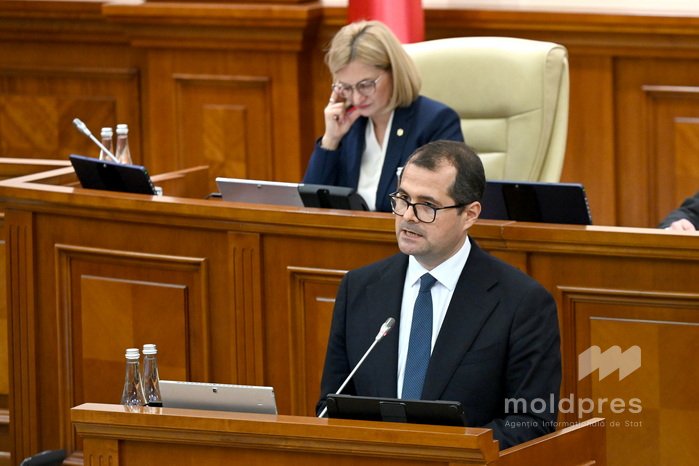
Moldovan PM presents draft law establishing state of emergency in parliament
Prime Minister Vasile Tofan today presented in parliament the draft law on establishing a state of emergency in the energy and hydrological sectors for a period of 60 days, starting from September 26. The official pointed out that Moldova was entering the cold season with more overlapping risks and that, under these conditions, the authorities need the necessary tools to act promptly and ensure that citizens have access to energy resources and water.

The PM said that the state of alert in the energy and hydrological sectors expires on September 25, while the risks that led to its introduction have not disappeared but, on the contrary, have intensified, especially as the country is on the threshold of the cold season, “a period when consumption begins to rise, temperatures fall and the safety margin becomes smaller.”

Thus, according to the prime minister, “the role of the government is not to wait for a crisis to occur and then explain why it did not act”; instead, the authorities must have the necessary tools to manage the situation effectively before potential crises materialize.

„Today is the second time I have come to parliament. I would have preferred it to be under different circumstances, but today we are here to ask for a vote of confidence to support the proposal to declare a state of emergency in the energy and hydrological sectors for 60 days, starting on September 26. I understand how important this decision is and how much responsibility it places on the parliament and the government. That is why, I want to explain very directly why we believe this is the right decision in the current context. I am not saying that tomorrow we will be left without gas, diesel, electricity or water. On the contrary, over the past two months we have managed to stabilize more difficult situations. The problem is that we are entering the cold season with more major risks overlapping at the same time. We are practically facing a perfect storm,” Prime Minister Vasile Tofan said.

According to the official, the first major risk concerns gas supplies and rising gas prices.

„For more than half a year, the crisis in the Strait of Hormuz has disrupted one of the world's most important hydrocarbon export routes. In addition, an oil pipeline in Saudi Arabia was damaged. In Qatar, attacks on Ras Laffan have taken approximately 17 per cent of the world's liquefied natural gas export capacity offline. The consequence can be seen directly in prices. In the first half of September, European gas reached approximately 84 euros per megawatt-hour, or more than 1,000 dollars per thousand cubic meters, which is 50 per cent above the benchmark used to calculate the current tariff, which has already been increased. We have contracted more than 90 per cent of the gas needed for the winter. So, that is the good part. But a large portion of this gas is indexed to TTF, meaning it is tied to the market price at the time. In other words, the fact that we have contracted the volumes does not mean that we have also fixed the final price. The price will depend on the market at the time of delivery, whether those deliveries take place in November, December or January. Therefore, our risk is no longer simply whether gas is available. It concerns the price at which we purchase it, how we finance the acquisitions and how we replenish stocks before winter,” Vasile Tofan noted.

The second risk mentioned by Vasile Tofan concerns ensuring the country's fuel supply.

„Refineries and production facilities have been damaged or taken offline both in the Middle East and in Russia. You know the reasons. Diesel exports from the Middle East have fallen sharply, while international prices have reached record levels. Diesel prices have exceeded 1,650 dollars in the Mediterranean basin. We already felt this problem in August. Diesel stocks had fallen to less than four days' supply, and 109 gas stations reported diesel shortages. We intervened. Today we have approximately 10 days of stocks and the number of stations experiencing problems has fallen from 109 to 8. This shows us two things. First, that the risk is real. Second, when the state has the necessary tools and intervenes on time, we can stabilize the situation,” the prime minister said.

The prime minister also highlighted the risks related to water supplies.

„The third risk is water. Drought is no longer just a problem for agriculture. It has become a problem of water supply and energy security. On the Dniester, in recent weeks, approximately 22 cubic meters per second have been flowing on average into the Novodnestrovsk reservoir, while we need to maintain a discharge flow of at least 60 cubic meters per second; under normal conditions, the flow is more than 100 cubic meters per second. The reservoir is falling, creating technological risks for the power plant there. But the problem is not limited to the Dniester. The flow of the Danube is also very low. This reduces hydropower production in the region and affects the power plants along the Danube, further reducing electricity supplies in our area,” Vasile Tofan said.

According to him, declining water levels in rivers also mean lower electricity production and this is happening precisely on the threshold of the cold season, when consumption increases.

„Less water means less energy available, exactly as we enter the months when we need to import more. At Costesti, hydropower production has fallen by approximately 55 per cent because of the drought. Water and energy are also interconnected. If major pumping stations are left without electricity for more than an hour, an energy problem can very quickly turn into a humanitarian problem involving the water supply of Chisinau or Balti,” Vasile Tofan warned.

The prime minister emphasized that the fourth risk concerned the possibility of importing electricity from Ukraine.

„Today, Ukraine is still managing to export energy to Moldova. This is a good thing and it helps us. But we cannot build our winter security on the assumption that this situation will remain unchanged indefinitely. Ukraine's energy system has suffered massive destruction as a result of Russia's attacks. According to our assessment, if Ukraine had approximately 70 GW of installed electricity-generation capacity before the war, today that capacity has fallen to 11–12 GW. This is a major problem for the region's energy stability, and we have a structural deficit of approximately 7 GW in our region. We have already seen how tightly interconnected the system is. On August 5, when it was a very difficult day for us, imports of 100 MW were needed to maintain grid balance during peak hours. For Moldova, the figure that matters this winter is very simple. During peak hours, we will have to import between 400 and 450 MW. On the Romanian side, however, we have a capacity limitation of 360 MW. Therefore, the deficit will have to come from Ukraine. Now, if Ukraine has a harsh winter, with further destruction of generation capacity, we simply will not find these volumes to import emergency electricity. That is also the problem,” the prime minister stressed.

Vasile Tofan noted that these multiple risks are aggravated by the fact that they do not exist separately.

„Gas affects district heating and electricity production. Water affects hydropower. Electricity keeps the water pumps running. The situation in Ukraine affects how much electricity we can import. And diesel affects transport, agriculture, logistics and, ultimately, prices throughout the economy. The real risk is not that one of these risks will materialize. The risk is that two or more risks will materialize, leaving us in a situation in which we are completely unprepared to respond to a truly major crisis,” the PM emphasized.

The official also explained the decision to move from a state of alert in the energy and hydrological sectors to a state of emergency.

„The state of alert worked and gave us real tools. For example, we were able to request daily reporting on stocks and import plans. We were able to protect minimum fuel volumes at Giurgiulesti and limit exports. We were able to create fast lanes, so that fuel trucks could pass through customs more quickly. We were able to limit electricity exports during peak hours. The fact that we went from having less than four days of diesel stocks to having 10 days of diesel stocks shows that our interventions worked. We also analyzed the option of continuing the state of alert, but we would not have all necessary tools, if more of the risks we have discussed materialized simultaneously. A state of emergency allows us to go further, where the state-of-alert framework is no longer sufficient,” Vasile Tofan said.

The prime minister said that it would be irresponsible for the authorities to wait for the risks to materialize and the crisis to begin before coming to parliament to request the intervention tools they need.

„We are requesting a state of emergency, as we are entering a period in which the risks are greater and more interconnected than the tools provided to us by the state of alert. Continuing the state of alert would not cover some of the more severe scenarios that we must be prepared to manage. And I want to make it very clear: we are not asking for a blank check, nor are we asking for unlimited freedom. Precisely because the tools are stronger, responsibility and oversight must also be greater. (...) The role of the government is not to wait for a crisis to occur and then explain why it did not act. We must have the tools before these crises materialize. I would rather come to parliament today to explain the risks transparently and be prepared than face, in January, a situation where we need these tools and do not have them available. I hope that, in 60 days, we will be able to say that many of these tools, ideally all of them, did not even have to be used. That would be the best outcome. But preparation for a crisis does not begin when the lights go out, the pump stops or diesel disappears from filling stations. It begins when the crisis has not yet struck with full force. It begins today,” Vasile Tofan concluded.

After presenting the draft law, the prime minister answered lawmakers' questions. Subsequently, the draft is to be put to a vote at the parliament’s plenary meeting.

The draft was presented in parliament after being approved by the government earlier today. The decision comes after the National Security Council, convened which on September 21, agreed on the need to establish a state of emergency in the energy and hydrological sectors, so that institutions would have the necessary tools to intervene rapidly in the event of major disruptions and ensure the country's supply of electricity, natural gas and oil products.
 Facebook
 Instagram
 X/Twitter
 Telegram
Joseph Mark Burkhalter sworn in as U.S. Ambassador to Moldova
Speaker about protests in Transnistrian region: Reintegration process irreversible
Moldovan parliament speaker provides details on administrative and territorial reform
Moldovan parliament speaker, after meetings in Budapest, says Hungary supports Moldova in its efforts
Moldovan parliament speaker explains need to create Moldova Project: “We must concentrate expertise in a single entity”
Lithuania to support Moldova’s European path during Presidency of Council of EU
Family members of Moldovan and Danish diplomats to gain access to paid work under new agreement
Brussels sends important message to countries moving forward with reforms
Moldova condemned repeated violations of airspace to OSCE
Moldovan parliament speaker in Budapest says Moldova, Hungary can open new chapter in relations between parliaments of two countries
President at Forum on justice reform and fighting corruption: Building rule of law most complicated commitment in EU accession program
Republic of Moldova among countries in EU enlargement perspective
Ministry of Economic Development and Digitalization has new state secretary
Government appoints new directors at SFS, CNAM, APP, AIPA
Moldovan energy minister gives explanations on how Transnistrian region to be supplied with energy resources during next cold season
Moldovan PM says situation on Dniester must not be turned into subject of political speculation
Moldovan PM presents draft law establishing state of emergency in parliament
Moldovan government negotiates direct contracts with major gas producers; PM makes clarifications
Moldovan PM says over 620,000 households might benefit from energy compensation during this season
LIVE // Moldovan PM in parliament: government calls for establishing state of emergency in energy, hydrological sectors
Moldova, Austria strengthen cooperation; Moldovan parliament speaker meets new Austrian ambassador
 National Bank of Moldova
Moldovan PM's speech at parliament's plenary meeting on establishment of emergency state
Moldovan president, delegation of Czech senators discuss Moldova’s European path, bilateral cooperation
Government improves financing mechanism for regional and local development projects
National railway infrastructure program for 2026–2030 approved by Government: Railway to be modernized and passenger transport expanded
Crime victims to gain easier access to support and compensation

Moldova establishes diplomatic relations with Togo
Energocom company's leadership rules to give up part of salary payments, postpone string of investments, with estimated savings of 17.5 million lei
Moldova's Foreign Minister discusses expanding bilateral cooperation with Chilean and Tunisian counterparts in New York
Czech Senator: Moldova belongs at European table and is part of European project
Environment Minister on Dniester situation: Water reserves three times lower than discharges, situation worsened
Energy Minister on declaring state of emergency: We must be prepared to act quickly
Council of Europe Office to UN inaugurated in New York
Government improves financing mechanism for regional and local development projects
National railway infrastructure program for 2026–2030 approved by Government: Railway to be modernized and passenger transport expanded
Crime victims to gain easier access to support and compensation
Chisinau's Triumphal Arch to be restored
Government begins reorganization of central public administration to reduce expenditures
Serghei Diaconu on state of emergency: Any scheme in procurement procedures applied in crisis situations ruled out
Moldova and India expand cooperation: investments, exports and new agreements on bilateral agenda
Number of families eligible for energy compensation to increase
Chisinau’s Triumphal Arch to be registered as state public property
Receive the latest news directly to your email

Receive the latest news directly to your email