
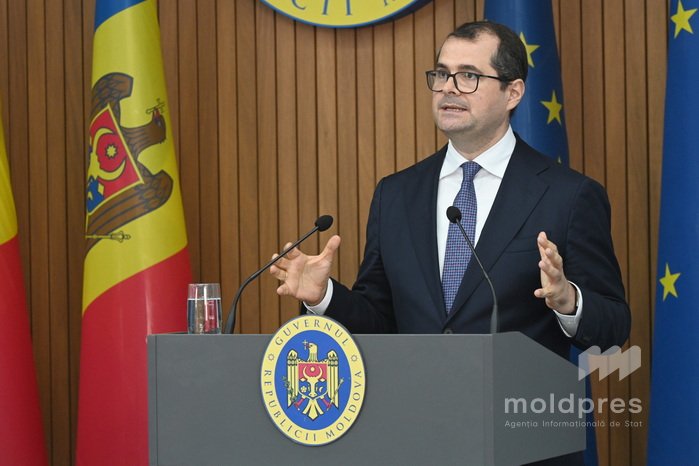
DOC // Moldovan PM speaks about districts' reorganization: ''We do not move the services. We move the administration above them.''
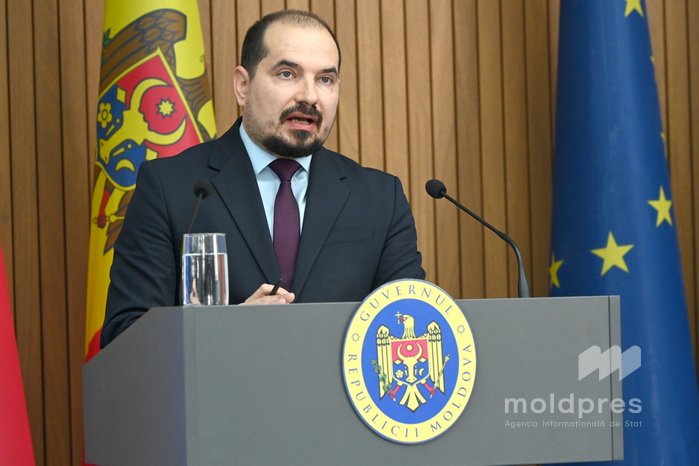
The government is proposing to reorganize second-tier local public administration, by replacing the 32 districts with three regions – North, Central and South. The reform concept was presented by Prime Minister Vasile Tofan and Government Secretary General Alexei Buzu in Chisinau today. The officials said that the main goal was is to strengthen mayors’ offices, reduce second-tier administrative structures and bring decision-making closer to citizens.

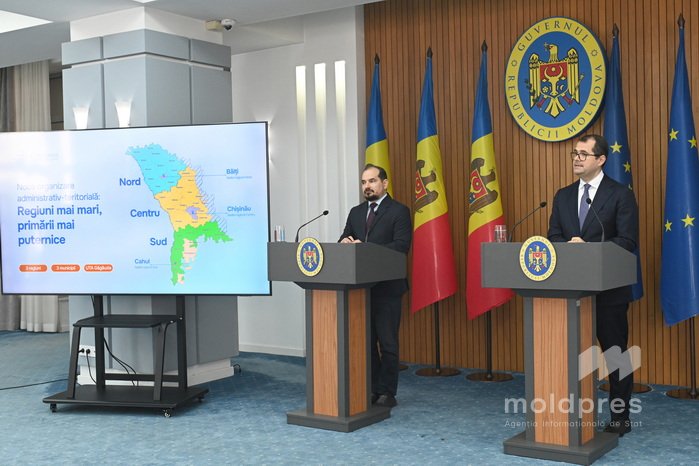
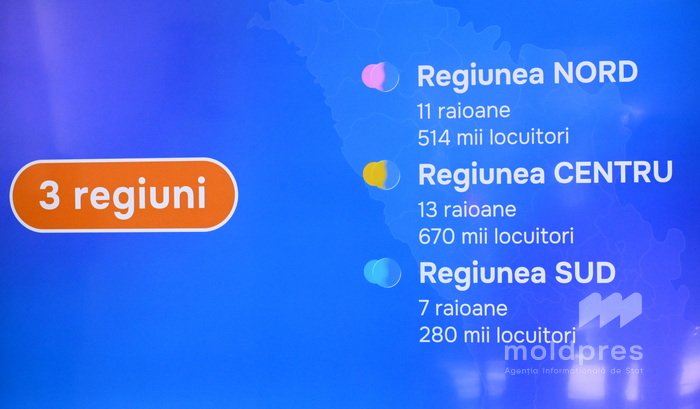
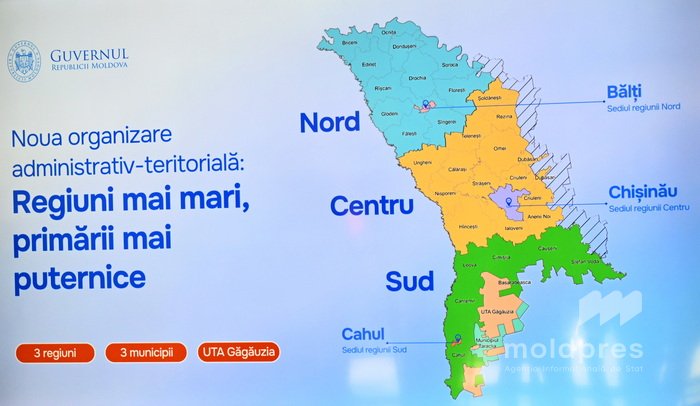
Under the proposal, the North Region would comprise 11 districts and have its administrative headquarters in Balti, the Central Region would include 13 districts, with its headquarters in Chisinau, while the South Region would comprise seven districts, with its headquarters in Cahul. The municipalities of Chisinau and Balti will retain their status as separate administrative and territorial units. The Autonomous Territorial Unit of Gagauzia will keep its special status, while Taraclia District is to be reorganized into a second-tier municipality.

990a848f8f3e33210195d64d3ffc574d_concept-reorganizare-apl-nivelul-ii-v45-docx-1_6abe351a48e54.pdf

Prime Minister Vasile Tofan said that the reform was built around the idea of strengthening first-tier local public administration.

“The essence of this reform is, above all, about building stronger mayors’ offices. Local power must be as close to people as possible, in their own mayors’ offices, while the mayor and their team know best whether a locality needs water, roads, a kindergarten or transport and how to deliver these services. We want mayors’ offices with greater capacity, more resources and more real power to solve community’s problems. And that means that the second tier must also be simpler, in order to transfer this power to mayors’ offices,” said Vasile Tofan.

The PM summarized the reform in four directions: fewer regions, fewer powers at the second tier, fewer civil servants and less bureaucracy, as well as stronger mayors’ offices.

“Today we have 32 districts. Our proposal is to replace them with three regions – North, Central and South. Chisinau and Balti will keep their current status. The Autonomous Territorial Unit of Gagauzia will also retain its special status. Taraclia will be reorganized into a second-tier municipality,” the prime minister said.

According to him, reducing the number of second-tier structures should be accompanied by a redistribution of powers between mayors’ offices and the central administration.

“If the powers of the current district level are divided more logically between mayors’ offices and the central administration, we will obviously have fewer powers at the second tier. And we do not want to create them there artificially and unnecessarily,” Tofan explained.

Under the proposed new architecture, the regions would not take over the role of mayors’ offices, but would focus on planning, coordination, regional development and projects that exceed the capacity of a single locality.

“We do not want to replace 32 districts with three regions or gigantic districts. That is not the intention. The role of the regions will also be different. They must focus primarily on matters of strategy, coordination, regional development and major projects,” the prime minister said.

Vasile Tofan gave as an example infrastructure projects involving more localities.

“They should help Cahul, Causeni, Leova, Cimislia and Stefan Voda when a water, road, waste-management or other infrastructure project goes beyond the boundaries of a single locality. So, the region is not coming to run the mayors’ office. The region must help the mayors’ office do the things it would not be able to accomplish on its own,” the prime minister noted.

The PM said that the proposed model had certain elements in common with the way regional administration is organized in other European countries, but stressed that Moldova does not intend to mechanically adopt foreign models.

“I spent a long time in the Netherlands. The Netherlands is a much larger country than ours, with 18 million people, and the provinces focus largely on regional planning, mobility, economic development and coordination matters, without being a level with rigid administrative functions, such as our districts can have. Lithuania has gone even further. In Lithuania, the regions are a level that is not elected, with very small administrative staffs of 12–15 people, and their role is primarily one of coordination,” Vasile Tofan said.

“We do not want to mechanically copy either the Netherlands, Lithuania or any other countries, because we have our own specific circumstances. But the principle and approach are the same: decisions and services, day to day, must be closer to citizens,” the prime minister added.

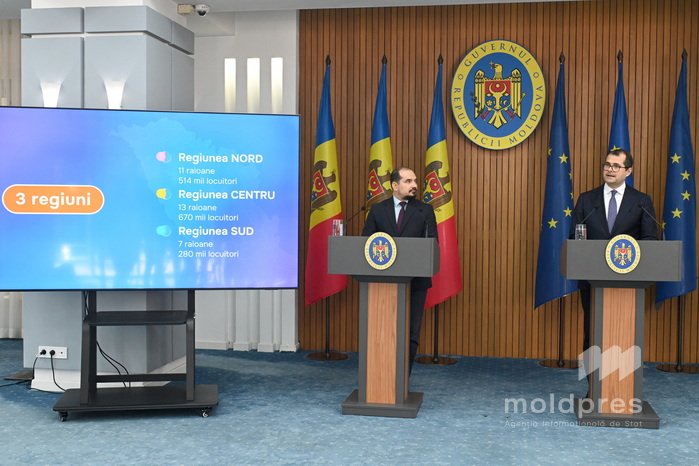
For his part, Government Secretary General Alexei Buzu presented data on the future regions. According to him, the North Region would comprise 11 districts, with approximately 514,000 inhabitants and its administrative headquarters in Balti. The municipality of Balti will not be part of the region and will retain its separate status.

The Central Region would include 13 districts, with approximately 670,000 inhabitants, and its headquarters would be in Chisinau, while the municipality of Chisinau would not be part of the region.

The South Region would comprise seven districts, with approximately 280,000 inhabitants and would have its headquarters in Cahul.

“You need to understand that the logic behind what we are proposing today stems from more considerations. First of all, from the beginning of the year until now, the State Chancellery has held approximately 1,000 consultations on this subject, at the level of mayors’ offices and districts. The prevailing opinion is that the district, in its current form, is indeed no longer productive,” Alexei Buzu said.

According to the secretary general, some of the powers previously held by districts have already been taken over by other administrative levels.

“In recent years, powers have also been taken over in the areas of social assistance and healthcare. In 2027, powers in education will be taken over. That is why, we are seeing this change,” Buzu said.

The official explained that the proposal for three regions was linked to the process of consolidating mayors’ offices through amalgamation.

“In Moldova, following the reform and the 2027 elections, we will have fewer mayors’ offices, but stronger ones. For example, we anticipate that, in the northern area, the number will decrease from 306 mayors’ offices to 81. In the central area, it will decrease from 349 to 96 mayors’ offices. And in the southern region, from 165 mayors’ offices to 48,” the government’s secretary general said.

According to him, consolidating mayors’ offices should allow them to manage more services and prepare large-scale development projects.

“We already have this extremely ambitious economic growth plan, with funding of 1.9 billion. In 2028, Moldova will benefit from a new instrument. The experience of other countries shows us that we need to have these regional development projects prepared and designed in an environmentally sound and sustainable way. If we want to bring water, waste-management services, better roads and investors, we need to have these projects ready. And that will be an important role for these regions,” Alexei Buzu said.

One of the points emphasized by government representatives during the presentation of the reform was keeping public services close to citizens.

“Services will not leave localities. If someone currently travels to Edinet for a service, we will not send them to Balti. If they go to Soroca, they will continue going to Soroca. If they go to Ungheni or Calarasi, they should not have to come to Chisinau. If they go to Causeni, Cimislia or Stefan Voda, the service will not move, simply because we have changed the administrative center of the region,” Vasile Tofan said.

“So, we are not moving services. We are moving the administration above them. But the services will remain where they are, close to people. Some services will be transferred to mayors’ offices, while others will be managed centrally. But the service must remain where it makes sense, where it is logical for the person,” the prime minister said.

The same principle will apply, according to the government, to local public institutions and assets.

“The library in Soroca will remain in Soroca. The school in Hancesti will remain in Hancesti. The cultural center in Orhei will not be moved to Chisinau; it will remain there, in place. The community and the locality will continue to manage their assets and take over the services they need,” Tofan said.

Alexei Buzu gave more examples of the transfer of management of institutions and assets to mayors’ offices.

“Museums, sports schools, children’s camps, sports grounds and cultural centers – all these services that are very important for the life of a community – will be transferred from district administration to the administration of the mayors’ offices that are currently district headquarters. We believe that mayors and mayors’ offices can manage these assets and services much better, because they are much more closely connected to local life,” the secretary general said.

Alexei Buzu recalled the experience of previous administrative reforms, saying that one of their lessons is the need to keep services close to the population.

“The problem with the previous reform arose when counties were created. Services were moved farther away from citizens and entrepreneurs. What we are doing, and the test requested by the prime minister, is to ensure that, regardless of where the administrative center is located, the way citizens receive a service must remain the same,” Buzu said.

“We will change the administrators and who is responsible, but citizens must not feel this change,” he added.

The secretary general said that services for the business community should also remain available locally.

“For an entrepreneur to access the services of a regional architect, they will not have to make the long journey from Soroca to Balti, but will go to the regional service point. We will make these changes so that these services remain there and are managed and funded much better,” Alexei Buzu said.

The prime minister also presented the financial arguments for the reform. According to him, the budgets of the 32 districts totaled approximately nine billion lei in 2025.

Vasile Tofan stressed, however, that most of these resources did not represent administrative expenditure as such.

“In 2025, the budgets of the 32 districts amounted to approximately 9 billion lei. However, we need to understand that 77 per cent of these budgets went to education. They represented education funding. Obviously, this money will not disappear and does not constitute savings. It will follow the service to the institutions that will take over these functions,” the prime minister said.

“But we will also have administrative savings at the second tier. Obviously, not at the expense of education. The real savings must come from the administrative apparatus, from eliminating structures that currently overlap and from greater productivity,” he added.

Asked about the exact amount of the savings, the PM said that the government had calculations, but they have not yet been made public.

“We have made a calculation. We are not ready to announce it publicly yet, including so as not to create additional anxiety in the system,” Vasile Tofan said.

According to the concept presented, the current district councils will be replaced by regional councils. Their election would take place during the general local elections in 2027.

Alexei Buzu explained that voters will have three ballot papers for the local and regional levels.

“During the 2027 general local elections, citizens will elect the local council, the mayor of their locality and the candidates for the regional council. District councils, as we know them today, will no longer exist and will switch to regions,” Buzu said.

According to him, the proposed regions are based on the current development regions established under legislation adopted in 2006.

“The regions proposed by the government are based on the development regions created under the Regional Development Law, adopted in 2006. So, for practically 20 years, we have had these development regions, larger projects and territorial development plans at the level of these three regions,” the secretary general said.

Regional councilors would elect the president and vice-presidents of the region by vote.

“We will have a smaller administrative apparatus, because there we need teams of specialists who will provide support for regional coordination and planning,” Buzu said.

The reorganization will also entail reducing the second-tier administrative apparatus. The government has not yet provided a final figure for the number of positions that would be eliminated.

“If we say that we are switching from 32 regions to three regions, there will be a significant reduction, including because the apparatus of a region will be much smaller compared with a district as it exists today. We want to ensure that we have professionals there who provide support, not an apparatus that creates another layer of intermediaries between mayors’ offices and the government, or between mayors’ offices and citizens,” Alexei Buzu said.

He said that the size of regional administrations would also be calibrated according to population.

“A fundamental principle of these changes is to have a much smaller budget and a much smaller administrative apparatus. Why? Because all these resources must go to mayors’ offices, mayors and their teams, because the purpose of this reform is to have stronger mayors’ offices,” Buzu said.

Asked what would happen to employees whose positions are eliminated, he said that mayors’ offices would need new specialists.

“With these changes, mayors’ offices will need more specialists – well-trained specialists in public procurement, planning and the preparation and implementation of projects. I am sure that most of the professionals there will find employment. Local teams and the government’s decentralized services are also looking for good professionals,” the secretary general said.

During the conference, the prime minister was asked whether the reform would be accompanied by fiscal decentralization at the regional level.

Vasile Tofan said that, under this reform, the government does not intend to transfer the collection of certain taxes to the second tier.

“The short answer is no, we do not intend to collect part of the taxes at the second tier, including because we intend to have a lean second tier with limited functions, primarily coordination and strategic planning, as I have said,” the prime minister said.

He stressed, however, that fiscal decentralization stays an objective the government intends to pursue.

“I believe it is important to continue our efforts to decentralize fiscally. It is also a promise to mayors’ offices and, yes, I believe that a greater share of resources must remain locally. However, you understand that the sequence of steps is that we must first build the capacity of mayors’ offices, make them larger and better institutionalized and only afterward give them the resources,” Tofan said.

“I do not think it would be responsible to give major fiscal responsibilities and fiscal rights to mayors’ offices that have four or five people. That is why we maintain the principle that part of the taxes should be collected locally, so they can be collected and controlled as close to people as possible. But the first step is building the capacity of mayors’ offices,” the prime minister added.

Another topic addressed at the conference was the threshold of 3,000 inhabitants for a mayors’ office.

Vasile Tofan acknowledged that this figure represents a compromise, given that  Moldova will continue to have smaller administrative and territorial units than other European countries.

“We are starting from the realities of the country. I acknowledge that the level of 3,000 was a compromise. Obviously, our mayors’ offices will still be much more fragmented than the ones of other countries with similar populations or geographical dimensions to ours,” he said.

The prime minister mentioned Romania as an example, where, according to him, the average population of a mayors’ office is larger.

“But it is a first step, and I believe it is already an important step that we have taken. Together with mayors’ offices and citizens, we would like to continue encouraging voluntary amalgamation. Because it does not disappear after the elections. The voluntary amalgamation mechanism will remain in place even after the elections,” Tofan said.

Alexei Buzu said that the new legislative package would establish 3,000 inhabitants as the minimum threshold.

“The legislative package will include a provision under which the threshold of 3,000 is a minimum threshold. From now on, this threshold will be a condition for all mayors’ offices. This means that, if the number of citizens or inhabitants in a mayors’ office falls below the minimum threshold of 3,000 during an electoral cycle, that mayors’ office will have two options. First, to enter the voluntary amalgamation process, and second, to undergo normative amalgamation, with the merger carried out at the next local elections,” the secretary general said.

The government has earlier said that it supported the voluntary amalgamation of mayors’ offices and simplified the procedures for this process in 2026. In last March, the cabinet said that the amendments had been drafted following consultations with more than 4,500 mayors and citizens.

The government will discuss the concept with district presidents and the mayors of district-seat cities, after which the legislative package needed to implement the reform will be drafted.

Alexei Buzu said that the authorities want to ensure a transition period for the transfer of powers, assets and services.

“Today we are going to discuss this with all the district presidents of Moldova and all the mayors of district-seat cities. We want to hear their opinions on our proposals, after which we will prepare the legislative package and agree on a very clear transition plan,” he said.

“Let us form a common team on behalf of the localities, citizens and our cities, ensuring that all services remain there, are strengthened and that citizens benefit from the changes we are making,” Buzu added.

According to him, the legislative package is necessary, in order to allow for one year of transition before the general local elections in 2027.

“Why do we want to bring this legislative package to parliament? Because once it is approved, we will have one year to ensure this entire transition. We will work with mayors’ offices to strengthen them, work with mayors’ offices and regional council teams to carry out the transition of assets and services, and ensure that they are prepared for the opportunities of funding which Moldova is expected to access,” Alexei Buzu said.

The government has been preparing the local public administration reform throughout 2026. In February and March, the authorities held consultations in all the country’s districts and in the Autonomous Territorial Unit of Gagauzia, attended by more than 4,500 local elected officials and citizens. At that time, the government announced that the main objective was to build stronger mayors’ offices and redefine the role of districts in the new administrative structure.

The concept presented on October 1 is to be translated into a legislative package and submitted to parliamentary procedures, while the new second-tier administrative structure is proposed to become operational in the context of the 2027 general local elections.

 Facebook
 Instagram
 X/Twitter
 Telegram
PHOTO // PM in New York tells Diaspora government willing to turn experience of Moldovans from United States into projects for country
Moldova under emergency state in energy, hydrological sectors as of September 26; what measures take effect
Balti Clinical Hospital to receive ultrasound machine through grant provided by government of Japan
Japan supports modernization of Balti Clinical Hospital with grant worth over 95,000 dollars
Moldova's Border Police receive six special vehicles on behalf of FRONTEX
Moldovan president attends events dedicated to 35th anniversary of foundation of Academy of Economic Studies
New charges brought against former Moldovan president Igor Dodon in “Kuliok” case; prosecutors seek harsher sentence
Mircea Eșanu on nomination to lead Moldova Project: More information could become known in October
PHOTO GALLERY // Moldova's new passport presented by Public Service Agency
VIDEO // Moldova to introduce new passport model as of October 15; document to feature more than 100 security elements
National Award for Seniors: 15 people winners in 2026 edition
PHOTO // Moldova’s protected areas strengthened through restoration works, planting and new management tools
PHOTO // Aircraft that exploded in Briceni had components marked “ГЕРАНЬ 4,” police announce
Drone fragments discovered outside north Moldova settlement
Moldovan government to provide Apa-Canal Chisinau enterprise with three additional pumps to draw water from Dniester
Russia’s Ambassador-Designate summoned to Moldova’s Foreign Affairs Ministry; Oleg Ozerov receives protest note, after three drones violated Moldova’s airspace in a single day
Moldovan president, European commissioner discuss EU's support for Moldova's economic development
DOC // Moldovan PM speaks about districts' reorganization: ''We do not move the services. We move the administration above them.''
Ministry of Labour nominates winners of 2026 National Award for Seniors
MOLDPRES INTERVIEW // Ambassador Zhihua Dong: Moldova's European integration opens up new opportunities for cooperation. China promoting direct freight route
VIDEO // Government proposes replacing 32 districts with three regions: north, center and south
 National Bank of Moldova
Deputy PM for reintegration has meeting between with Ambassador of Kingdom of Sweden to Moldova
Moldovan president, European commissioner discuss EU's support for Moldova's economic development
Stronger city halls, three regions and new municipality: Government presents concept for reorganizing second-tier local public administration
New working session of special commission on reintegration policies of Moldova
Moldovan Parliament to host 109th Rose-Roth Seminar of NATO Parliamentary Assembly

VIDEO // Government proposes replacing 32 districts with three regions: north, center and south
Foreign Ministry summons Russia’s Ambassador after several drones violated Moldova’s airspace
CEC: 15 candidates enter race for mayoral positions in November local elections
Prime Minister: Financial stability must be transformed into investment and economic growth
European Commissioner begins visit to Moldova with meeting with President
Parliamentary activity in September: five plenary sessions held and 30 laws and decisions adopted
Speaker after drone explosion in Ivancea: We categorically condemn and will continue to condemn every illegal overflight of our airspace
Moldovans who worked in Slovakia to be able to combine pension insurance periods
Former Victoriabank vice-president to stand trial for complicity in fraud and money laundering
Police complete investigation at site of drone explosion in Ivancea
People’s Republic of China celebrates National Day
BNM launches commemorative coin dedicated to 80th anniversary of Moldova State University
ARMENPRESS // Armenia and US take practical steps to implement minerals memorandum
Moldovan PM meets Ambassador of Kingdom of Saudi Arabia
Moldovan PM has meeting with U.S. Ambassador
Moldovan president awards Order of Honour to honorary consuls of Moldova in Denmark, Brazil
Receive the latest news directly to your email

Receive the latest news directly to your email