
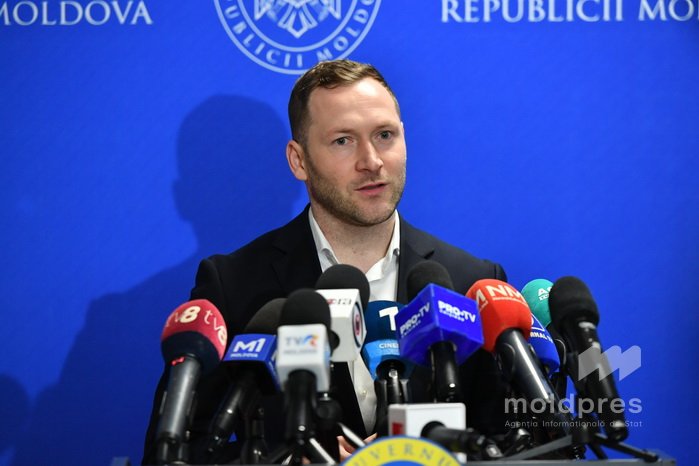
Moldovan environment minister unveils report in parliament: “I will call things by their name: the sole party responsible for this massive pollution is the Russian Federation”
Environment Minister Gheorghe Hajder, at a today’s plenary meeting of the parliament, unveiled a detailed report on the pollution of the Dniester River, noting that responsibility for the incident lies with the Russian Federation, which had attacked Ukraine’s infrastructure.

According to the environment minister, the pollution was caused by an attack on a hydropower complex in Ukraine, which resulted in massive discharges of oil products into the Dniester River.

“I will call things by their name: the sole party responsible for this massive pollution is the Russian Federation. This is not a natural accident, but a direct consequence of the war at our border, of the attacks on Ukrainian infrastructure. What we see today in the river is the result of an aggression that creates direct risks for public health and for state security. The consequences of the war do not stop at the border,” Hajder emphasized.

The minister said that the first signs of contamination had been detected on March 10, and the authorities intervened immediately.

“As soon as we detected the first signs of pollution, we mobilized all competent  institutions. Samples were taken, and since then we have been continuously and strictly monitoring water quality. In parallel, we requested official information from the Ukrainian side, in order to understand the scale of the situation and to be able to act effectively,” he said.

To limit the effects, the authorities installed absorbent barriers and took risk-mitigation measures.

“We installed over 20 barriers in strategic areas of the Dniester River, in order to stop or reduce the spread of pollution. They are constantly monitored, cleaned and replaced when necessary. In addition, we use biodegradable absorbent materials to reduce the impact on the environment,” the minister noted.

He specified that, during the critical period, water intake for cities in the north of the country had been temporarily suspended, and the population was supplied from reserves.

“We made the difficult but necessary decision to temporarily stop water intake from the Dniester. During this period, the population was supplied from existing reserves in order to avoid any health risk,” Hajder explained.

Subsequently, after water quality was confirmed, supply was gradually restored.

“Following more laboratory analyses confirmed that the water is safe for consumption, we gradually resumed supply in the affected localities – Soroca, Sangerei, Floresti and the municipality of Balti. It was a priority for us not to endanger people’s health,” the official said.

Hajder specified that the government had declared a state of alert across the entire Dniester basin to allow for rapid intervention.

“The state of alert gave us the necessary tools to intervene quickly, mobilize resources and coordinate the actions of the institutions involved,” the minister also said.

Hajder thanked the teams involved and external partners for their support.

“Over 850 people were involved in managing this crisis. People worked day and night to protect the population. I thank them all: rescuers, specialists, local authorities and external partners, especially our colleagues from Romania, who responded promptly to our request,” he said.

At the same time, the minister criticized the spread of false information during the crisis.

“Regrettably, there were also attempts at disinformation that triggered panic. In such situations, it is essential that citizens get information only from official sources,” Hajder warned.

In conclusion, the official reiterated that the situation remains under monitoring.

“We continue strict monitoring of water quality and are ready to intervene at any time. Our priority stays protecting the health of citizens and the environment,” concluded the environment minister.

The Dniester River was polluted following an attack on the Novodnistrovsk hydropower plant in Ukraine, which led to leaks of oil substances into the river.
 Facebook
 Instagram
 X/Twitter
 Telegram
VIDEO // Prime Minister announces resumption of drinking water supply in four districts in north of country
LIVE TEXT // European Social Charter Meeting
New intervention equipment sent from Romania
Moldova's State University of Medicine and Pharmacy, national leader in SCImago 2026 rankings
New water filtration system to be installed at north Moldova treatment plant
Moldovan PM says priority to restore water supply in north of country
Agreement entered into force: Moldovan driving licenses to be recognized in United Arab Emirates
Moldova's Medical University to launch study programme – dental nursing
About 300 schools, kindergartens to be equipped with modern digital devices
Defense Minister: Moldova to have new radar in first half of year
Otilia Dandara has been officially confirmed as rector of USM
Ludmila Vartic case: Director of Hîncești district hospital submits resignation
High-level Conference on Social Rights – European Social Charter to be held on Thursday in Chișinău, bringing together over 50 official delegations
Moldova to implement MD-ALERT system
Moldovan authorities prepare impact studies after Dniester River's pollution
Moldovan parliament speaker says Transnistrian conflict must be settled in civilian format
Moldovan environment minister unveils report in parliament: “I will call things by their name: the sole party responsible for this massive pollution is the Russian Federation”
Moldovan president says La Francophonie one of few country's bridges to European family
More transparency on shelf: Moldovan parliament adopts law on short agri‑food supply chains
Arrest warrant for leader of Moldovan Democratic Party extended for another 30 days
China’s opportunities shared with the world; Chinese Ambassador to Moldova says deepening bilateral cooperation can bring benefits to Moldova
 National Bank of Moldova
President meets with Admiral Giuseppe Cavo Dragone, Chair of NATO Military Committee
Consultations on local public administration reform held in all districts of country and Gagauzia: Over 4,500 mayors and citizens participated
Moldovan President met with UK Minister of State
Water supply in Bălți, Soroca, Sîngerei and Florești restored
Moldovan government's secretary general participates in European Social Charter Conference

President meets with Admiral Giuseppe Cavo Dragone, Chair of NATO Military Committee
VIDEO // French language and Francophone values celebrated in Parliament of the Republic of Moldova
New step in development of digital payments: Open Banking standard entered into force
VIDEO// Speaker appreciates Romania’s support, which reacted quickly in managing situation on Dniester River
Parliament examines denunciation of CIS agreements
Parliament ratified agreement with Ukraine on repatriation of unaccompanied children
Consultations on local public administration reform held in all districts of country and Gagauzia: Over 4,500 mayors and citizens participated
DOC // Moldova aligned with new EU sanctions against Russia
President: In cognitive war, consolidation of democracy also depends on citizens’ ability to resist manipulation
Environment Minister expected to report to Parliament amid Dniester River pollution
Moldovan President met with UK Minister of State
Secretary General of Council of Europe: Democracy that cannot protect digital space will not be able to protect citizens
Over 3,000 tons of gasoline and diesel imported in Moldova on Thursday
EU leaders condemn attacks on Ukrainian civilian infrastructure and assess impact of pollutants on Dniester
Over 500 prosecutors take part in General Assembly of Prosecutors
Moldovans working in Ukraine to be able to receive pensions and other social benefits
Receive the latest news directly to your email

Receive the latest news directly to your email