
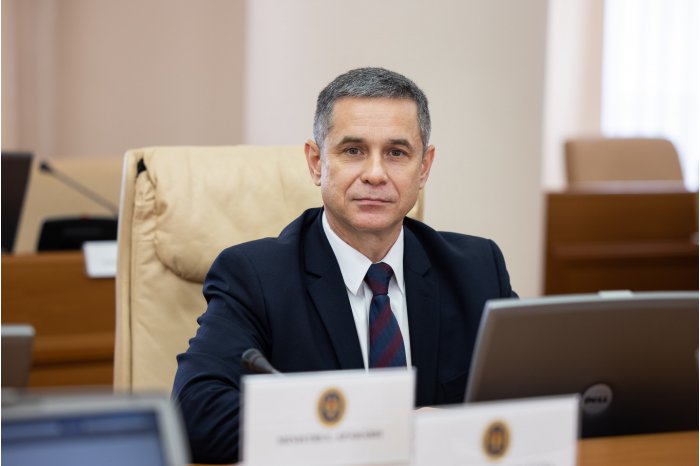
EUROPEAN MOLDOVA // Defence Minister: Neutrality obliges us to develop and modernize defence capabilities, to build army at international standards
*Moldova applied for EU membership on 3 March 2022

* Moldova was granted EU candidate status on 23 June 2023

*On 14 December 2023, the European Council decided to open accession negotiations with Moldova

*Moldova undergoing assessment of the alignment of national legislation with European Union law, a first step for our state’s accession to the EU

*Authorities aim for Moldova to join the EU by 2030

Interview given to MOLDPRES State News Agency by Defense Minister Anatolie Nosatîi
MOLDPRES: Mr. Anatolie Nosatii, Moldova has been in a difficult regional context for over two years. Ukraine is heroically resisting the Russian military invasion, and the Moldovan authorities recognize that thanks to the courage of the Ukrainians, we are also defended. According to your estimates, how real is the danger of Russian invasion of Moldova at the moment?
Anatolie Nosatii: It is more than two years since the Russian Federation started an unjustified war in Ukraine. It is influencing the dynamics of the regional and international security environment in an unprecedented way. Most tragically, it continues to claim victims and destroy innocent lives. With a war on its border, Moldova has been and is affected in many ways. However, at present, there is no imminent military risk to the security of our country, and this is thanks to the courage and heroism of the Ukrainian armed forces and citizens who are protecting their independence, sovereignty and territorial integrity.
At the same time, we are closely following developments in this area, analysing various scenarios, working to strengthen defence capabilities and increase national resilience.
MOLDPRES: Moldova is directly threatened by officials in Moscow, and it is openly acknowledged from the world's highest forums that our state is subject to a hybrid war. What are the main elements of the hybrid war and what is the role of the National Army in annihilating them?
Anatolie Nosatii: Continuous hybrid warfare is a major threat in our country, and this is clearly stipulated in the National Security Strategy. It comes with destabilizing elements on a wide spectrum, such as cyber attacks, disinformation, propaganda, economic and energy crisis that Moldova has been facing from the very beginning, along with protests or attempts to rig elections. All of this is aimed at dividing society, instilling fear and distrust in the capacity of the national authorities.
Moreover, they have a negative impact on the development of our country, the achievement of reforms and the European path, which is a strategic objective for the prosperity, stability and security of our citizens. Combating hybrid threats is a joint and continuous effort of the national authorities and citizens of Moldova.
MOLDPRES: The Republic of Moldova is a neutral state according to the Constitution. What does the principle of neutrality laid down in the Supreme Law mean?
Anatolie Nosatii: According to Article 11 of the Constitution, Moldova is a neutral state. I would like to refer to the 2017 Constitutional Court ruling, which clearly stipulates that in the event of threats to fundamental constitutional values, such as national independence, territorial integrity or state security, the Moldovan authorities are obliged to take all necessary measures, including military ones, which would allow it to effectively defend itself against such threats. Moldova's participation in collective security systems, such as the United Nations security system, peacekeeping operations, humanitarian operations, etc., which would impose collective sanctions against aggressors and offenders under international law, is not in contradiction with the status of neutrality. Another important item says: "the deployment on the territory of Moldova of any troops or military bases, led and controlled by foreign states is unconstitutional".
MOLDPRES: The neutrality set out in the Constitution has not stopped the Russian Federation from illegally keeping military troops and weapons on the territory of the Republic of Moldova. Moscow refers to Moldova's neutral status when criticizing the efforts of the current authorities in Chisinau to modernize the National Army. What is your explanation for this situation?
Anatolie Nosatii: As I said earlier, the presence of Russian Federation forces illegally based on the territory of Moldova, without the consent of the state authorities is a violation of the neutrality status of our country. In 1999, at the Istanbul Summit of OSCE, the Russian Federation undertook to complete the withdrawal of its military forces from the territory of Moldova by the end of 2002, and the Treaty on Conventional Armed Forces in Europe (CFE) was approved. This process was started and then unilaterally stopped by the Russian authorities. It is also known that the Russian Federation withdrew from the CFE Treaty on 7 November 2023.
Neutrality obliges us to develop and modernise defence capabilities, to build an army trained to international standards, properly equipped, an army that citizens can trust. It is a firm commitment, which requires hard work, resources and time. So far, we have been able to take important and concrete steps in this direction and we will not stop here.
MOLDPRES: Mr. Anatolie Nosatii, since the beginning of the war in Ukraine, drones and missiles launched by Russia towards the neighbouring state have illegally penetrated the airspace of Moldova, and several times have fallen on the territory of our state. For example, the drone found in February this year near the village of Etulia in Vulcanesti district had a payload of 50 kg of explosives, enough to destroy a block of flats if it had fallen in a village. Moldova has purchased one airspace monitoring radar and signed a contract for the purchase of a second. Where are the sources for the purchase of radars coming from and when will Moldova have fully protected airspace?
Anatolie Nosatii: These incidents of violation of national airspace are a wake-up call for the Moldovan authorities and show how vulnerable we are to such collateral effects of the war in our immediate neighbourhood. That is why strengthening Moldova's defence capabilities, including by equipping it with airspace surveillance systems, has become an urgent necessity.
Thus, at the end of last year, we purchased the Ground Master 200 (GM 200) radar for airspace monitoring from our defence budget.
We certainly want to have airspace that is as protected as possible from missiles launched in the context of the war in Ukraine, and one radar alone cannot cover the whole range of airspace surveillance issues. That is why we need a modern complex system consisting of several radars. Their cost is extremely high and the defence budget does not currently allow us to do this.
That's why we've called on our external partners for help. Recently, the European Union through the European Peace Facility has offered us assistance in the purchase of another radar. This will considerably improve our monitoring and early warning capability of possible air risks to the security of the country. It is just part of the efforts we have been able to make for the safety of Moldova's citizens.
MOLDPRES: In the last period, the Moldovan servicemen were trained in multiple exercises with colleagues from several countries, which took place both on the territory of our country and in EU member states. The National Army has also received multiple equipment from development partners. What else would the National Army need to be ready to protect citizens in case of need?
Anatolie Nosatii: A strong defence sector means modern military capabilities, an army resilient to security challenges, ready to defend its country and citizens. At the same time, a modern army means a well-trained military that is interoperable with colleagues from other states in joint exercises and international peacekeeping missions.
The external assistance we receive from our partners, the expertise in adjusting strategic policy documents, the training activities and the bilateral and multinational exercises carried out together with the military of other countries help us considerably in achieving the goal of transforming and modernising the National Army.
MOLDPRES: Moldova is undergoing assessment of compatibility of national legislation with the European Union law, a first step for our country's accession to the EU. What does Moldova have to do in the defence sector to be compatible with the EU acquis?
Anatolie Nosatii: The Moldovan authorities are doing their utmost to move as quickly as possible on our European path, which gives our country a chance for a better, more prosperous future with peace and stability. The Ministry of Defence, together with other state institutions is involved in actions to adjust legislation to the EU framework.
The end result of this process will be a strong defence sector capable of fulfilling its constitutional mission, maintaining peace and security at national and international level.
MOLDPRES: Citizens of Moldova are invited to answer the question "Do you support amending the Constitution in order for Moldova to join the European Union?" in a constitutional referendum on 20 October. What do citizens need to know about the European Union's defence system towards which we are aiming?
Anatolie Nosatii: The EU is guided in the security and defence by the Common Foreign and Security Policy (CFSP), the Common Security and Defence Policy (CSDP) and a number of complementary strategies and instruments. They make it possible for the EU to ensure peace and stability on the continent, to manage crises effectively, to cooperate and coordinate with member states on all defence-related actions, to conduct civilian and military missions and operations abroad, including peacekeeping missions.

Thank you for the interview!


Reporter: Alina Zara
 Facebook
 Instagram
 X/Twitter
 Telegram
MOLDPRES INTERVIEW // Lithuanian Ambassador about prospects of Moldova’s EU accession: If you make things real, they will become achievable
MOLDPRES INTERVIEW // Moldovan finance minister says government aims to modernize financial system for benefit of businesses, citizens
MOLDPRES INTERVIEW // Ambassador of State of Qatar to Moldova: We are working to improve ways of attracting Qatari investors to Moldovan market
MOLDPRES INTERVIEW // President of Moldova's Chamber of Commerce and Industry says country must use opportunities provided by European integration to attract investments, become competitive
MOLDPRES Interview // Minister of Internal Affairs: Interior Ministry applies European security standards and is ready to advance in EU accession process
MOLDPRES INTERVIEW // Moldovan energy minister says foremost interest citizens to have secure energy at affordable prices
Moldovan justice minister says, according to European Commission’s Report, Moldova made greatest progress among EU candidate states, including in justice field
INTERVIEW MOLDPRES // Moldovan defense minister says Russia's war in Ukraine highlighted vulnerability of defense sector, need of building strong, prepared, resilient army to current challenges
INTERVIEW WITH MOLDPRES // Deputy PM says wants Moldova where a child from any village has same opportunities as a child from Chisinau
INTERVIEW MOLDPRES // Deputy Prime Minister on Ukraine Peace Agreement: No discussion about Moldova can take place without Chișinău's participation
INTERVIEW MOLDPRES // Moldovan agriculture and food industry minister says European integration fundamentally changes way leadership supports agriculture
INTERVIEW MOLDPRES // Romania's Ambassador in Chisinau says Moldova to never be alone in its efforts, Romania to stand by its side
MOLDPRES INTERVIEW // Romanian culture minister says culture adds value, rebuilds trust
MOLDPRES interview // IGP head: Russia whether through Ilan Shor or other means to constantly try to find ways to create disorder and destabilization
Over 20 companies from Moldova present products in Baia Mare, Romania
Moldovan PM to attend 81st session of United Nations General Assembly
VIDEO // Prime Minister about privatization of Zarea Hotel: Our goal - to generate as much money as possible for state budget, while also making good use of important property in central Chișinău
PHOTO // Fragments that may have come from drone found on land near Colonița
 National Bank of Moldova
Moldovan PM meets with Head of Council of Europe Office in Chisinau
Moldovan PM to attend 81st session of United Nations General Assembly
Prime Minister visits Zarea Hotel: We want transparent auction and as many bidders as possible
New edition of program „Sub cușma lui Guguță” launched at Parliament
Reforming recruitment in civil service: from legal framework to implementation

Five youth centers to receive €500,000 for equipment and technical support
PHOTO // Fire Shield 2026 exercise concludes
New edition of program „Sub cușma lui Guguță” launched at Parliament
DOC // New rules for recognition of professional qualifications obtained abroad
Joseph Mark Burkhalter sworn in as U.S. Ambassador to Moldova
Reforming recruitment in civil service: from legal framework to implementation
Speaker about protests in Transnistrian region: Reintegration process irreversible
Moldova strengthens public finances in line with European standards with Slovenia’s support
Palanca border crossing point temporarily suspended due to communication network failure
Moldovan parliament speaker provides details on administrative and territorial reform
Summary of Moldovan parliament's plenary meeting held on September 17, 2026
Moldovan parliament speaker, after meetings in Budapest, says Hungary supports Moldova in its efforts
Roman Rosca takes over as chair of special parliamentary commission for monitoring and oversight of Moldova’s reintegration policy
Working of small farms in built-up areas of localities to be regulated by law in Moldova
Moldova accedes to convention in marine environmental protection sector
Moldovan parliament speaker explains need to create Moldova Project: “We must concentrate expertise in a single entity”
Receive the latest news directly to your email

Receive the latest news directly to your email