
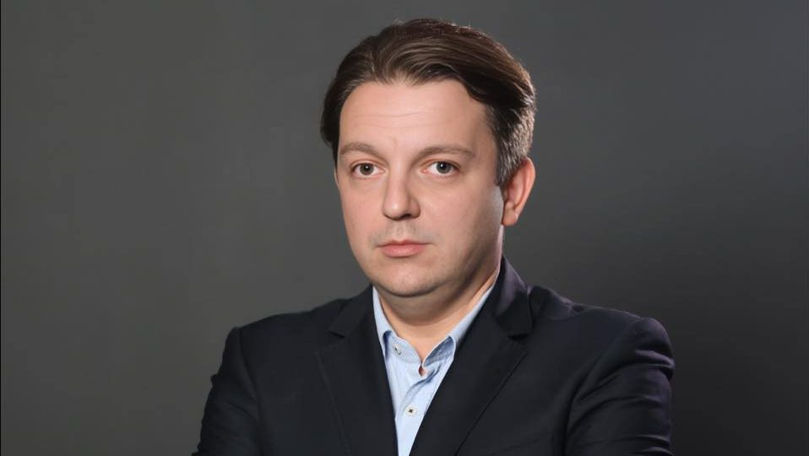
OPINION // Expert Andrei Curăraru: Government’s resignation reflects failure to manage tax reform and public communication
The poorly implemented tax reform and the lack of effective public communication from the prime minister were among the main causes that led to the resignation of the Government headed by Alexandru Munteanu. The view was expressed by public policy expert Andrei Curăraru, who analyzed the background of the current political crisis and the stakes involved in forming the future Cabinet.

"On 3 July, Moldova entered a political crisis at a very poorly chosen moment. Prime Minister Alexandru Munteanu announced his resignation after eight months in office, and this automatically means the resignation of the entire Government. The Cabinet remains in an acting capacity, led by the same Alexandru Munteanu, until a new team is approved," said Andrei Curăraru.

In his view, the tax reform was the decisive factor that eroded public trust in the Executive.

"If we carefully analyze the speeches and the scope of the reforms, the tax reform was the stumbling block that overturned the Munteanu Government’s cart. Tax reform reaches into our pockets. The line ministry and the Prime Minister did not sufficiently take into account the social impact, the protection mechanisms for the vulnerable, and they were forced to withdraw parts of this policy after people became angry. A reform can be economically sound and still be lost politically if people do not understand its logic," the expert said.

Referring to MoldATSA scandal, Curăraru believes it amplified public discontent but did not represent the main cause of the Government’s fall.

"The MoldATSA scandal, although much more visible, was only a secondary cause. The scandal concerning outrageous salaries inside state-owned enterprises is ongoing; there is a clear need there for reform, for reducing the direct and indirect incomes of the ‘big shots’ in the public sector, and for oversight that would prevent a repeat of MoldATSA-type situations," Andrei Curăraru said.

At the same time, in the expert’s opinion, there were also internal disagreements, but these do not demonstrate the existence of a major internal conflict, instead highlighting mainly coordination problems.

"There were internal frictions as well. This was predictable in a cabinet made up of technocrats, party members and people close to the prime minister. But friction does not automatically mean that the nonsense spread on Telegram is true. So far, the facts point to a non-homogeneous team and a coordination problem, which do not amount to proof of an internal war that would have blocked the act of governing. We would have found out about that from the press, as in the MoldATSA case. The only incident cited even by the President of the Republic of Moldova was a clash of personalities between the Prime Minister and Minister Dan Perciun, a man with significant political and reform experience, who apparently had objections to Prime Minister Munteanu’s style," he added.

Another aspect highlighted by the expert is the prime minister’s insufficient public communication.

"It must be noted that during these eight months, the prime minister was rather absent from the public space and left his subordinates to communicate on essential issues. In the Republic of Moldova of 2026, such a strategy had no chance of success," he argued.

Curăraru draws attention to the fact that the change of Government is taking place at a crucial stage for the European path of the Republic of Moldova, after the opening of Cluster 1 of the accession negotiations and in the context of implementing the European Union’s Growth Plan.

"Let us not ignore our national project either: European integration. On 15 June, Moldova opened Cluster 1, the fundamentals cluster. This is the cluster that sets the pace for the entire process. There is now the objective of opening two more clusters by the end of the summer, and tasks that must be delivered by 1 September. In parallel, the EU Growth Plan means up to 1.9 billion euros for 2025–2027, conditional on reforms," the expert noted.

Under these conditions, expert Andrei Curăraru emphasized that Moldova does not just need a new government, but a government capable of delivering European accession within the agreed timelines. Thus, according to him, the new prime minister must have a clear results-based mandate: progress on negotiation clusters, well-explained decisions on taxation and wages, order in state-owned enterprises, and political accountability when institutions fail.

"That is why the appeal to the ruling party, the Presidency and the future candidate for prime minister is this: do not come forward with just a name that can pass through Parliament. The new prime minister must have a clear mandate for results: progress on negotiation clusters, clearly explained decisions on taxation and salaries, order in state-owned enterprises, and political responsibility when institutions fail. Moldova does not just need a new government. It needs a government that can deliver European accession within the agreed deadlines," Curăraru said.

The public policy expert pointed out that, unlike Romania, the Republic of Moldova has a party with a stable majority in Parliament that can nominate, without needing a coalition, a candidate who will certainly be approved.

Today in the morning, Prime Minister Alexandru Munteanu announced that he was stepping down after eight months in office. Shortly afterwards, President Maia Sandu held a press conference in which she announced the start of consultations with parliamentary factions for nominating a candidate for prime minister.
 Facebook
 Instagram
 X/Twitter
 Telegram
State-owned enterprises to be audited
Republic of Moldova moves toward EU standards: Parliament adopts new Arbitration Law in first reading
Deputy Speaker’s message on U.S. Independence Day
Ireland assumes presidency of EU Council
US Embassy marks 250 years of United States independence
Parliament convenes in plenary session on Thursday
Moldova continues withdrawal from CIS treaties
State Chancellery to launch comprehensive review of consultancy contracts
State Chancellery to review all consultancy contracts
Prime Minister: We will review how members of state-owned enterprises’ boards of directors are appointed and remunerated
President announces measures to revise criteria for appointing people to leadership positions
VIDEO // President announces “general clean-up” in institutions: Preferential treatment and waste of public money unacceptable
Moldova among Romania’s priorities at NATO Summit in Ankara
Constitutional Court rejects challenges to unconstitutionality filed by three parties and ruled that contested provisions of Law on Political Parties constitutional
PHOTO // About 90 graduates of USMF “Nicolae Testemițanu” assigned to labor market
OPINION // Rapid formation of new Government, mandatory signal of stability for external partners of the Republic of Moldova
Secretary General of Government: Reforms must continue, regardless of political changes
Education Minister on disagreements with Prime Minister: I said what I think on fiscal policy
 National Bank of Moldova
Deputy Prime Minister for Reintegration in dialogue with European Union Special Representative for Transnistrian settlement
President to hold press conference today, July 3
Social benefits totaling 76.3 million lei provided to citizens of Moldova residing in Transnistrian region in first half of 2026
Government Program: 85 young people to complete paid internships within public authorities
Prime Minister met with EU Representative for Transnistrian settlement

Education Minister on disagreements with Prime Minister: I said what I think on fiscal policy
In June, Energocom purchased electricity at price of 131 euros/MWh
President: We are obliged to succeed in bringing Moldova into European Union and developing country
Expert Daniel Vodă: In difficult times, country needs unity, clarity and cohesion
Speaker after Prime Minister’s resignation: We will launch discussions on necessary key reforms and carefully analyze society’s expectations
President announced start of consultations with parliamentary factions to nominate candidate for Prime Minister
Deputy Prime Minister for Reintegration in dialogue with European Union Special Representative for Transnistrian settlement
DOC // Economic resources of individuals targeted by international sanctions frozen by Tax Service
VIDEO // President announces steps to be taken after Prime Minister’s resignation
Prime Minister resigns. What follows under Constitution of the Republic of Moldova
President to hold press conference today, July 3
Moldova presented artificial intelligence priorities at parliamentary meeting of Black Sea Region states
Parliamentary Committee on Economy, Budget and Finance has new chair
Breaking news
Prime Minister announces resignation
PHOTO GALLERY // Exhibition “True Nature” by artist Șerban Savu opened at National Museum of Art of Moldova
Discover Moldova with #MOLDPRES // Wooden church in Palanca, heritage symbol of Călărași for over two centuries
Receive the latest news directly to your email

Receive the latest news directly to your email