
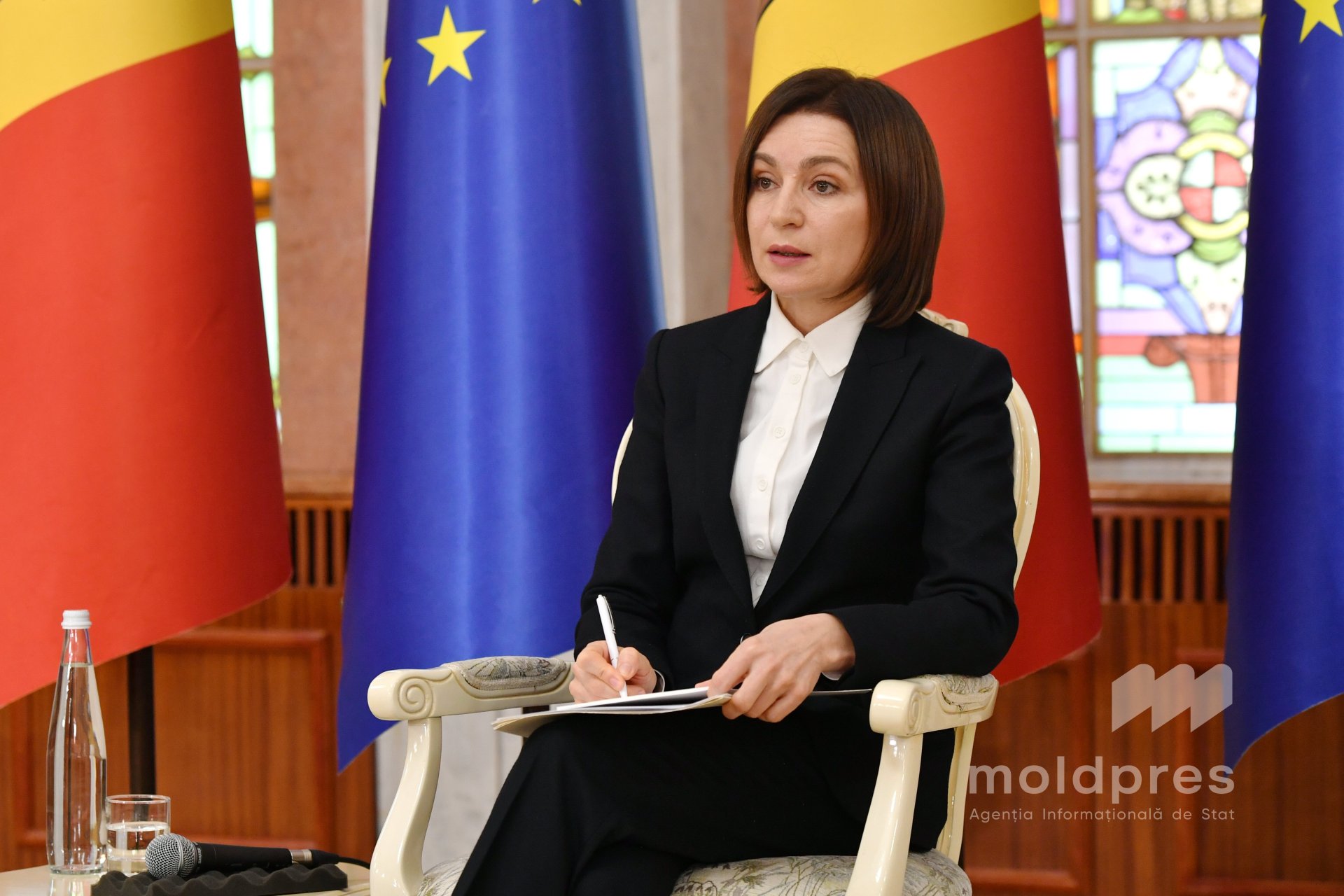
Head of State calls for continuation and expansion of vetting
The escapes of people under investigation or already convicted before the final sentences are handed down, as well as the slow pace of justice reform remain serious problems in the Republic of Moldova, said President of the Republic of Moldova Maia Sandu.

The head of state stated that the authorities are discussing solutions to prevent defendants from fleeing before conviction, but their implementation depends largely on the decisions of prosecutors and judges.

“I know that discussions have been held with representatives from Parliament, the Government, and the Superior Council of Magistracy, and I understand they will come up with certain proposals. Of course, the solution itself exists, because it is up to the prosecutor and especially the judge to take this risk into account,” Maia Sandu said at a TV show.

The President stressed that the situation is further complicated by the existence of the Transnistrian region, which is not under the control of the constitutional authorities.

“When we have this region in the country where we cannot search for and find convicted persons, we need an extraordinary solution. And we have already had several cases, and it is clear that we need to come up with an extraordinary solution for a situation that is recurring,” the head of state declared.

Asked about possible arrangements or suspicions of corruption in such cases, Maia Sandu acknowledged the existence of systemic problems.

“Sometimes I think it’s the prosecutor’s fault, other times it’s the judge’s fault,” the President said, adding: “We have a system that is still not clean, not even halfway.”

Referring to the vetting process, the head of state noted that it has not yet been applied in the first instance courts, where most of the problems arise.

“We see that the behavior of judges in the first instance courts has not changed. We see the same suspicions of corruption. Of course, not for everyone, but in many cases we see case files postponed indefinitely, for more than ten years, so that the statute of limitations expires,” Maia Sandu stated.

The President advocated for the continuation and expansion of vetting, including until the Supreme Court of Justice is fully staffed. “It is not fair for some judges to get there through vetting and others to pass without vetting,” she said, emphasizing that although the process may create temporary blockages, “there is no solution in avoiding the blockage and keeping corrupt people in the system.”

In the context of justice reform, Maia Sandu acknowledged that the process is difficult and lengthy. “Reform is reform. There is no reform manual,” the President said, noting that the Republic of Moldova initially followed the recommendations of the European Union but had to adjust its approach because the system did not clean itself up.

The head of state also commented on the situation of the new Prosecutor General, who won the competition but has not yet passed the external evaluation.

“As long as we don’t have the result of the vetting, I have nothing to say. If he passes vetting, that will be one thing; if he does not pass, it will be another,” Maia Sandu stated, specifying that she cannot influence the duration of the procedure.

According to the President, the lack of a Prosecutor General with a full mandate is a problem, including in the context of negotiations with the European Union, but the authorities must wait for the completion of the evaluation process.
 Facebook
 Instagram
 X/Twitter
 Telegram
Competitions for hospital leadership: Ministry of Health seeks managers for 20 institutions
Over 51,000 medical leave certificates issued digitally in first month after portal’s launch
As of 1 April drivers may drive without using low beam headlights during day
Higher pensions and social benefits: 6.84 percent indexation applied as of today
Over 1,800 hectares of forest to be planted in 15 districts along Dniester River, under World Bank–supported programme
Over 900,000 unique beneficiaries, representing 38% of population received reimbursed medicines through ePrescription system
Ben Gurion Airport in Tel Aviv remains closed until 16 April
Another Shahed-type drone detected while unauthorizedly flying over national airspace in Transnistrian segment
DOC // Official Journal publishes implementation mechanism for CEEPUS IV
Moldova’s airspace violated again: Shahed drone found in Dubăsari–Orhei area
Nicolae Testemitanu Medical University of Moldova launches new master’s programme, Health Promotion and Protection
Permanent teaching grades and less bureaucracy in schools
Prosecutor’s Office provides new details on investigation into death of Ludmila Vartic
Moldova, Romania to sign Agreement on extending coordinated control at Leuseni–Albita border crossing point
New oil slicks on Dniester River; Moldovan authorities order reinforcement, expansion of anti-pollution barriers
New wave of oil products' slicks detected on Dniester River; authorities convene for emergency meeting
Moldovan PM participates in awards ceremony recognizing rescuers' achievements
Large wind farms with energy storage systems to be built in Moldova: 16 bids submitted in tender
Environmental protection experts from two banks of Dniester hold new working meeting
Moldovan Central Electoral Commission accredits 14 national observers to monitor new local elections, local referendums
New milestone for green energy: Moldova surpassed 1 Gigawatt of installed renewable energy capacity
 National Bank of Moldova
Moldovan authorities step up prevention, response measures on Dniester, amid anticipated new pollution wave
Moldovan PM participates in awards ceremony recognizing rescuers' achievements
Environmental protection experts from two banks of Dniester hold new working meeting
Moldovan deputy PM has meeting with Ambassador of Germany
President met with U.S. Senator

President met with U.S. Senator
PAS faction to have new MP
VIDEO // Single institution to manage Moldova’s forests
CNMC: Eenergy sector remains fragile, ending state of emergency requires caution
Foreign Ministry: We condemn violation of airspace. Such actions endanger citizens’ security
Support for export promotion: 16 business associations to receive 14.6 million lei through Bridge Export Program
Over 20 media projects to get funding from media subsidy fund
Shahed drone illegally flew over airspace of Moldova
Over 25,000 residents from left bank of Dniester commute daily to right bank, Deputy Prime Minister for Reintegration says
BTA: Bulgarian Literature Has Become Increasingly Visible on International Stage - Deputy Culture Minister Stoyanov
Simple motion on public policies implemented by Ministry of Labour and Social Protection failed
Proposals for improving efficiency of ministries discussed at roundtable
PHOTO GALLERY // Premiere at Mihai Eminescu National Theater: “Intrigue and Love,” directed by Alexandru Cozub
Moldova to sign social security agreements with Quebec (Canada), Albania, Croatia and Ireland
Around 622,000 vulnerable families receive energy compensation
Prime Minister visited agricultural business in Unguri village, Ocnița district
Receive the latest news directly to your email

Receive the latest news directly to your email