
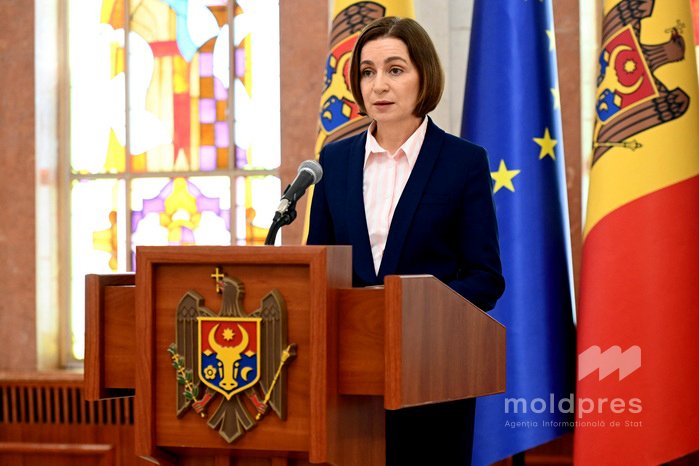
VIDEO // Moldova's National Security Council: authorities to consider declaring state of emergency in energy, hydrological sectors
Authorities will examine the need to declare a state of emergency in the energy and hydrological sectors, amid risks related to the supply of resources for the cold season. The issue was discussed during a meeting of the National Security Council (NSC). At a news conference held after the NSC meeting, President Maia Sandu said that the government must be prepared to act quickly in the event of unforeseen situations, including a reduction in the flow of the Dniester River or rising fuel prices.
Moldova must strengthen its capacity to secure energy and water supplies, in order to cope with the effects of the international energy crisis and the difficult hydrological situation in the region. President Maia Sandu has made statements to this effect, after the meeting of the National Security Council. The head of state noted that regional electricity production had declined because of reduced river flows caused by drought, which continues to put pressure on the energy market.
The Moldovan president also drew attention to the hydrological situation of the Dniester River, which stays worrying. According to the data presented, the water level in the Novodnistrovsk reservoir reached a historic low, while the average inflow during September 11-20 amounted to only 23 cubic meters per second, compared with 100–120 cubic meters per second, the usual level for this period.
Maia Sandu stressed the need to prepare for various scenarios and mobilize all state institutions to guarantee uninterrupted access for the population and the economy to water, electricity, natural gas and fuel.
“Together with the parliament, the government and the responsible institutions, we agreed on the need to declare a state of emergency in the energy and hydrological sectors. The government must be able to act quickly in the most unpredictable situations: if rapid decisions are needed to purchase fuel, if the water flow in the Dniester continues to decline, or if fuel prices continue to rise.
First, the government will prepare plans for various scenarios, so that every institution knows what to do if supply problems arise.
Second, the institutions must ensure import capacity and alternative electricity supply routes for the cold season, the possibility of using the 110 kV interconnections with Romania on an emergency basis and the maximization of commercial capacity at the Romania–Moldova border.
The competent institutions are obliged to create reserves of equipment and spare parts, so that they can intervene quickly in the event of breakdowns. We are ensuring that the necessary gas stocks are established and we are gradually preparing emergency stocks of oil products as well,” Maia Sandu said.
According to Maia Sandu, petrol and diesel prices have reached record levels in the European Union and developments on the international market are also reflected in prices at the pump in Moldova. Gas and fuel prices remain high, because of the international energy crisis, blockages along the main supply routes, and the depletion of European reserves. According to the head of state, Moldova currently pays approximately 1,000 dollars for 1,000 cubic meters of gas, while diesel prices have exceeded 1,500 dollars per ton.
“I know that some people are still wondering why we do not buy natural gas from Russia. I want to remind them that Russia first reduced and then halted gas supplies to our country in 2022, violating the provisions of the contract. Also, after the transit agreement through Ukraine expired, Russia no longer supplies Russian natural gas even to the Transnistrian region, where it supports a separatist regime. Russia is facing a severe shortage of motor fuel. And let us not forget that the money Russia earns from selling energy resources is used to kill innocent people in Ukraine and send drones, including into our airspace, endangering people’s security,” Maia Sandu said.
The head of state also emphasized the authorities’ concern about the impact of regional prices on household invoices. According to Maia Sandu, tariff increases are placing significant pressure on family budgets, and the government has intervened in recent years through compensation mechanisms.
“We are aware of the impact of regional prices on people’s invoices. In recent winters, people have faced significant pressure from their invoices and the government has supported them through compensation. Every tariff increase is strongly felt in the budgets of our families. I know that these prices are worrying us about the coming winter. (...) The government will ensure the resources necessary for the compensation mechanism to operate throughout the cold season. Compensation will take into account tariff developments and the vulnerability of each household. The government will also provide clear information about what people can do to save energy and how they should act, if temporary interruptions to electricity, gas, or heating occur,” the Moldovan president noted.
Another issue discussed during the meeting of the National Security Council was the protection of energy infrastructure, including against drones and cyberattacks. According to the head of state, critical infrastructure must be protected as effectively as possible and any malfunctions must be remedied as quickly as possible. Critical vulnerabilities identified in the field of cybersecurity are to be addressed as a priority.
Referring to the threat posed by Russian drones, Maia Sandu stressed that violations of the airspace of Moldova represent a regional problem. She noted that Russian drones have also entered the airspace of such countries as Poland, Romania and the Baltic states.
“To better detect drones, we are modernizing the airspace surveillance system. Even though we can see more clearly what is happening, the existing capabilities are still insufficient. Thirty years of neglecting the defense system cannot be made up for in five years. We are working with our partners to accelerate this process. To neutralize drones, we have portable anti-aircraft missile systems, anti-aircraft machine guns and electronic warfare systems. These capabilities are operational, but their range is limited to protecting critical infrastructure that provides essential services for the working of the economy. The army is investing resources to expand the area covered by air defense. The Defence Ministry has recently announced that it secured 120 million euros in grant funding from the European Union, which will be used to purchase a medium-range air defense system, an advanced system for detecting and destroying aerial targets,” the president explained.
President Maia Sandu today convened a meeting of the National Security Council, The participants in the event discussed the impact of the international energy crisis on Moldova and the measures needed to strengthen the country’s energy resilience in preparation for the cold season.

 Facebook
 Instagram
 X/Twitter
 Telegram
Moldovan Foreign Affairs Ministry condemns incident near Colonita settlement
Estonia to continue providing expertise to Moldova in EU accession process
Joseph Mark Burkhalter sworn in as U.S. Ambassador to Moldova
Speaker about protests in Transnistrian region: Reintegration process irreversible
Moldovan parliament speaker provides details on administrative and territorial reform
Moldovan parliament speaker, after meetings in Budapest, says Hungary supports Moldova in its efforts
Moldovan parliament speaker explains need to create Moldova Project: “We must concentrate expertise in a single entity”
Lithuania to support Moldova’s European path during Presidency of Council of EU
Family members of Moldovan and Danish diplomats to gain access to paid work under new agreement
Brussels sends important message to countries moving forward with reforms
Moldova condemned repeated violations of airspace to OSCE
Moldovan parliament speaker in Budapest says Moldova, Hungary can open new chapter in relations between parliaments of two countries
President at Forum on justice reform and fighting corruption: Building rule of law most complicated commitment in EU accession program
Republic of Moldova among countries in EU enlargement perspective
Moldovan energy minister gives explanations on how Transnistrian region to be supplied with energy resources during next cold season
Moldovan PM says situation on Dniester must not be turned into subject of political speculation
Moldovan PM presents draft law establishing state of emergency in parliament
Moldovan government negotiates direct contracts with major gas producers; PM makes clarifications
 National Bank of Moldova
Moldovan PM, European Commission official discuss accelerating growth plan projects
Moldovan PM's speech at parliament's plenary meeting on establishment of emergency state
Moldovan president, delegation of Czech senators discuss Moldova’s European path, bilateral cooperation
Government improves financing mechanism for regional and local development projects
National railway infrastructure program for 2026–2030 approved by Government: Railway to be modernized and passenger transport expanded

Moldovan PM's speech at parliament's plenary meeting on establishment of emergency state
LIVE // Moldovan PM in parliament: government calls for establishing state of emergency in energy, hydrological sectors
Moldova, Austria strengthen cooperation; Moldovan parliament speaker meets new Austrian ambassador
Bypass road of over 7 km to be built in Cimislia town of Moldova under a 43.3 million-euros-worth contract
Moldovan president, delegation of Czech senators discuss Moldova’s European path, bilateral cooperation
Moldova establishes diplomatic relations with Togo
Energocom company's leadership rules to give up part of salary payments, postpone string of investments, with estimated savings of 17.5 million lei
Moldova's Foreign Minister discusses expanding bilateral cooperation with Chilean and Tunisian counterparts in New York
Czech Senator: Moldova belongs at European table and is part of European project
Environment Minister on Dniester situation: Water reserves three times lower than discharges, situation worsened
Energy Minister on declaring state of emergency: We must be prepared to act quickly
Council of Europe Office to UN inaugurated in New York
Government improves financing mechanism for regional and local development projects
National railway infrastructure program for 2026–2030 approved by Government: Railway to be modernized and passenger transport expanded
Crime victims to gain easier access to support and compensation
Chisinau's Triumphal Arch to be restored
Receive the latest news directly to your email

Receive the latest news directly to your email